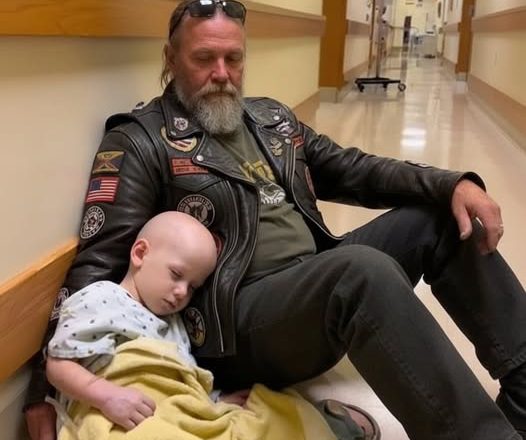
A lone biker — heavy boots, worn leather jacket, hands scarred by years on the road. He didn’t stride in like a polite visitor; he walked with the focused resolve of someone who had already made up his mind.
But when he entered the room where the girl lay, something in him softened. The intimidating presence faded, and he stood there almost carefully, as if the slightest sound could break her.
She opened her eyes just enough to recognize him.
That faint, tired smile — it was small but radiant.
A doctor approached with a clipboard, clearing his throat.
“We’re very sorry, but due to her insurance limitations, she cannot remain in this room overnight. We’ll need to move her—”
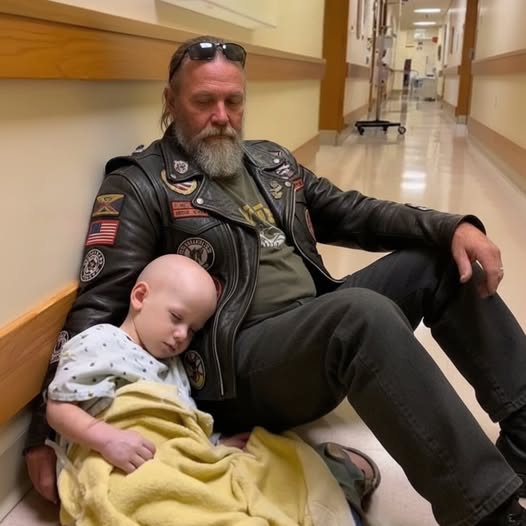
He didn’t raise his voice — just cut in gently:
“She’s not going anywhere.”
It wasn’t a threat. It was a boundary drawn in stone.
Nurses tried to reason with him.
An administrator tried to persuade him.
Security walked in, ready to insist.
But he simply sat down and took her hand — steady, protective, unshakable.
She whispered something.
He bent close to hear.
Whatever she said, it turned his expression into something almost painful — a blend of grief and loyalty and something beyond ordinary friendship.
Time passed.
The hospital kept moving — announcements echoing through corridors, phones ringing, footsteps rushing by — yet inside that room, there was a strange quiet, like the world outside had faded.
A senior physician eventually arrived — stern, authoritative.
“Sir, we have rules we must follow—”
The biker finally stood.
No anger in him — just resolve.
“She believed I could become better when no one else did. I owe her more than anything I own. If this is the last room she ever rests in, she stays. And I stay with her.”
Something flickered in the doctor’s eyes — not defeat, but recognition.
No one tried to move her again.
Night settled in.
The hallway lights dimmed into a bluish hush.
Machines whispered softly.
Her breathing grew steadier, calmer.
She looked at him again.
His voice trembled when he spoke:
“You don’t have to struggle alone anymore.”
She answered — quietly but clearly:
“I’m not alone. Not if you’re here.”
It wasn’t a dramatic miracle.
She didn’t suddenly recover or rise from the bed.
But something real happened:
nurses started bringing blankets;
someone offered a warmer pillow;
a young intern left two cups of tea outside the door.
The rules didn’t break — they simply bent around compassion.
By morning, she was still with them — weak, fading — but at peace, unafraid.
And he — this rough-looking wanderer of asphalt roads — remained there, a steady presence beside her, offering what might be the only medicine left: presence.
Later, the staff would talk about it quietly — how love, expressed without drama or spectacle, stopped the relentless machinery of protocol.
The true shock wasn’t that he defied the hospital.
The shock was that humans, even in a place ruled by procedure, remembered how to care.