
She lay in the luxurious new bedroom beneath a gilded ceiling, listening to the old man breathe beside her. His breathing was heavy and uneven. She even thought his heart might stop at any moment.
And the thought didn’t bring her guilt — only a cold sense of anticipation.
But by morning, her flawless plan began to crumble.
A stranger arrived at the mansion — tall, stern, with a sharp gaze and a neatly trimmed beard. He walked through the house as though he owned it, as though every inch belonged to him.
“Who are you?” she asked, trying to maintain confidence.
“I’m his guardian,” he replied. “And the representative of his beneficiaries.”
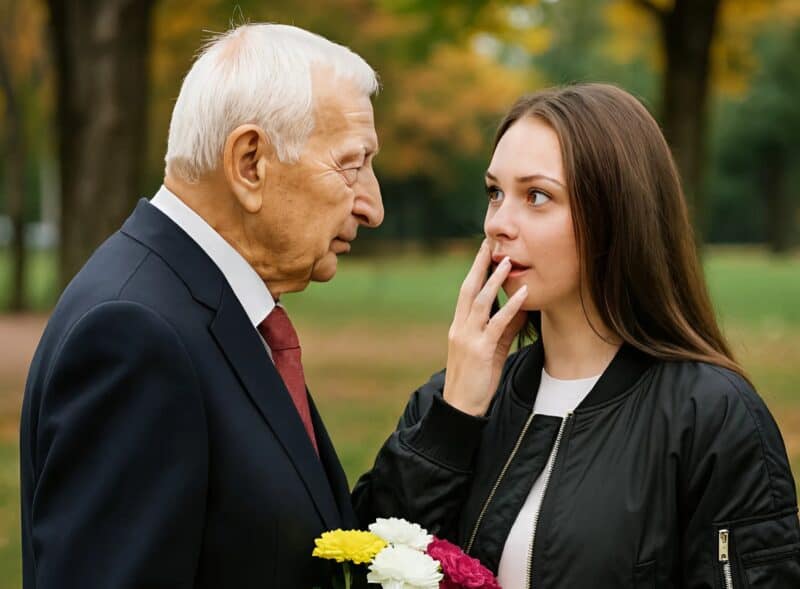
She frowned.
“What beneficiaries? He has no family… no heirs…”
“Perhaps that’s what he told you,” the man interrupted calmly. “But that isn’t the truth.”
For the first time, fear flickered in her chest.
The old man regained consciousness later that afternoon and asked to see both of them.
His voice was no longer soft or adoring — it had hardened, stripped of infatuation.
He looked at the young woman for a long time.
“You really thought I didn’t understand why you married me?” he asked softly, with unsettling clarity.
Her cheeks flushed.
For the first time, she felt not remorse, but humiliation — the bitter sting of being exposed.
“I hoped,” he continued, “that you might change. That comfort and kindness might soften you. That you would grow into this life instead of simply taking advantage of it…”
He exhaled.
“But I was wrong.”
She tried to speak, but he raised a hand — and she fell silent.
“I truly have no family or direct heirs. But I do have people I trust.” He nodded toward the guardian. “And I transferred my estate long ago — into a charitable fund that supports education, medical aid, and those who genuinely need help.”
She stared at him, stunned.
“What about… me?” she whispered.
“You?” He tilted his head thoughtfully.
“You’ll receive exactly what you’ve earned.”
And he pointed to an envelope.
Later, behind a closed door, she opened it with trembling fingers.
Inside were only a few lines:
“You were given a chance to reshape your life,
but you only tried to reshape your bank account.
Leave this house. Find real work. Build something of your own.
If in three years you return as a human being rather than a fortune-hunter —
we will talk.”
She sank to the floor.
Anger, shame, panic, grief — all swirled through her.
But beneath them all lived one simple, painful realization:
he had seen her clearly — and still wished her to grow, not fall.
She left that same day.
No jewels, no cards, no chauffeurs.
Just a small suitcase in her hand.
The world outside the mansion was harsh and honest:
waiting tables, cheap rent, long hours, exhaustion.
At first she resented it.
Then she endured it.
Then she reflected on it.
And finally — she changed.
She returned to school.
She volunteered at a local charity.
She learned to respect people for their effort, not their income.
And three years later, she did return to that mansion.
Not as someone expecting an inheritance —
but as someone who had earned dignity.
The old man looked at her and smiled gently.
“Now I see a woman — not a hunter.”
And in that moment she understood:
this was the true inheritance he had always intended for her.
Sometimes the greatest legacy isn’t wealth —
but the lesson that forces a human being to become better than they were yesterday.