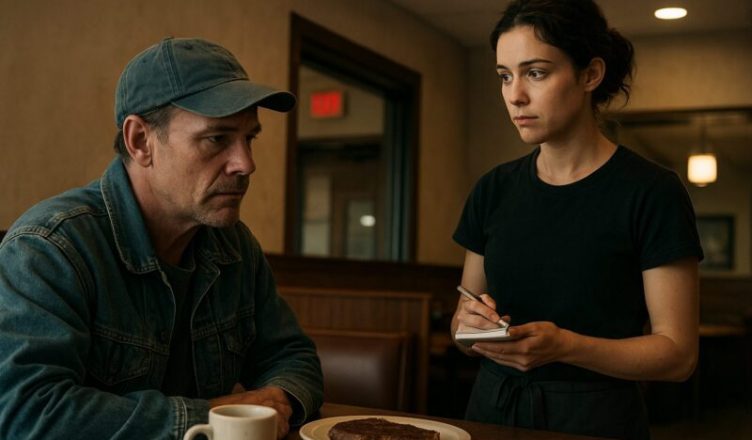
Just that fierce, tired heat people carry when they’ve been silent too long. She stood near the soda machine that flickered every other hour, half-lit like a broken streetlamp. Under that lousy bulb her eyes looked deeper, older.
She wiped her hands on her apron and jerked her chin toward the back exit.
“Too many cameras in here. Too many ears. Back there—less.”
He didn’t move. Just lifted a brow—barely.
A man who’d been lied to often enough to know the scent.
“If this is about customer service—” he began.
“It’s not about customer service,” she cut in. “It’s about what you came here to find. And about what you’ll miss if you keep looking at faces instead of the cracks between them.”
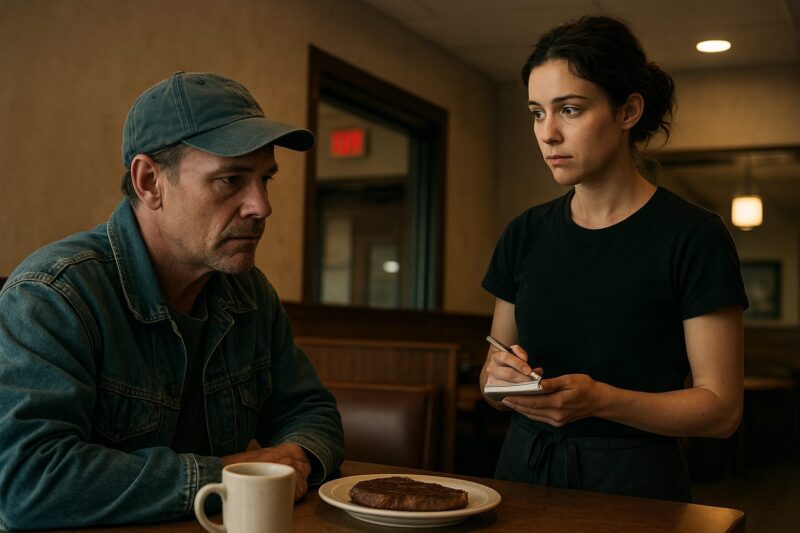
Clean. Sharp. No fake humility. No corporate obedience in her tone. She wasn’t playing the loyal employee; she was someone who’d had enough.
He followed. Slow, deliberate, as if offering her an exit if she wanted one. The hallway smelled like wet rag and stale spices—normal for a place like this, but here the scent felt thicker, older, like something was rotting behind the tiles.
“Talk,” he said.
She turned.
“Manager. Bryce.”
She swallowed hard.
“He’s laundering money. And when someone gets close to finding out? They’re fired for some ‘policy violation’ he invents on the spot.”
She took a breath that hit like a confession she’d been carrying for months.
“And your ribeye, sir… you wouldn’t have ordered it if you saw how the meat is stored.”
The words hit with the weight of a hammer—direct, unglossed, real.
He didn’t blink. Didn’t flinch.
Just tilted his head, gathering her words like evidence.
“And that’s all?” he asked.
“No.”
She reached into her apron pocket, pulling out a tiny key with a faded metal tag.
“This opens the storage room by the freezer. He thinks no one uses it. But inside… inside is everything you need to understand why Bryce’s shirts cost more than half our crew’s weekly pay.”
He extended his hand. She placed the key in his palm—but held it for one heartbeat longer, as if measuring him.
“Why trust me?” he asked.
She gave a short, almost bitter laugh.
“I grew up in Tulsa. Your first location? The one with the red awning? My dad used to say, ‘If it’s got Whitmore’s name on it, you’re safe.’”
Her voice faltered just a bit, like the words cut deeper than she expected.
“I need that to be true again. Because whatever this place is—safe isn’t it. This is a sinkhole wearing a grill sign.”
He closed his fingers around the key.
A small piece of steel, suddenly heavy with purpose.
“Jenna,” he said quietly. “If I open that door and I find what you’re telling me… you understand we can’t go back to normal?”
She nodded.
“That’s exactly why I gave you the key.”
He turned.
A simple motion of the shoulders—slow, measured.
The movement of a man remembering who he was before people turned his name into a logo and a profit graph.
As he walked down the corridor, he noticed things most people would never see:
the scratched metal of the freezer door, the greasy shine on the tiles, the way Bryce snapped his head around at the slightest sound—too quick, too alert.
The storage door looked ancient, like it had survived a flood or two.
He slid the key in.
Turned.
The lock coughed—a dry, miserable sound.
The smell hit first.
Not rotten meat.
Not mold.
Worse.
The smell of paper. Cheap alcohol. And something chemical and wrong, like a cover-up sweating through a wall.
He flipped on the light.
And what he saw in that cramped, forgotten room made him curse—quietly, under his breath.
Not with anger.
With recognition.
The recognition of a man who finally understands how his name, his life’s work, his entire reputation had been dragged through filth…and sold for spare parts.
He stepped inside.
“Well, Bryce,” he said softly, like a verdict being signed.
“Your game’s over.”
Outside the door, Jenna stood perfectly still—knowing no one walks away from this unchanged.