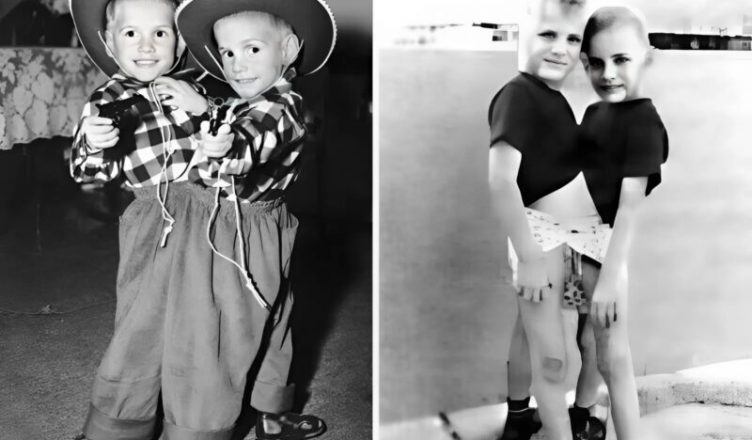
Some stared with pity, others with fear, and a few with that raw, unfiltered curiosity people try to hide. But the twins learned early what most adults struggle with their entire lives: being different isn’t a flaw. It’s a battle you fight every single day — and they fought it together.
They were born on October 28, 1951, in Dayton, Ohio, joined at the abdomen and pelvis, sharing organs the surgeons couldn’t separate without killing them both. Doctors whispered predictions like funeral notices: They won’t make it past childhood. Their bodies won’t endure. Life will be short.
But life didn’t care about those predictions. It loved proving experts wrong.
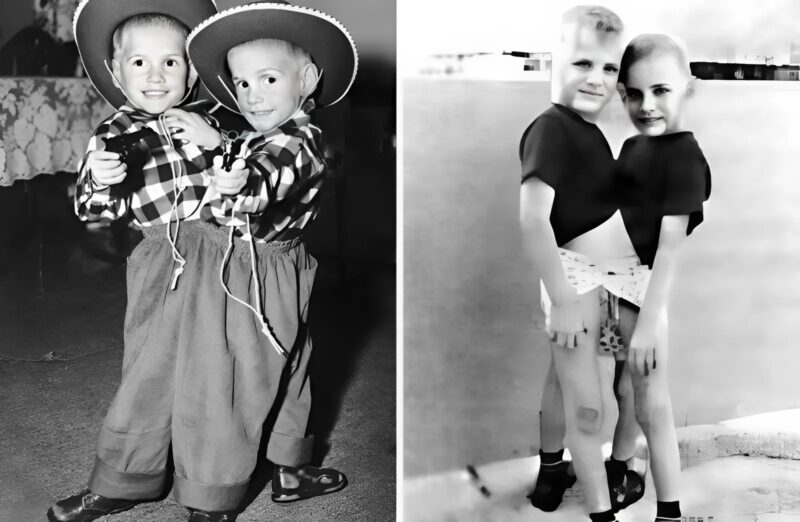
Growing up, they weren’t “a medical miracle.” They were two boys who wanted adventure and space — even though space was the one thing they didn’t have. They argued like brothers do. They yelled. They got annoyed. One would want to turn right, the other left. There was no storming out of the room, no slamming of doors. They shared the same step, the same balance, the same direction.
Yet five minutes after a fight, you’d hear them cracking up so loudly the neighbors wondered what comedy show they were watching. That was their rhythm: frustration, laughter, resilience — a loop that carried them through decades.
By eighteen, the medical warnings grew darker. Specialists said their bodies would simply burn out.
But the twins had a different plan.
They worked at fairs, traveled, earned their own money. Not because they were forced to, but because they refused to live a life padded with limitations. They understood the weight of a stranger’s stare, but they didn’t bend under it.
“We’re not here for pity,” they used to say. “We’re here to live.”
And live they did.
They traveled across states, made friends, fought with neighbors over loud radios, argued about baseball, teased each other endlessly, and laughed louder than most people ever dare to laugh at themselves. They built a life that ordinary people — free, separate, unburdened — often never manage to build.
And then came the heart-stopping part: they grew old.
Not just older than expected — old.
Sixty-eight years old.
Two men who weren’t supposed to survive infancy ended up outliving the very predictions that haunted their childhoods. Their bodies carried scars, their movements slowed, but their eyes still burned with that stubborn spark that refuses to go out.
Once, an interviewer asked them:
“Did you ever wish you had been separated?”
They looked at each other the way only two souls sharing one lifetime can — with a mix of memory, mischief, and unspoken truth.
“We were never alone,” they said.
“Can you understand that?”
That answer hit harder than any tragedy ever could.
Because their story wasn’t about survival.
It wasn’t about deformity.
It wasn’t even about luck.
It was about connection — a rare, unbreakable kind that defies biology and statistics and the limits of the human body.
In their late sixties, they sat in rocking chairs on their porch, listening to old country songs, arguing about who sang worse, and laughing at the doctors who once wrote them off.
Their smiles weren’t a miracle.
They were a rebellion.
Sometimes the most shocking story isn’t the one filled with disaster or heartbreak — it’s the one where two people beat every odd simply by waking up each morning and choosing life again.