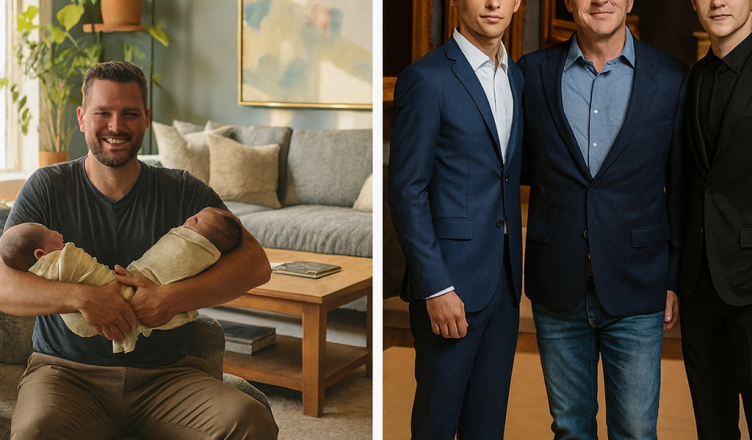
Back then, I saw her choice as pure betrayal. But time polishes pain into dull scars, and the space she left was filled by two boys — my twins.
I still remember that night, 17 years ago. The maternity ward smelled of disinfectant and nervousness. She didn’t look at me, didn’t look at the babies — only at her already-zipped bag. I talked, pleaded, begged her to say goodbye… but she seemed carried away by a current pulling her somewhere else. The door shut — and just like that, our family ended.
And now — a knock at the door. Sharp, confident, as if the owner of that hand had every right to knock.
I opened.

There she stood — the same eyes, but in a face tired with time.
“Are they home?” she asked, as if we had last spoken yesterday and this was merely a pause between sentences.
“Who do you mean?” I asked, though I knew.
Footsteps behind me.
My boys walked into the room — dressed in suits, ready for their graduation night. They didn’t even recognize her. To them, she wasn’t a mother. She was a question mark, a biological footnote.
She began to cry — not loudly, not dramatically, but softly, as if allowing herself emotions for the first time in years.
“Boys… I couldn’t… back then… I was…”
But I won’t fill in her excuses for her. Explanations are like cheap paint — up close, you see only what someone tried to cover.
Arman — one of the twins — looked at her calmly, like an adult.
“We have a mom.”
She flinched.
“Who…?”
“The one who raised us. Dad.”
In that moment, everything shrank to a single point: the three of us — roots and branches — and her standing apart, caught between past and present. And here’s the real dilemma: if someone once abandoned you, can they ever return without still being an abandoner?
I asked quietly,
“Why are you here? Now? On the day of their graduation?”
She closed her eyes:
“I was sick. I got treatment. And I couldn’t return earlier — it would’ve only given them guilt and grief. But now… they’re becoming adults… I want to at least try to be present.”
Age teaches you something youth cannot — balance. I didn’t slam the door in her face, but I didn’t open my arms either.
Truth doesn’t sit halfway between two sides — it floats above them while we struggle to reach it.
I turned to my sons:
“It’s your choice. If you want to talk to her — talk. If not — I’ll close the door.”
They exchanged a look. What I saw there wasn’t bitterness — but clarity. Maybe they had grown strong because of her absence.
Arman stepped forward, but not too close.
“We don’t know you. And we don’t owe you anything. But we won’t carry hatred. If you want to tell us your story — tell it. But don’t ask us to call you mom.”
Her hands shook. And suddenly I understood: sometimes the villain in our story isn’t a monster — just someone who broke under the weight of life.
She didn’t leave immediately. They talked — quietly, with pauses, with unfinished sentences. Then she stepped through the gate and disappeared.
Graduation night was beautiful — laughter, photos, hugs, speeches. Life moved onward. And a week later, an unmarked envelope appeared in our mailbox.
Inside — three letters.
One to each of the boys. And one to me.
I read mine late at night, when the boys were asleep. There were no excuses — just honesty:
“I wasn’t ready to be a mother. I didn’t know how to love, because I grew up without love myself. But it was never your fault. Or his. Thank you for doing what I couldn’t.”
It was painful to read — but also strangely peaceful.
And here’s what I’ve learned: love is more than just staying. Sometimes it’s endurance — the kind that carries on even when someone else walks away.
What happens next — we’ll see. I’m no prophet.
And who knows — maybe a broken past can return not to demand forgiveness… but simply to hope for it.