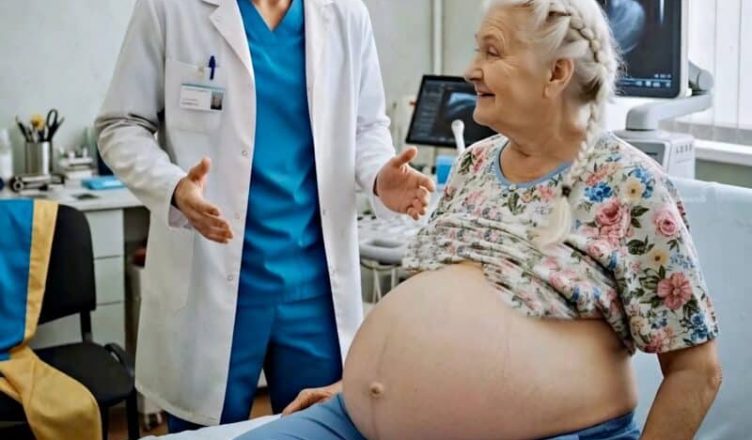
Instead, the monitor showed a dense, layered mass, dark and unmoving, almost like something encased in stone.
The doctor abruptly pulled the probe away, as if it had burned him.
“ This isn’t a pregnancy,” he said, voice suddenly rough. “I’m not even sure this qualifies as a normal condition. We need a full medical review. Immediately.”
He asked Larisa to wait outside. She sank onto a bench in the hallway, both hands pressed to her abdomen. Worry began to break through her faith — like cracks running through old porcelain. Something inside her, deep and instinctual, began to whisper: what if this wasn’t a miracle at all?
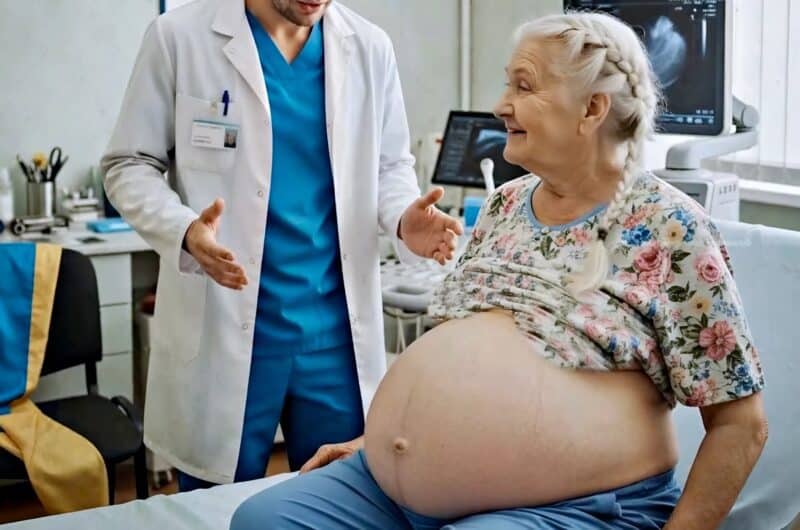
Twenty minutes later, they called her back in. Three doctors were now in the room. One held the scans, another the bloodwork, and the third her medical file. Their faces carried that quiet, serious expression doctors reserve for difficult truths.
“Larisa,” the senior specialist began gently. “You are not carrying a baby. You have what is known as a ‘stone pregnancy’ — lithopedion.”
She blinked.
“Stone…?”
“Many years ago, a fetus began to form but did not develop properly and died inside the body. Instead of being naturally expelled, it remained — and over decades became encapsulated by calcium. Your body created a protective shell around it, so infection wouldn’t kill you.”
She stared at him, motionless. Her fingers trembled. It’s strange how a person can cling to a dream even after it’s shattered — she still felt like a mother expecting a miracle.
“But… I felt movement,” she whispered. “There were moments when something shifted inside me.”
The doctor gave her a restrained, compassionate look.
“Those sensations were intestinal contractions caused by inflammation. You interpreted them as fetal movement… because you truly believed you were carrying life again.”
Those words hit her like a cold gust of wind.
She remembered how she spoke to her belly at night.
How she knitted tiny socks.
How she chose names — Paul for a boy, Elizabeth for a girl.
“We need to operate as soon as possible,” the doctor continued. “But I must be honest — your body has been carrying this… form… for close to forty years.”
And for the first time in the entire ordeal — Larisa felt genuine fear. Not of pain. Not of death. But of the truth: that the last ten months had been built on hope that had nowhere to land.
She remembered neighbors smiling:
“What a wonder! At your age!”
She remembered standing by her window, stroking her belly, whispering:
“You are my gift from God…”
And now that imagined joy shattered into dust.
“We will do everything we can,” the doctor assured her. “But you’ll need not only physical recovery… but emotional healing as well.”
Larisa nodded slowly.
“So… there never was a baby?” she murmured.
No one answered. Silence said everything.
That evening, at home, she opened the box with the socks she knitted, the tiny hat, the little toy rabbit. She stared at them for a long time. And then — an unexpected realization came:
her grief was real…
and so was her love.
She hadn’t expected a child with logic — she had expected it with her heart.
And perhaps… that was the most human thing of all.
She gently placed everything back into the box, closed it, and put it away. For the first time in many weeks, she released her abdomen — letting it simply be her body, not a cradle.
No one could judge her belief in a miracle. Sometimes belief is the final refuge of a person who is afraid to admit that the world has grown unbearably quiet.
The next morning, she woke feeling something new: inside her there was emptiness — but not the emptiness of loss. The emptiness of space.
Space where, someday, not illusion — but genuine life — might finally take root.
And that, in its own quiet way, was a miracle too.