The zookeeper finally caught his breath, as if he had sprinted across the entire park:
“Please understand… this animal is part of a special observation program. He’s not mimicking a gesture. He’s reliving a memory.”
The father frowned:
“What do you mean?”
The zookeeper glanced around as though afraid someone might overhear and lowered his voice:
“This orangutan was rescued from an illegal private ‘collection’ more than ten years ago. He spent years in a concrete pit. The people who kept him treated him horribly. When he sees a child standing at the glass… he reaches out not to play, but to ask for help. It’s not imitation — it’s a plea.”
The cheerful mood around them vanished instantly. A heavy silence settled — thick, suffocating, like fog.
The mother held her son tighter and asked softly:
“But why did he place his hand exactly where my son did?”
The zookeeper looked directly into her eyes:
“Because he used to do the same thing… with another little boy who tried to comfort him back then. That child would cry and press his palm to the glass of his cell. The orangutan never forgot. That was the only gentle contact he had with a human for years.”
A nearby elderly woman wiped her eyes and whispered:
“My God… so he remembers.”
The zookeeper nodded.
The boy, finally calmed, lifted his face again and looked at the orangutan through the glass:
“He’s not scary. He’s just sad.”
As if he understood, the orangutan slowly lowered himself to the floor again, sitting in silence, gazing at the child. In his eyes there was no threat, no wild fury — only exhaustion… and a sorrow that made adults instinctively look away.
The zookeeper sighed:
“People like to believe animals are simple creatures — incapable of deep emotion or memory. But this orangutan… remembers far too much.”
He turned to the onlookers holding up their phones:
“So we ask: less treating them like entertainment. More treating them with dignity.”
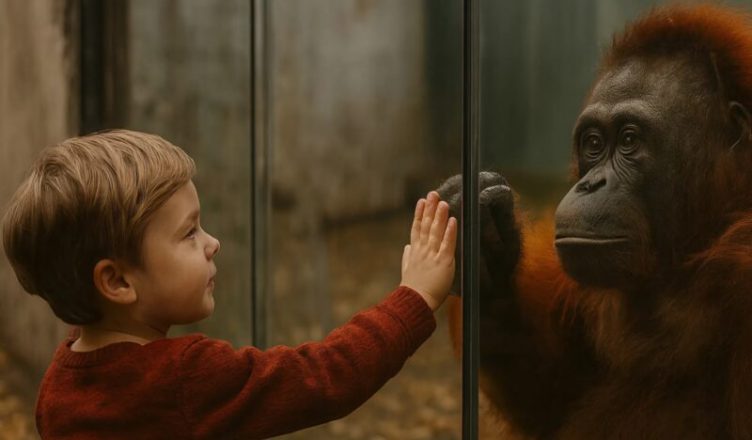
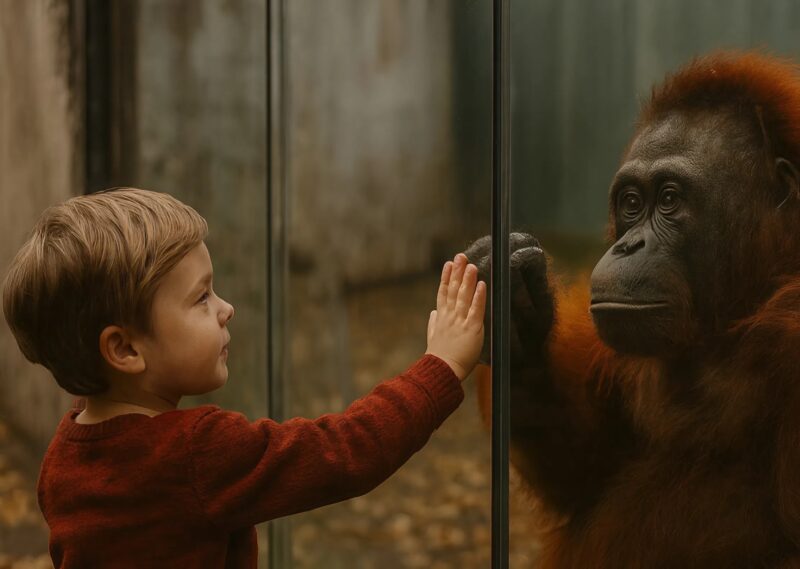
But suddenly something unexpected happened — the boy slowly raised his hand again and pressed it to the glass. The parents reacted too late to stop him.
The orangutan raised his own massive hand… and mirrored the gesture again.
This time, the movement was different — no urgency, no despair. Something in the boy’s calmness changed the expression of the ape — softening it, gentling it, almost soothing it.
The silence around them shifted — no longer suffocating, but warm, almost tender.
The father murmured, almost to himself:
“Maybe we don’t just remind him of the cruelty he’s seen. Maybe we remind him of kindness too.”
The zookeeper stared at the two hands — tiny and giant — touching through the invisible barrier:
“That gesture… a child’s palm on the glass… for him it’s a symbol. A sign that hope still exists in the world.”
People were no longer filming. No longer whispering. They simply watched.
And no one smiled in a cutesy way — not anymore. It wasn’t about amusement. It was about understanding.
The boy asked quietly:
“Can I stay like this a little longer?”
The mother nodded.
And so he stood. And the orangutan stayed seated before him. Two beings separated by glass, joined by something wordless.
Some people wondered in silence: who was truly behind the barrier — the orangutan… or us?
When the family finally walked away, the orangutan remained by the window, watching them leave. Not pleading. Not begging. Just… observing.
And for the first time in many years, his eyes seemed not only heavy — but peaceful.
And that sheet of glass, once a prison wall, now looked less like a barrier… and more like a fragile bridge between two worlds.