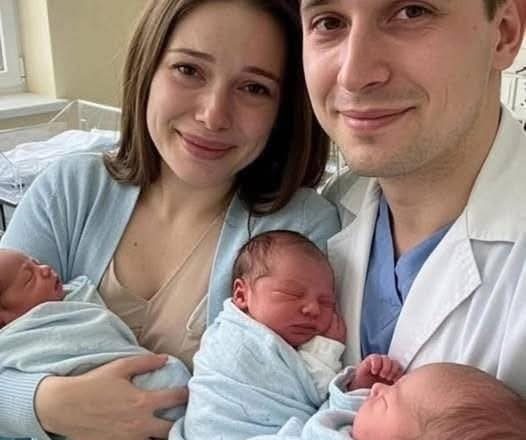
She was twenty-two, with that fearless optimism of someone who still trusts the world to be kind. The pregnancy was unexpected, the ultrasound unbelievable — not one heartbeat, but three. Anyone else might have panicked, but she laughed through tears, joking that life decided to deliver love “in bulk.” Did she fully understand the journey ahead? Probably not. But does any new mother, the first time she hears triplets?
Doctors warned her: intense, risky, exhausting. She simply nodded and rested her hand over her belly — calming not the doctors, but the three little hearts inside her.
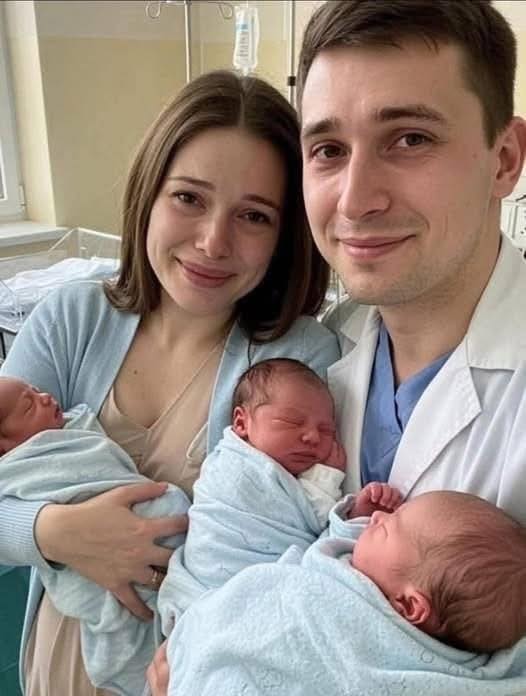
The birth arrived like a storm — bright lights, urgent voices, quick instructions. First came a tiny girl, outraged at the cold air and screaming as if scolding the world itself. Then another daughter — quiet for a second, then crying with a fierce, determined voice. And last, the smallest — a boy, light as a feather, yet born with eyes open as if already searching for someone.
Before she slipped into unconsciousness, she whispered one final sentence:
“Take care of them.”
She didn’t look like a patient — she looked like a young warrior surrendering her shield.
She never woke again.
Doctors said her body simply couldn’t sustain the strain — three births, massive loss of strength, an overwhelmed heart. Life demanded too much from her at once.
Imagine the father — leaving the delivery room with arms empty but heart shaking, knowing three newborns were waiting for a mother who would never return.
He went back to her room. The bed still held her warmth. The pillow still remembered the weight of her head. On the table lay a notebook, pages filled with late-night scribbles. Plans, hopes, little strategies:
— “If one wakes at night, maybe the others will stay asleep if I hum…”
— “I want them to grow up close, so they never feel lonely.”
— “Their names should fit together like parts of a melody.”
Her final thoughts were not about herself — but about them.
For the first week, the triplets stayed in neonatal care — tiny, fragile, instinctively curling into one another. Nurses said that sometimes, when one began to cry, one of the others would extend a tiny hand, as if offering comfort learned before birth.
The father came every day. He didn’t cry inside the hospital — only later in the car. He bought three little knitted hats. He read stories to them, knowing they couldn’t understand the words — but babies understand tone. They hear love, even when spoken through grief.
Time moved forward.
Three children grew up without their mother — yet never without her presence. It lingered like a quiet guardian. They had her eyes. Her dimpled smile. Her thoughtful lashes. Sometimes the father would look at the girls and see her reflected. Sometimes the boy would furrow his brow in a way that felt painfully familiar.
And here is the quiet turn of fate: years later, he opened the notebook again — and on the final page, written shakily, maybe in exhaustion, maybe in intuition, were four simple words:
“Life will take care.”
It wasn’t surrender — it was trust.
And perhaps she was right.
The children grew. They laughed. They learned. They built a bond like a three-strand braid — inseparable. They carried their mother forward — not just as memory or sorrow, but as living echoes of someone who loved them with every breath she had, even if only for one day.
Some tragedies take a life.
This one created three.