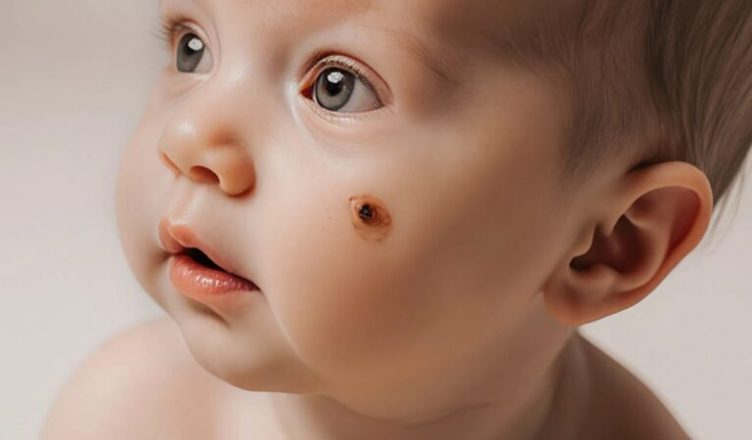
She tilted her head, as if listening to something no one else in the room could hear.
“She’s unusually alert,” she said softly. “Give her time… she’ll grow into a presence people won’t forget.”
I smiled, weak and overwhelmed, not knowing what to do with those words. How could something so tiny, so fragile, hold a promise that sounded almost supernatural?
The delivery room felt different that day — like a place between worlds. Newborn cries floated through the air, antiseptic hung like a cold veil, and nurses whispered as they moved. When I held my daughter for the first time, her fingers curled tightly around mine, and my chest cracked open with a kind of love I wasn’t prepared for.
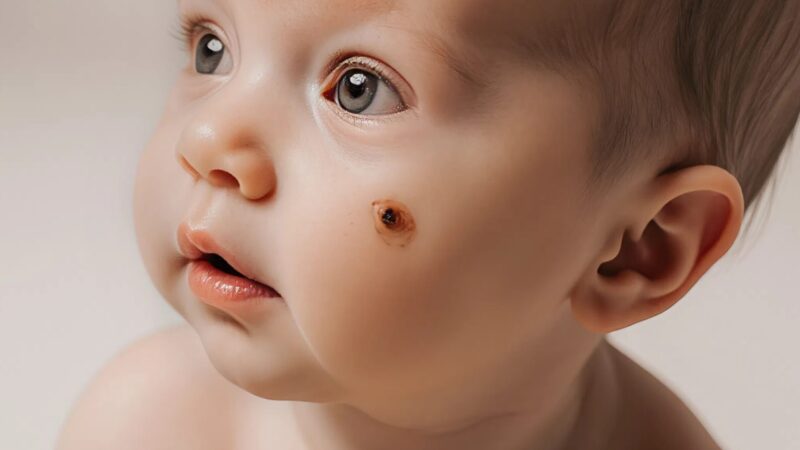
But the moment the nurses cleaned her and wrapped her in a tiny blanket, my eyes locked on the dark mark on her cheek — a striking beauty mark standing out against her newborn skin. It wasn’t small. It wasn’t subtle. It demanded attention.
And my heart stumbled.
Would this mark hurt her someday? Would it change how people looked at her?
Would it change how I looked at her?
I hated myself for even thinking that. But the fear was there before I could stop it.
I watched her for hours, searching for flaws I had no right to search for. All I saw was the softness of her nose, the gentle curve of her lips, the glimmer behind her half-open eyes. Yet the doubt stayed — quiet, but sharp.
I imagined her growing up, walking into classrooms, navigating stares, fielding awkward questions from children who speak before they think. I pictured teachers hesitating for a second too long, strangers tilting their heads, adults whispering in the background of their own insecurities.
And then came the worst thought — the one that tightened my throat:
What if one day she sees me judging her?
That thought terrified me more than anything the world could do to her.
Late that night, when the room finally emptied and the fluorescent lights hummed their lonely song, I stood over her bassinet, watching her tiny chest rise and fall. That little mark on her cheek felt like a message — not from fate, not from fear, but from her.
Look at me honestly.
Look at yourself honestly.
This is who I am — can you handle that?
I reached out and traced the mark with my finger. It wasn’t a flaw. It wasn’t a warning. It was the first chapter of her story, written on her skin before she even had words.
But my mind kept whispering its cruel little lines:
People will stare.
Kids will ask.
The world is not kind to the different.
And then came the whisper that hit hardest:
Are you kind to the different?
I wanted to be the parent who said, “You’re perfect exactly as you are.”
But deep down, I knew I had to earn that sentence first.
That night, I didn’t sleep. I paced the room, I studied her face, I studied my own reflection in the window — a terrified adult pretending to be ready for this. And slowly, painfully, something settled inside me:
I wasn’t afraid for her.
I was afraid of myself.
But when she stirred, when her lips twitched as if forming the beginning of a dream-smile, something shifted. For a moment, the fear loosened its grip.
Sometimes a tiny human becomes your mirror.
Sometimes they are the teacher, and you are the one who must catch up.
Standing over her, I realized something that hit with the force of a confession:
If I don’t learn to see strength where others see imperfection,
how will she ever learn to see it in herself?
This wasn’t her test.
It was mine.
And God help me — I intend to pass it.