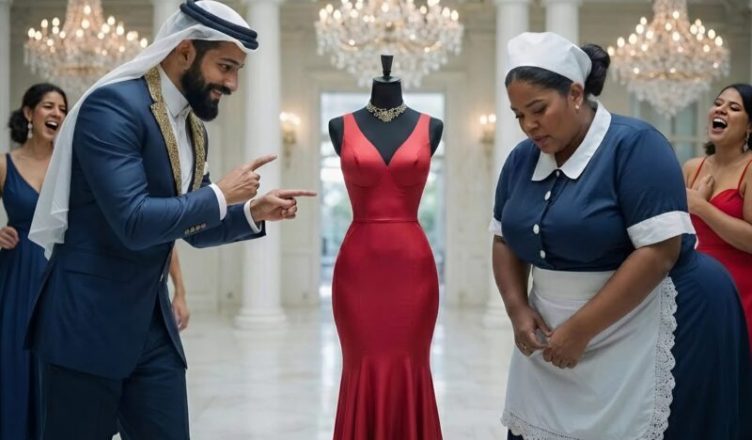
The palace was turning into a glittering music box filled with perfume, crystal light, and the soft shuffle of servants preparing for the guests. Musicians tuned their instruments; gold trays floated through the hall like silent comets.
Leila sat alone in a tiny storage room near the kitchen, a place meant for extra dishes and forgotten linens. She was perched on a narrow wooden bench, hands pressed against her knees as if she were trying to warm herself from the inside. No one came looking for her. No one even noticed she had disappeared.
But the dress was there. Hanging on a hook by the door.
That dress.
The red one.
Red like cut glass. Red like a dare.
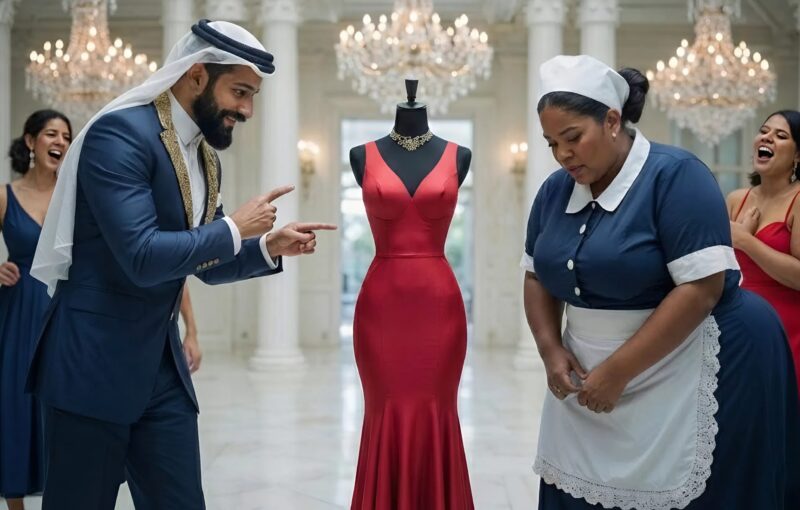
It looked almost unreal in this dim, cramped room. A mocking reminder of everything she wasn’t allowed to touch, let alone dream about.
“Wear it tonight… and I’ll marry you.”
His voice echoed in her head like a cruel joke told twice: once loudly, once quietly, but both times sharp enough to bruise.
She repeated to herself, I can’t. I simply can’t.
But beneath the fear, something stirred—a strange clarity, born not from courage but from exhaustion. Why, she suddenly wondered, did she owe him obedience? Why did his words weigh more than her own breath?
She stood up. Slowly. As if testing the strength of her own legs.
The dress felt heavier than she expected when she lifted it. The fabric was smooth, expensive, cold. Sheikh Khaled had bought it for another woman, someone thinner, younger, someone who glittered when she walked. But tonight, for the first time, the dress was in Leila’s hands.
And with a quiet, startling certainty, she realized something:
For one brief moment, she had the right to make a choice that belonged only to her.
The dress was impossibly small. Laughably small. No one in their right mind would expect her to fit into it. But she didn’t try to force herself inside it — she grabbed a needle, thread, then scissors, and began to reshape it. The seams snapped. The silk fought back. But she kept working, stitching as if each pull of the thread hooked itself onto her heart.
Hours passed. The hall outside erupted into music and chatter. Guests drifted in with polished smiles. The night was already in motion.
And then it happened:
She looked into a cracked mirror and saw a woman she didn’t recognize.
The dress no longer looked like a runway masterpiece — it looked altered, imperfect, stitched with raw determination. But it fit. And strangely, it suited her. It honored her strong shoulders, her steady gaze, the quiet resilience that had lived inside her for far too long.
Leila inhaled.
And stepped out.
When she entered the marble hall, the sound didn’t stop immediately. It died slowly, like a candle smothered by a hand. One by one, heads turned. Conversations froze mid-sentence. Even the musicians faltered.
Leila walked through the glittering hall with measured steps, the red dress shimmering faintly around her like smoldering embers.
Sheikh Khaled was the last to notice.
His expression flickered — from surprise, to irritation, to something dangerously close to fear. Because she had done the one thing he never expected:
She called his bluff.
She refused to be the joke.
She refused to be the shadow in the corner.
— I came, — Leila said, her voice soft but steady. — In the dress. As you requested.
There was no laughter.
Not even a hollow giggle.
The women who had mocked her earlier stared at the floor, their mascara-lined eyes suddenly fragile and unsure.
One of the older guests, a respected man with silver hair, stepped forward, bowed his head slightly, and said — loudly enough for everyone to hear:
— Tonight, she is the only person in this palace who carries herself with dignity.
The words struck harder than a slap.
Sheikh Khaled’s lips twitched as if he wanted to laugh, but no sound came out. The joke had dissolved — and with it, the power he believed was permanent.
He took a step toward her.
— You… you ruined the dress, — he snapped, desperate to regain control. — This was never meant—
— I know what it was, — Leila interrupted. Her voice was no longer soft. It was a blade. — You don’t see people. Only objects. Tonight, I refuse to be one.
The hall trembled with silence.
Some guests turned away in shame. Others watched her with newfound respect. And for the first time in his life, Sheikh Khaled looked small — not because she challenged his authority, but because she exposed the emptiness behind it.
Leila felt something loosen inside her.
A pressure that had lived behind her ribs for years.
Not triumph. Not victory.
A quieter thing: release.
She had not come to win. She had come to stop being invisible.
And that, tonight, was the real shock.