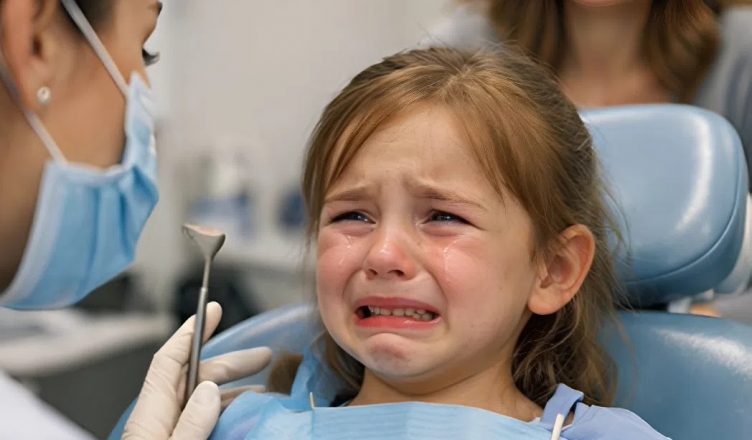
The dental office blurred before my eyes, a dull ringing filled my ears, and I had to grip the back of a chair to keep from collapsing. I pressed my hand to my chest and whispered, barely able to form the words:
— What… what is happening?
My daughter lay motionless in the chair, her face deathly pale. Her lips were trembling, her eyes glossy with tears. She didn’t fully understand what was going on, but the dentist’s tone alone was enough for her to sense that something was terribly wrong. I rushed toward her, but the dentist stopped me with a calm yet firm gesture.
— Please, try to remain calm and don’t frighten the child, he said quietly. — I have to follow protocol.
He placed what he had just removed onto a sterile pad. It wasn’t a piece of food, and it wasn’t a fragment of a tooth. It was a thin piece of metal—something like a wire or part of a small clip—deeply embedded in her gum. The edges were sharp, and the surrounding tissue was badly inflamed, clearly not from a recent injury.
— This could not have gotten there on its own, the dentist continued without looking at me. — And it certainly didn’t happen overnight.
My body began to shake. Memories I had once dismissed suddenly rushed back with painful clarity. The way my daughter flinched whenever her father raised his voice. How she would go silent the moment he entered the room. How she wiped away her tears too quickly and said she was just tired. How he always insisted there was no need to see a doctor.
— Are you saying… someone did this to her on purpose? I asked, my voice breaking.
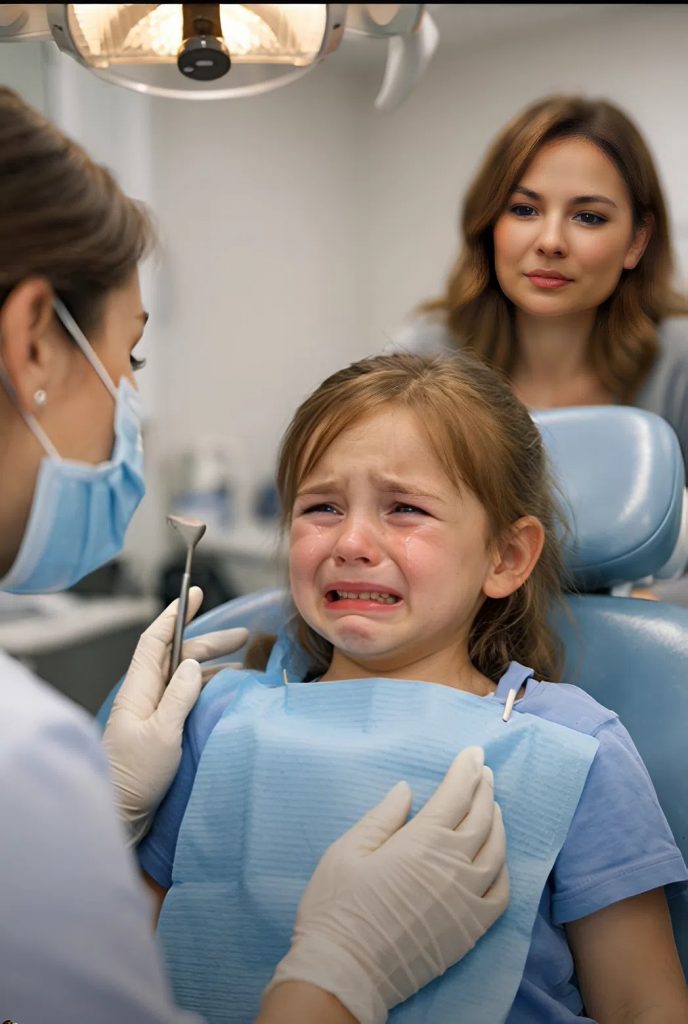
The dentist finally met my eyes. There was no doubt in his expression.
— I don’t want to go into details in front of your daughter. But yes. This appears to be an intentionally inflicted injury. And judging by the condition of the tissue, it wasn’t the first time.
I slowly sank into a chair. In a single instant, everything I believed to be safe and familiar collapsed. The door opened slightly, and the assistant—who had overheard the last sentence—turned just as pale as I felt.
The police arrived far more quickly than I expected. My daughter was already sitting in my lap, her face buried in my shoulder. In a small, unsteady voice, she asked:
— Mom… did I do something wrong?
That question shattered me. I held her tightly and, for the first time, I couldn’t stop myself from crying.
The hours that followed felt unreal. Interviews, medical examinations, X-rays, reports. And the truth—more painful than anything else. Doctors confirmed that there were injuries to her jaw from different periods of time. Someone had been hurting her repeatedly, carefully, over a long span of time—making sure there were no visible marks.
When the officer finally said the suspect’s name out loud, I wasn’t shocked. I simply nodded. Inside, there was nothing but emptiness.
My husband was taken into custody that same evening.
He screamed that it was all a mistake. That I was making things up. That the child was lying. That the dentist was wrong. But the evidence was undeniable. And the hardest moment came when my daughter finally began to speak. Softly, with long pauses, as if she was still afraid of being punished. She told how he had “taught her to endure pain,” how he said silence was normal, how he forbade her from telling me anything.
As I listened, a horrifying realization struck me: if I had trusted him one more time, if I had postponed that dental visit by even a few days, my daughter could have lost her jaw. Or her life.
Now it’s just the two of us. Time moves forward, but not every wound heals quickly. She still wakes up at night. She’s still afraid of dentists. But she smiles. And she eats without pain.
And every single day, I ask myself the same question: how many children are suffering in silence right now, simply because the adults around them refuse to listen?
If that day I hadn’t gotten into the car and taken her to the doctor, this story might never have existed.
Or it might have ended far more tragically.