
How her fingers trembled as if the chill had reached somewhere deeper than her skin. She kept asking the same question, barely above a whisper:
“Mom… did I do something wrong?”
Every time she said it, something inside me cracked. I didn’t answer. If I had, my voice would have broken completely. I wasn’t angry at her — I was angry at myself, and at the years I had spent convincing myself that enduring silence was the same thing as keeping peace.
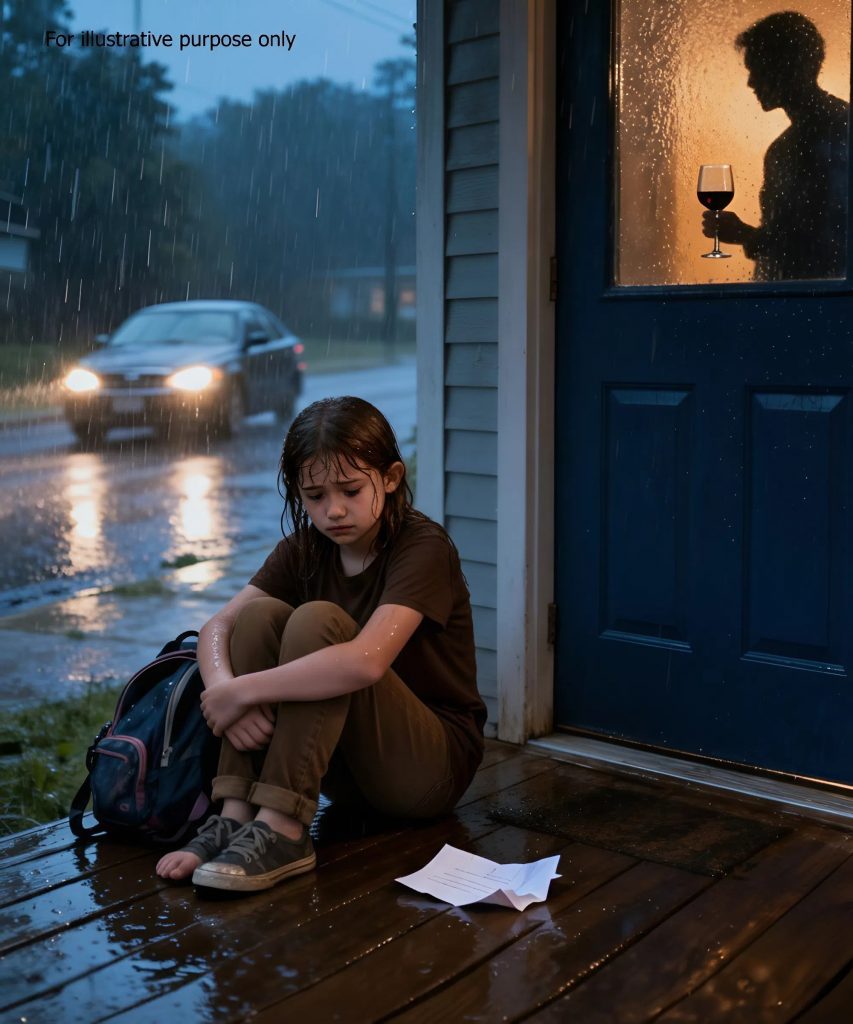
That night, Hannah barely slept. She coughed and turned restlessly, her small body still reacting to five hours spent outside in the rain, sitting on cold concrete steps with no way in. I stayed beside her bed, watching her chest rise and fall. One thought repeated over and over in my head: I failed to protect her.
The next morning, I called in sick. Then again the day after. We packed only what we could carry, quietly, carefully, as if making noise might somehow make things worse. No one called. My mother didn’t reach out. Neither did my sister, Brittany. The silence was heavy, almost cruel.
On the third morning, I opened the mailbox and found a thick white envelope inside. Official. Heavy paper. A law firm’s name printed neatly at the top. My heart tightened instantly.
I opened it right there, standing in the hallway.
The letter explained that the house we had been living in did not legally belong to my mother. It was held in a trust — in my name. The documents had been signed by my father a year before he died. The property was designated for me and my minor child, with full residential rights. My mother was allowed to live there only with my consent.
I read it three times. My hands started to shake.
Then I reached the final paragraph, and my breath caught in my throat:
“Due to the unlawful change of locks and the exclusion of a minor child from the residence, we strongly recommend immediate legal action.”
I didn’t file a lawsuit that day. I waited.
A few hours later, my phone rang.
“Elena…” My mother’s voice sounded unfamiliar — low, careful. “We received a letter. There must be some mistake.”
For the first time in years, I spoke calmly.
“No, Mom. The mistake was locking my child out in the rain.”
She tried to explain. She talked about stress, about household tension, about Hannah being “overly sensitive.” I let her talk until she ran out of words. Then I said:
“You have thirty days.”
“Thirty days for what?”
“Thirty days to move out.”
There was silence on the line. Then crying. Accusations. Threats. I ended the call.
A week later, Brittany showed up. She said she wanted to “talk peacefully.” She said the kids would suffer, that our mother wasn’t well, that I was tearing the family apart. I looked at Hannah, sitting at the table with her crayons. She had drawn a house. Above it, a bright sun.
“My family is right here,” I said. “And I’m protecting it.”
On moving day, my mother never once met my eyes. When the door closed behind her, the house fell silent. But this silence felt different. It wasn’t tense or sharp. It felt safe.
That first night after they left, Hannah came to me and asked quietly,
“Mom… is this really our home now?”
I nodded.
“Yes.”
She wrapped her arms around me and whispered,
“Thank you for coming for me that day.”
In that moment, I understood something I had ignored for far too long: silence is also a choice.
And I will never make it again.