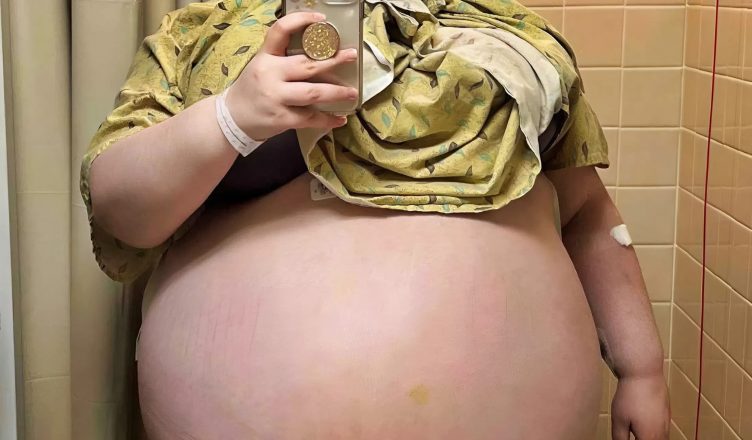
“You just need to lose weight.”
“Try harder.”
“It’s stress.”
“This is your own responsibility.”
Every doctor’s appointment left her feeling smaller. She walked out of medical offices carrying shame instead of answers, guilt instead of help. Her body was changing in ways she could not control. Her abdomen continued to grow, her movements became heavy, and breathing felt increasingly difficult. She stopped wearing fitted clothes, avoided mirrors, and learned to ignore the looks of strangers. People whispered. Friends asked uncomfortable questions. Doctors, meanwhile, shrugged.
Pain became part of her daily life. It followed her everywhere — a constant pressure deep inside her body, a feeling as if something was stretching her from within. Nights were the worst. She woke up gasping for air, clutching her stomach, terrified and alone. Still, she kept asking for help. And still, she was not believed.
The most devastating part was not the physical suffering, but the fact that no one took her seriously.
“You’re too young for anything serious.”
“There’s nothing wrong.”
“You’re overreacting.”
Eventually, she began to doubt herself. She blamed her own body. She blamed her own weakness. She learned to stay silent.
What no one realized was that inside her, something enormous was growing.

Only after years of silent suffering did one specialist finally insist on a full examination. What appeared on the screen left the medical staff speechless. Inside her body was a massive ovarian tumor, filling almost her entire abdominal cavity. It weighed nearly 50 kilograms (104 pounds) and contained more than 46 liters of fluid. According to doctors, it may have been growing since her teenage years.
Suddenly, everything made sense.
She had not been lazy.
She had not been careless.
She had not imagined her pain.
She had been living with a life-threatening condition while being told it was her own fault.
The surgery was long, complex, and extremely risky. Her internal organs had been pushed aside, her heart and lungs were under severe strain, and her body was exhausted from years of pressure. Surgeons later admitted that waiting any longer could have cost her life.
When the tumor was finally removed, the operating room fell silent. Even experienced doctors struggled to comprehend how a human body had endured such a burden for so long. Some openly admitted that the most shocking part was not the size of the tumor, but the fact that it had been ignored for years.
When she woke up after surgery, she didn’t immediately understand what had changed. Then she felt it — lightness. For the first time in years, her body felt like her own again. She cried, overwhelmed not by pain, but by relief.
Recovery was slow and demanding. Her body had to relearn balance, movement, and strength. But alongside physical healing came something even more powerful — clarity. She stopped apologizing for her symptoms. She stopped questioning her pain. She finally trusted herself.
Today, she speaks openly about her experience. Not to seek sympathy, but to tell the truth. To remind others that persistent pain is not weakness, that being dismissed does not mean being wrong, and that silence can be deadly.
“If someone had listened earlier, everything could have been different,” she says. “But I survived. And now I want others to be heard.”
Her story is not just a medical case. It is a warning. A reminder of how easily real suffering can be overlooked — and how dangerous it is to blame patients instead of listening to them.
She was given a second chance at life.
The question is — how many never get one?