
As if he hadn’t once abandoned two newborn daughters without a second thought.
I rose slowly from my desk. My chest tightened, but it wasn’t fear. It was memory. Freezing nights in a worn-down trailer. An almost empty refrigerator. Endless shifts that left me barely able to stand. His face looked unfamiliar now—older, worn, shaped by the consequences of his own decisions.
“Hi,” he said hoarsely. “We need to talk.”
I said nothing. The silence between us felt heavy, oppressive.
“I… I need help,” he finally admitted.
At that exact moment, something inside me shifted. Not anger. Not hatred. Just a deep, unsettling calm.
I let him into the living room. He sat on the edge of the couch, rubbing his hands nervously. I noticed his eyes wandering around—light walls, family photos, warmth and order. Everything my daughters and I had built without him.
“My life fell apart,” he began. “I lost my job. Then my place. The debts piled up… I’m completely alone now.”
He talked for a long time. About how life had been unfair. About people who had turned their backs on him. Not a single word about us. Not about the girls. Not about the night I walked into the cold, holding two infants, with nowhere to go.
“Where are they?” he asked suddenly. “The girls.”
“At school,” I replied shortly.
He nodded, as if he had the right to ask.
“I’d like to see them,” he continued. “And maybe… stay here for a while. Just until I get back on my feet.”
Those words hurt more than a slap.
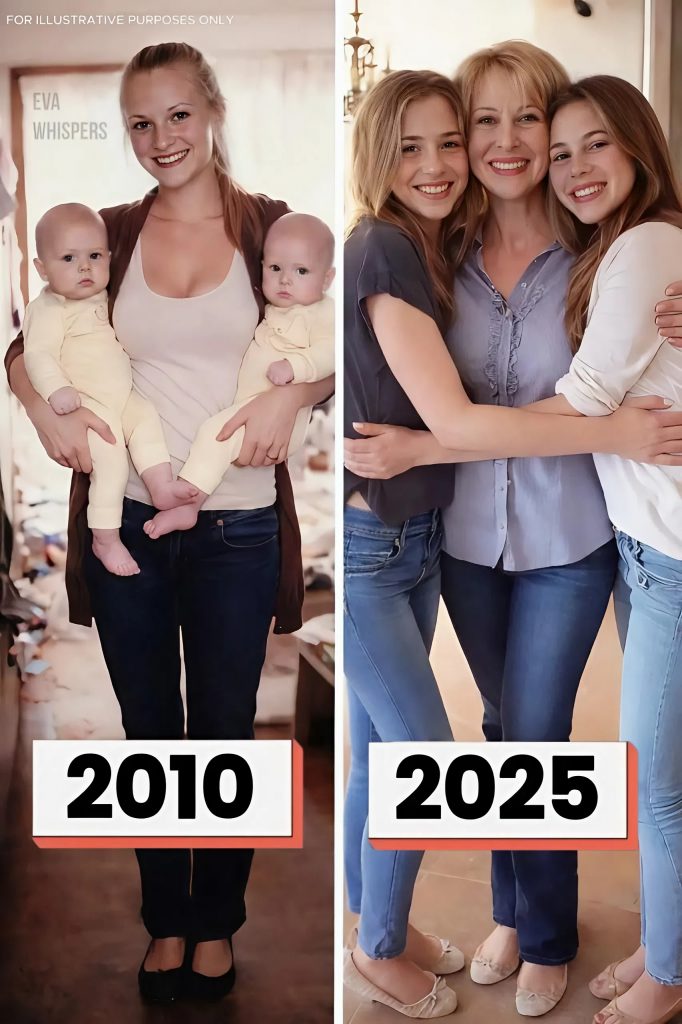
Images flashed through my mind: counting coins at the register to afford diapers, falling asleep sitting up, my daughters growing up without a father—but never without love.
“You threw us out,” I said quietly. “You didn’t just leave. You chose yourself.”
He sighed, as though the conversation exhausted him.
“I was young. I made a mistake.”
“A mistake?” I looked straight at him. “Forgetting to buy bread is a mistake. Abandoning a woman with two newborns is not.”
He fell silent.
Then I heard the key turn. The door opened and my daughters walked in—tall, confident, strong. Their laughter filled the house with light.
They stopped when they saw the stranger.
“Mom, who’s that?” one of them asked.
I took a deep breath.
“Someone from the past,” I said. “A very distant past.”
David stood up and took a step forward.
“I… I’m your father.”
The room went completely still.
The girls looked at each other. There was no anger in their eyes. No joy. Just clarity.
“We have a mom,” the other one said calmly. “And that’s enough for us.”
In that moment, I understood—we had won. Not loudly. Not through revenge. But truly.
I turned to him.
“I’ll help you,” I said. “But not in the way you expect.”
I gave him the address of a shelter, contacts for social services, and a small amount of money—exactly what I once had when I started over from nothing.
“You won’t come back into this house,” I added. “It was built from the pain you caused and the strength you never saw in us.”
He left without looking back.
I closed the door. The past stayed outside.
Inside, there was warmth again. Peace. Safety. The kind that exists only where people survived, grew stronger, and no longer owe anyone anything.