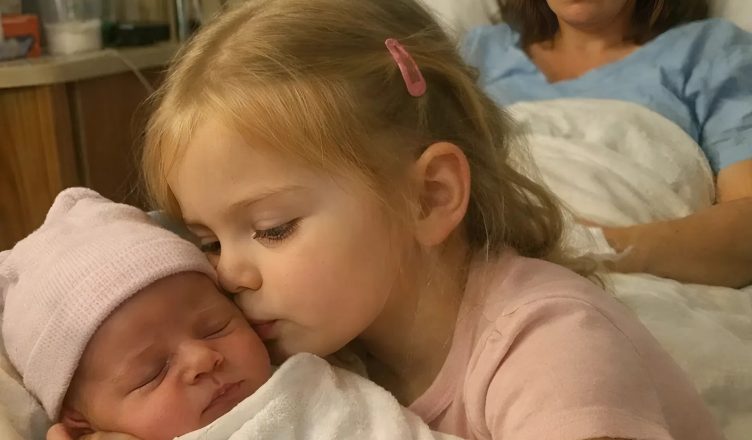
But Harper didn’t look up. She kept rocking her newborn sister, as though her small body was shielding the baby from something unseen.
“Daddy and Grandma,” she answered quietly, naming them the way someone would mention something obvious, not frightening.
My heart skipped. It wasn’t the content of the words that made me cold; it was the calmness in her voice. Children rarely use the word “alone” in a serious context—not about toys or bedtime, but about life with other people.
I tried to smile, but my lips didn’t cooperate.
“What do you mean, sweetheart?” I asked. “Do they scare you?”
She shook her head.
“No. They’re just mean. And when you were sleeping a lot because of Mila, nobody loved me.”
She didn’t sound angry or dramatic. She sounded resigned—like someone who had already adapted to a painful truth. I felt something sharp and cold crawl up my spine. I remembered my pregnancy: constant exhaustion, my husband’s long shifts, his mother practically living in our house, correcting everything Harper did. Back then, I chalked it up to old-fashioned parenting. Now it suddenly looked different. Much darker.
I opened my mouth to say something, but then my husband walked into the hospital room.
He hadn’t answered my texts all morning. His explanation was predictable: tired, overslept, busy. He carried flowers, as though performing the role of the supportive father. He kissed my cheek and smelled of expensive cologne, but all I could register was the artificiality behind the gesture.
“How are my girls?” he asked cheerfully.
Harper gently returned Mila to the nurse, but right before she let go, she whispered something into the newborn’s ear again—this time with a tiny flicker at the corner of her mouth. When the baby left her arms, Harper’s entire body changed. Her shoulders rose, her gaze dropped to the floor, and she seemed to fold into herself.
My husband didn’t notice. His eyes were on the newborn, on me, on the camera lens of his phone—anywhere except on the five-year-old who had just become a sister.
“Look at her,” he said proudly, “she looks just like me.”
He never acknowledged Harper. Not a word. Not a smile.
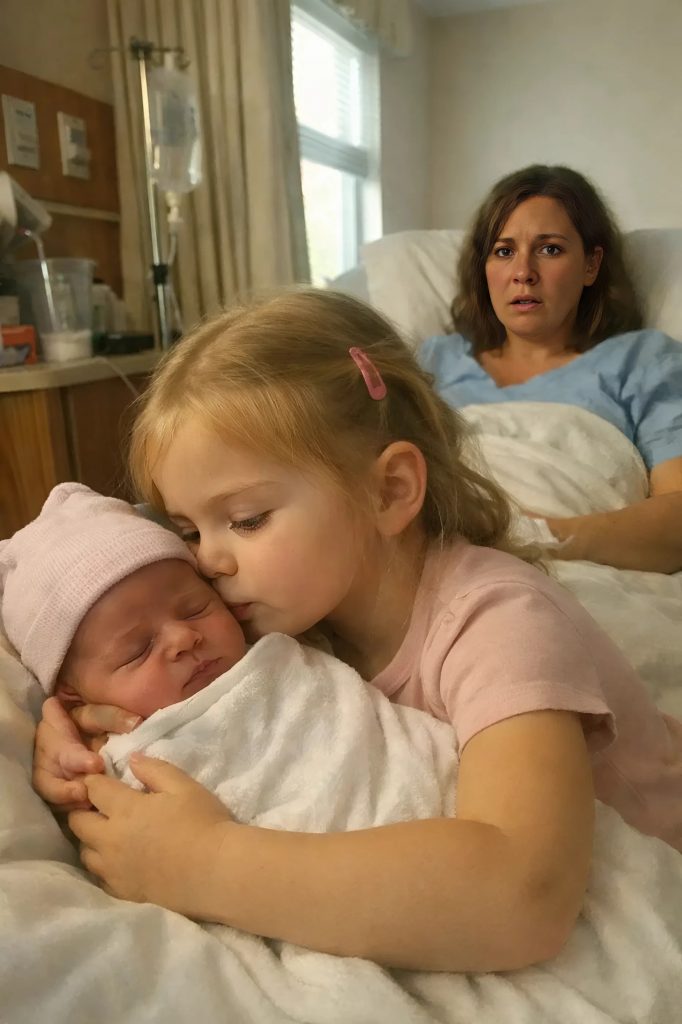
Five minutes later, his mother arrived, loud and theatrical, as if entering a stage.
“Poor thing,” she said to me, “such a long night. But you did well.”
Then she spotted Harper—and instead of hugging her or even greeting her, she immediately frowned.
“Why are you dressed like that? Where is your hair tie? This is a hospital, not a playground. You’re five, you should know how to look presentable.”
Harper didn’t respond. She simply walked over and stood behind my bed—hiding, silently, the way children hide from thunderstorms.
That was the moment I saw my life from the outside. Not through the lens of “stability,” or “family,” or “proper structure,” but through the eyes of a child.
And it was terrifying.
After we came home, everything became clearer. I tried to rationalize my husband’s behavior—stress, fatigue, pressure. I told myself children exaggerate. I made excuses the way women in unhappy marriages often do.
But the more I watched, the less room there was for doubt.
If I stepped into the kitchen to cook—Grandma lectured Harper about “proper posture” and “not whining.” If I went to shower—my husband hissed at her to stop talking because “her voice hurt his head.” If she cried—his mother rolled her eyes and said, “Girls who cry too much grow up weak. No one wants weak girls.”
But what broke me were not their words—it was the nights. I fed Mila in the nursery and heard quiet, restrained sobbing from the other bed. Harper cried like an adult—silently, hiding it.
One night, when I kissed her hair, she whispered:
“Can I live with just you and Mila? I’ll be quiet. I’ll be good. Just don’t let me stay with them.”
There are sentences a mother never forgets. That was one of them.
I started planning in secret. I contacted a lawyer. I hid cash between stacks of baby blankets. I lived in two realities: the one they saw, and the one I was building.
We left early one morning while the house was still sleeping.
When the door closed behind us, Harper didn’t shrink or flinch. She breathed. Deeply. Like someone breaking the surface after being underwater too long. She wrapped her arms around Mila, not for protection—but for freedom.
Now we live in a small apartment, just the three of us. Harper still has nightmares sometimes. She still asks if they will come back. But she doesn’t whisper anymore. She speaks. She laughs. She cries when she needs to. She exists without apology.
And one morning, over breakfast, she looked at me and said:
“I used to think adults were always right. But you’re the rightest one.”
That was the day I understood something simple and brutal: sometimes the only way to save a child is to burn down the life that hurts them and build som