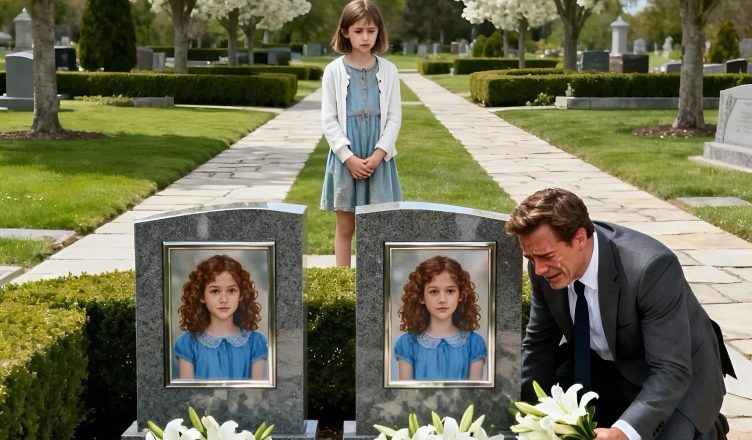
The girl introduced herself only as Lily, and her frail silhouette seemed almost ghostly against the rising sun as they exited the cemetery gate and stepped into the waking town.
“Blue house at the end,” she repeated quietly, as if afraid the world might punish her for knowing too much.
Mason wanted to demand answers, wanted to scream that it was impossible, that Olivia and Claire were underground, and that no house—blue or otherwise—could change that. But another part of him, the part that never fully surrendered to grief, was already calculating, fighting, hoping.
They walked for nearly twenty minutes before the town’s trimmed lawns gave way to cracked sidewalks and the faint smell of gasoline and mildew. Children’s bicycles lay toppled in weeds, and old couches sat abandoned beneath sagging porches. Mason’s expensive loafers crunched glass fragments with every step.
Lily pointed at a narrow street lined with rusted mailboxes.
“They live there… but nobody talks to them. They don’t go to school. They’re always inside. My mama says to ignore that house.”
Mason’s heart rattled inside his chest as they reached the block’s end. The house was unmistakably blue—peeling paint, boarded windows, and a mailbox hanging by a single screw. It was a house no parent would willingly raise children in, and that alone made his stomach turn.
Suddenly, Lily pulled on his sleeve and ducked behind a hedge beside him.
“There!” she hissed.
The front door opened just enough for a shadow to squeeze through. A woman stepped onto the rotted porch, lighting a cigarette with trembling hands. Her hair was greasy blond, her eyes hollow, her movements sharp and paranoid. Mason stared at her, breath frozen, disbelief mounting.
It was Hannah.
Not a memory of Hannah. Not a ghost or a hallucination. Hannah, alive, thin, pale, aged by fear and secrecy.
Mason’s knees buckled. He pressed a hand to the hedge for balance as bile surged up his throat. Every newspaper headline, every condolence card, every graveyard lily suddenly felt like a cruel, calculated performance.
And then it got worse.
Two tiny silhouettes appeared behind Hannah, peeking through the crack in the doorway. Two girls with identical curls and bright hazel eyes—eyes he had kissed goodnight, eyes he had cried for at their graves.
Olivia.
Claire.
The world narrowed to a pinhole. The hedge blurred. Even the air seemed to disappear.
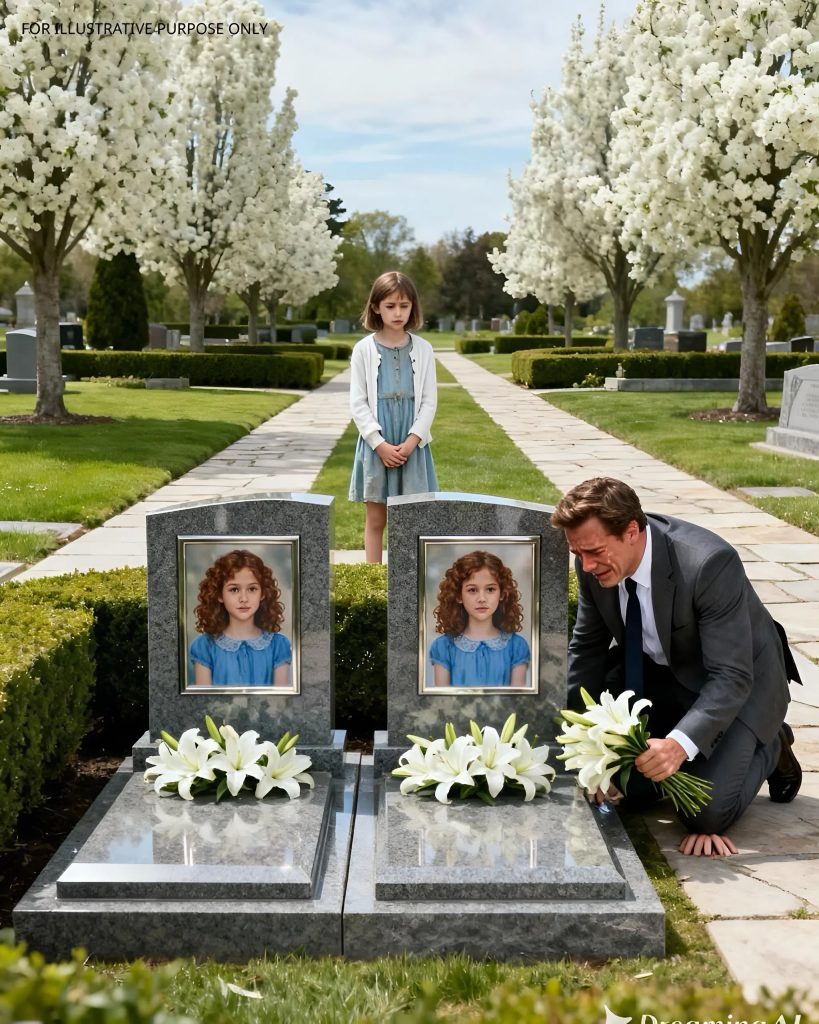
He didn’t remember standing. He didn’t remember crossing the yard. All he knew was that within seconds he was at the porch steps, staring at the daughters he had mourned for two years.
Hannah’s cigarette dropped to the wood and rolled, still burning, as her eyes widened in animal terror.
“Mason,” she whispered, voice shredded by panic, “you weren’t supposed to know.”
His daughters stared at him as if seeing a ghost of their own—a face remembered but forbidden, a father carved out of dreams and warnings.
Everything after that happened in fragments.
Mason shouting their names.
Hannah bolting back into the house.
The girls hesitating—wanting to run to him, too afraid to try.
A man’s voice booming from inside, “Get away from the door!”
Someone yanked the children out of sight. Mason lunged up the stairs, but the door slammed and locked. He hammered his fists against it, screaming, threatening, begging. His voice was the roar of a man betrayed by fate itself.
“I buried them,” he choked. “I buried empty coffins!”
Inside, footsteps scattered. A chair scraped. A window rattled open. He spun around just in time to see a black pickup truck tearing out of the alley beside the house, tires spitting dirt, engine screaming like an animal. Mason sprinted after it, but the truck fishtailed down the road and vanished into a cloud of exhaust.
The blue house was silent again.
Lily appeared behind him, wide-eyed and terrified.
“They leave a lot,” she whimpered. “Always at night. Always fast.”
Mason stood in the yard, gasping, shaking, staring at the emptiness where his daughters had been just seconds earlier. He felt the ground tilt beneath him as realization settled like ice in his veins.
Hannah hadn’t simply moved the girls.
She had staged their deaths.
Paid for coffins.
Arranged funerals.
Vanished.
And someone—some unknown man—was helping her.
Within hours, the police tape surrounded the house, and neighbors spilled into the street, whispering theories that sounded like fever dreams. Officers pried open windows, kicked in doors, and uncovered tiny bedrooms furnished with second-hand toys, stacks of canned food, and notebooks filled with drawings of a man with a familiar face labeled “Daddy.”
But there were no girls.
No Hannah.
No trace of the truck.
Detective Sorensen, gray-haired and sharp-eyed, pulled Mason aside.