She smiled, but it wasn’t a fragile smile anymore. It was the kind a person wears after they’ve made it through something that should’ve broken them.
“I hope I’m not interrupting,” she said softly.
I couldn’t find a word. Not one. I just nodded and stepped aside.
She walked into my kitchen like a gentle breeze sweeping through a dusty room. The baby on her hip—now chubby-cheeked and wide-eyed—giggled at Molly, who was wagging her tail like she’d just seen Santa.
“I never got to thank you properly,” the woman said, setting the gold-wrapped box on my table.
I shook my head. “There’s nothing to thank me for.”
But her expression shifted—serious, unblinking, almost fierce.
“Yes,” she said. “There is. You don’t know what you did.”
She set the baby down, then placed both hands on the countertop as if steadying herself. And then she told me.
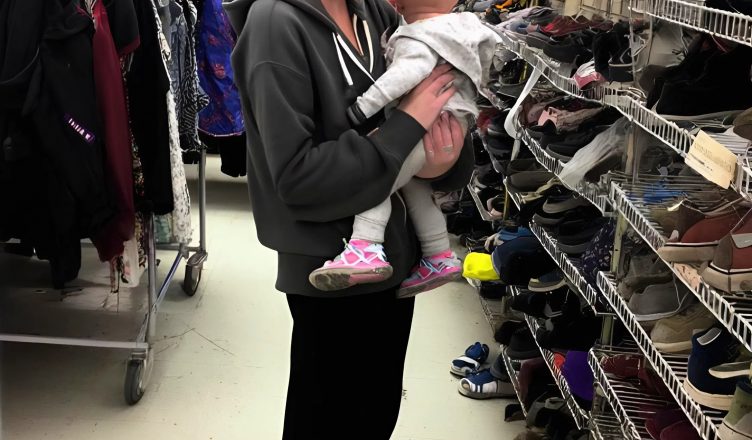
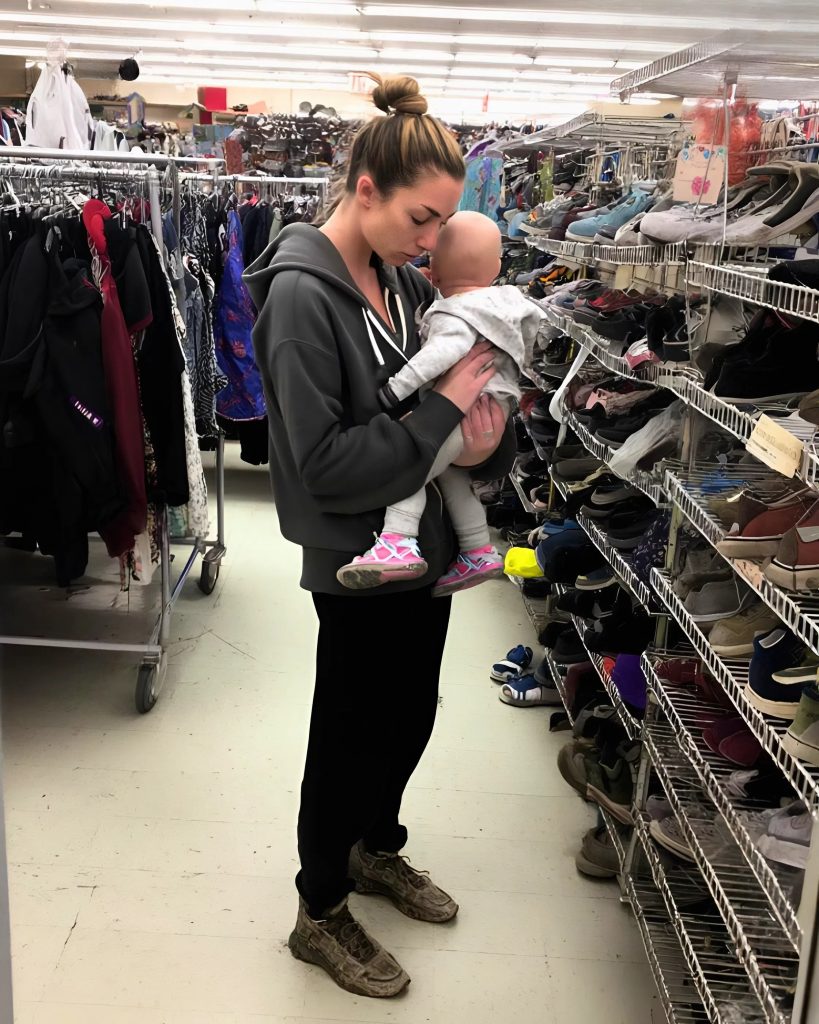
That day—the thrift shop day—she had been on her last thread. Her husband had died in a construction accident eight months before, leaving her with a newborn, no insurance payout yet, and bills stacked like leaning towers on every flat surface of her apartment. She’d lost her job during pregnancy, and food stamps were her only lifeline.
“Those shoes,” she said, voice trembling, “weren’t for me. They were for a job interview. A front desk job at a car dealership. My sneakers were broken, and I was so embarrassed I almost cancelled.”
But then—my bag, my words, my fifty dollars hidden like a silent lifeboat.
She wiped her cheek.
“Because of you, I bought diapers, formula, and bus fare,” she whispered. “I went to the interview. And I got the job.”
She took a shaky breath.
“Two months later, the company owner found me crying in the break room because I couldn’t afford daycare. Instead of firing me, he asked about my degree. Turns out he needed someone who could handle inventory and scheduling. I had the skills. I just didn’t have the clothes… or the confidence.”
The baby cooed as if confirming the whole tale.
“So I got promoted. Then promoted again. Then transferred to corporate. By the time the insurance payout for my husband came through, I wasn’t drowning anymore. I was already swimming.”
She opened the gold box. Inside was an envelope, thick as a small Bible, and a small velvet pouch.
I pushed it back toward her. “No. No, honey, I don’t want anything.”
She didn’t move the box. Didn’t blink.
“You don’t even know what it is,” she said.
I sighed, resisting.
She picked up the velvet pouch, loosened the drawstring, and poured out a delicate silver bracelet—no diamonds, no flashy stones—just a tiny engraved plate that said: Because you matter.
My throat closed.
“It’s not expensive,” she said. “But it’s the words that saved me. I read that little gift note over and over until I believed myself worth saving.”
Then she tapped the envelope.
“This,” she said, “is simply my way of making sure you never doubt that kindness comes full circle.”
I opened it—hands shaking—and pulled out paperwork. At first I didn’t understand. Pages from a bank. A veterinary clinic account. Something about prepaid funds.
Then I froze.
She had paid off every outstanding vet bill for Molly. Every future check-up. Every vaccination. Every medication—for life.
My knees felt weak enough to give out.
“How did you—?”
She smiled. “I asked the clinic. Told them I wanted to cover everything for the woman who saved me.”
I covered my mouth with my hand. That’s when the tears came, hot and disobedient.
“Why would you do all this for me?” I whispered.
She stepped closer.
“Because you matter,” she said, echoing my own voice back to me like a boomerang finally coming home. “Not just that day. Not just for me. You matter, period.”
We stood there in the quiet hum of my tiny kitchen—two women who’d never been meant to meet, somehow altering the course of each other’s stories.
Finally, she gathered the baby, fixing the little coat buttons with hands that no longer shook from fear.
“I still struggle,” she admitted. “Grief doesn’t vanish. But now I fight from higher ground. And I will never forget the stranger who handed me a pair of shoes and a second chance.”
She hugged me. Tight. The baby pressed a cracker-sticky hand against my cheek. Then she walked to the door.
On the porch she paused.
“You think you did something small,” she said. “But sometimes small things are the only things keeping someone alive long enough to see big things happen.”
And just like that, she was gone. Down the steps, into a sleek sedan, and back into a world that once tried to swallow her whole.
I stood at my doorway long after she disappeared.
Later, as I cleaned Molly’s wound and watched her drift to sleep, I realized something: kindness isn’t charity. It’s currency. And the interest rate is savage.