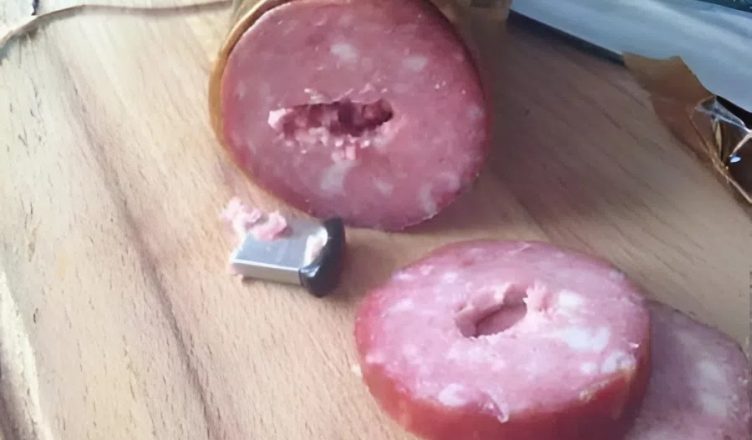
The previous day, while doing some routine grocery shopping, I grabbed a modest-looking sausage from the refrigerated aisle. Nothing premium, nothing exotic—just a simple product to throw between slices of bread for a quick snack. That evening, I cut several slices, ate them without noticing anything unusual, and stored the rest in the fridge before going to bed. At that moment, there was no warning, no strange taste, no sign that anything was seriously wrong.
The next morning, I woke up hungry and went straight to the kitchen to prepare breakfast. I took out the same sausage, placed it on the cutting board, and began slicing again. But this time, the knife did not glide smoothly through the meat. Instead, it met resistance. It felt as though the blade was scraping across something firm and out of place. I paused, confused, assuming that perhaps part of it had frozen or become stiff in the refrigerator overnight.
Curiosity pushed me to cut another slice. The knife jerked to a halt mid-stroke, as if it had struck a pebble embedded in clay. That was the moment I truly stopped. I leaned closer and noticed a faint gleam beneath the pink processed surface. It was subtle but unmistakable. Something inside the sausage was reflecting the light.
At first, my brain desperately tried to make sense of it—maybe a shard of packaging, maybe a small metal clamp that slipped in during processing. But as I carefully dug into the sausage with the tip of the knife, the truth turned out to be far stranger than anything I had imagined. With a faint sucking sound, a small rectangular object slid out of the meat and onto the wooden board. I stared, unable to move for several seconds. It was a USB flash drive. A black plastic flash drive, the kind you might see dangling from a student’s keychain or left on an office desk.
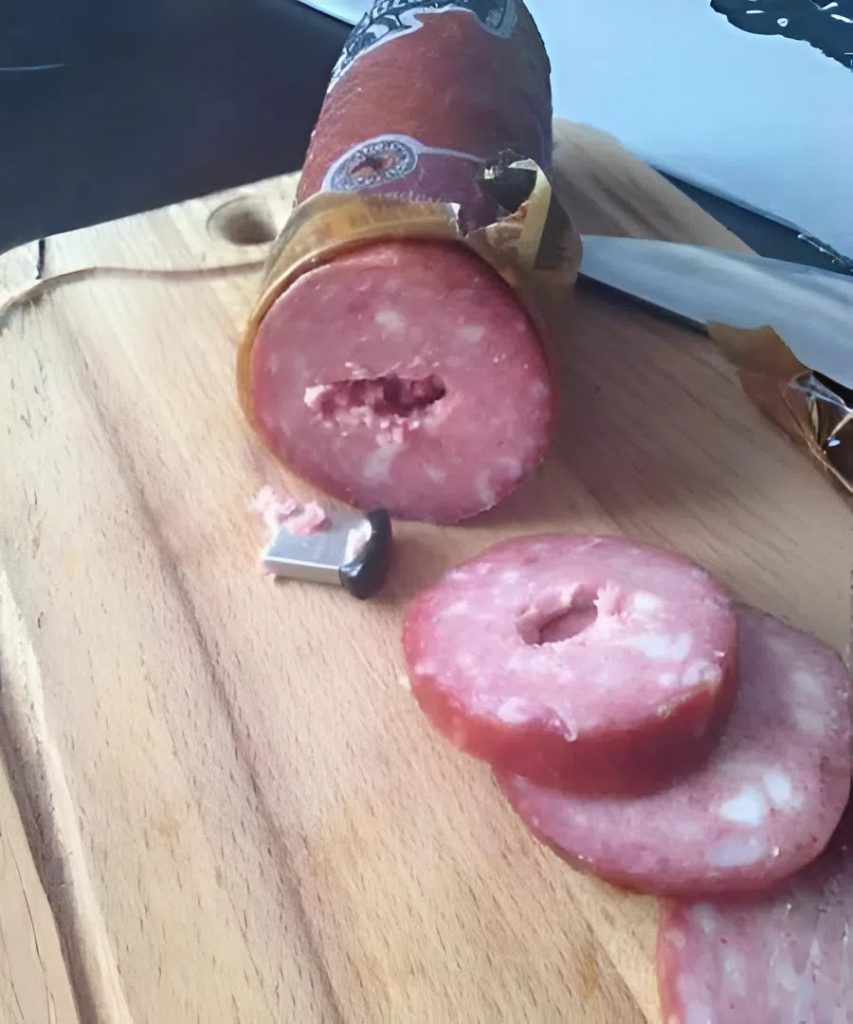
A wave of disgust rolled over me as the realization hit that I had eaten from the very same product the day before. My throat tightened as if the taste had suddenly resurfaced. Who could possibly imagine digital storage media hidden inside a factory-sealed sausage? How could such an object enter the production chain? And more importantly—why?
Disgust soon gave way to a different force: curiosity. Against my better judgment, I wiped the flash drive clean, carried it to my computer, and inserted it into a USB port. For a moment nothing happened. Then the device lit up, and a small notification pinged in the corner of the screen. It contained only one folder. The folder’s name consisted of numbers, symbols, and letters that did not correspond to any language I recognized—like a fragment of an encrypted code or a botched serial number.
Inside the folder were dozens of photographs. Not family images, not nature, not selfies—nothing remotely normal. The pictures showed the interior of an industrial facility. Metal rails, conveyor belts, crates filled with raw materials, and large stainless-steel machines used in food processing. The timestamps in the corner of the images indicated they were taken recently—no more than a few weeks old.
But the deeper I went, the more disturbing the content became. Several pictures showed plastic containers with no labels, filled with dark-colored substances. Others showed workers inside what appeared to be a meat processing plant—but without protective gloves, without hairnets, without masks. In one image, a worker held what looked unmistakably like the same model of flash drive I had just extracted from my breakfast. He was looking directly at the camera, his expression strangely intent, as if the photograph were meant to be evidence rather than documentation.
The final section of the folder contained several video files. When I opened the first, I heard machinery grinding and clattering in the background, followed by muffled voices. The facility looked chaotic, disorganized, nothing like the sanitized environments companies proudly show in advertisements. Another video was shot inside a dimly lit storage space. Shelves were stacked with plastic bags containing powders and liquids that clearly were not food ingredients. At the end of the footage, someone placed a transparent bag on the table, and for a brief moment the camera captured a printed label used for chemical laboratory samples, not for edible goods.
By the time the last video finished, the grim pattern became undeniable. This wasn’t an accident. The flash drive inside the sausage was not a careless mistake. Someone wanted these files to be found. Someone had inserted evidence into a consumer product—almost like a message smuggled behind enemy lines.
I sat in silence, staring at the remaining piece of sausage on the chopping board. The kitchen light flickered slightly, as if emphasizing the absurdity of the situation. My first instinct was to notify the grocery store, to demand information about their suppliers. But another thought crept in: what if thi