
I swear the entire dining room seemed to slow down, as if someone had pressed a silent emergency brake on reality.
“I’d like to make a toast,” I repeated, lifting my glass with the kind of politeness that hurts more than shouting. For a moment, it looked like we were simply another American family finishing a Sunday dinner, not standing on the edge of a domestic earthquake.
My mother’s face lit with automatic courtesy. “Oh honey, that’s so lovely—”
“It is,” I cut in calmly. “Because it’s important to toast family. To loyalty. To honesty. To bonds that hold even through sickness.”
The subtext wasn’t subtle. Derek’s shoulders tensed. Kelsey’s eyes flickered down, and her fork slipped from her fingers, hitting the plate with a loud metallic crack.
I took a sip of water and went on, “And of course… to strong immune systems.”
My mother blinked, confused. My stepfather stared at his daughter as if her face had become a puzzle he could no longer solve. The twins babbled in their baby swings, completely unaware that their parents’ marriage was disintegrating in real time.
I picked up my phone.
A few taps. AirPlay. The television behind me lit up like a crime scene monitor.
Slide one: Derek, shirtless, in a hotel mirror, looking relaxed and smug in a way he had never once looked during his so-called “brutal conference.”
Slide two: A champagne bucket, two glasses, fluffy hotel bedding, luxury spa brochures.
Slide three: Kelsey in a spa robe, leaning against him as if they were on a honeymoon.
Silence—thick, surgical—fell over the table.
My stepfather’s voice cracked first. “Kelsey. What is that supposed to be?”
Kelsey went pale. The fading chickenpox marks beneath her makeup suddenly seemed to glow like evidence under ultraviolet light. Derek sputtered—some cocktail of denial, apology, and coughing that didn’t amount to coherent language.
“This is being taken out of context,” he managed to gasp.
“Out of context?” I echoed. “You handed me a medical timeline to cross-reference. You claimed clients were ‘brutal’ while you were at a spa with my stepsister. You came home sick and let me care for you while I was on maternity leave with twins.”
“I was going to tell you,” he whispered.
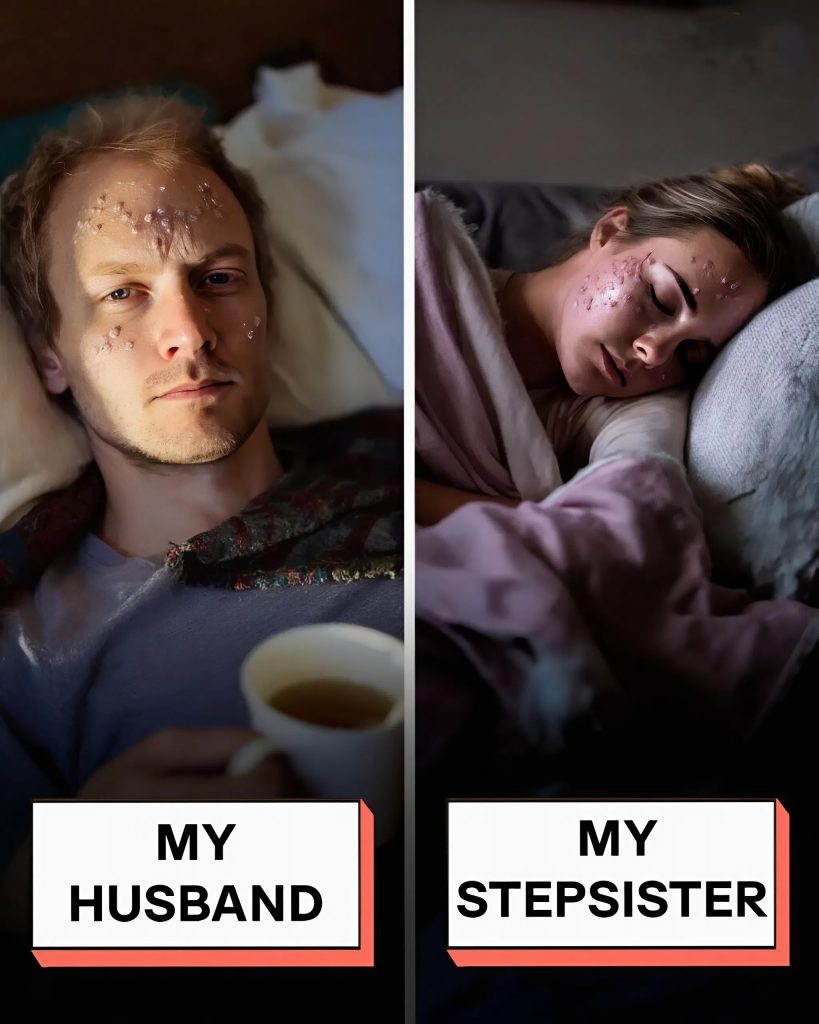
“No,” I said evenly. “You were going to recover. Then you were going to pretend nothing happened. Then you were going to wait until I was too exhausted to notice the gaps in your story. It would have worked—until Kelsey caught the same illness and her father sent that cheery text.”
My mother pressed both hands to her mouth. My stepfather stared at his daughter with the stunned expression of a man who suddenly realizes he raised a stranger. Kelsey finally drifted into speech, her voice trembling:
“It wasn’t supposed to matter.”
That sentence will follow me for the rest of my life, because it wasn’t an apology—it was a worldview. A statement of priorities. A perfect summary of everything that was wrong.
I set my glass down. “You’re both leaving tonight.”
Derek stared at me like I’d spoken a foreign language. “Leave? I live here. My kids—”
“Our kids,” I corrected. “And they will grow up knowing their mother refused to shelter decay. My attorney will contact you. You will not contact me privately. You will not show up unannounced. You will not use childcare as leverage. And you will not recruit your mother for sympathy campaigns. Do you understand?”
My voice didn’t waver. His did: “Yes.”
Kelsey gathered her purse with shaking hands, her eyes glossy with humiliation, fear, and something like distant regret. My stepfather followed her to the door, silent as a judge. My mother remained frozen in her chair, staring at Derek as though she had just discovered a hidden flaw in the world.
Derek left without another word. The door slammed softly, sealing a chapter shut.
I cleared dishes. Nursed babies. Ran the dishwasher. Changed diapers. The small rituals of survival carried me through the evening. I didn’t cry—crying is something people do when they feel safe.
Hours later, when the house was quiet, my mother finally spoke.
“Why didn’t you expose them sooner?”
I looked down at my sleeping twins and said, “Because timing matters. Evidence matters. And I wanted the consequences to arrive in daylight, not slip away in the dark.”
She nodded slowly. She understood.
In the weeks that followed, people asked variations of the same question: Why would he risk everything? Why Kelsey of all people? Why during newborn chaos?
The truth is painfully simple: fragile people chase small victories. They seek rooms where they can feel admired, wanted, powerful. Kelsey wanted to be envied. Derek wanted to be adored. Neither of them wanted accountability.
They counted on exhaustion to blind me.
They counted wrong.
This is not a tragedy. It’s a cleansing. A controlled burn.
My house is peaceful now—the real kind of quiet, not the simmering silence held together by denial. My twins are growing strong. I’m regaining sleep. I’m rebuilding str