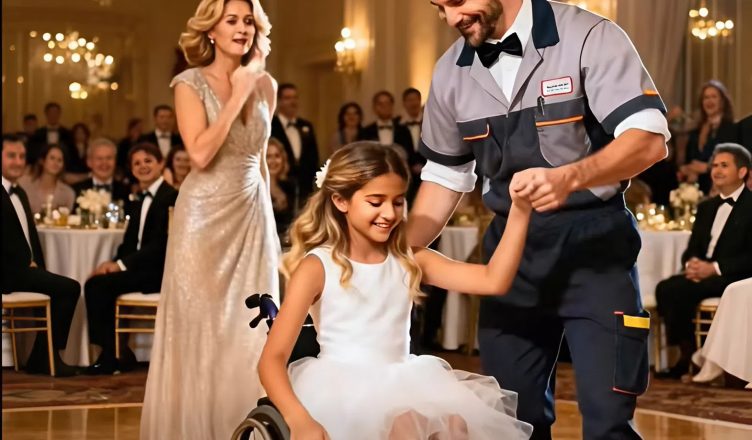
And a teenage girl in a wheelchair—quiet, delicate, with a determination flickering deep in her eyes. No one would have believed that one ordinary evening in a worn-out gymnasium could change multiple lives.
Aaron Blake knew the gym floor better than anyone. He knew the scratches, the pale streaks from old sneakers, the uneven boards that bent under pressure. Not because he loved sports, but because he waxed, polished, repaired, and maintained that floor year after year. It was his job—silent, repetitive, unseen yet essential. Without him, the school would collapse into chaos.
After his wife’s death, life drained of color. He was left with his young son, Jonah, too small to understand why his mother never came back, but old enough to sense his father’s grief. Aaron battled bills, exhaustion, insomnia, and loneliness. He could not afford to break down—Jonah needed him.
That night, the gym had been transformed for a school celebration. Paper banners hung from the ceiling, colored lights cast soft reflections on the polished floor, and tables were stacked with snacks, juice, and cheap plastic cups. Parents buzzed around, adjusting decorations and arguing about placement as if the fate of the world depended on correct napkin folds. Aaron walked among them in his work uniform, collecting trash, wiping spills, and pushing chairs back into line.
Jonah slept curled on the bleachers, his head resting on a small backpack. It stung Aaron to see him so tired, but at the same time, there was a bittersweet comfort—sleep meant safety.
Then Aaron heard a faint whisper of wheels. The sound of small rubber against lacquered wood. He turned and saw her: a girl, maybe twelve, approaching in a wheelchair. She had pale blond hair resting on her shoulders and a spotless white dress that seemed far too formal for a school gym. Her fingers gripped the armrests. Her eyes were shy but not afraid.
“Hi,” she said softly. “Do you know how to dance?”
Aaron blinked, confused for a moment, then gave an awkward smile.
“Me? Well… I can make this floor shine, if that counts,” he replied, lifting his mop slightly.
The girl tilted her head and a small smile warmed her face.
“I don’t have anyone to dance with,” she whispered. “Everyone else is… somewhere else.”
Aaron looked around. He saw frantic parents, decorations, his sleeping son, and the mop bucket. Something inside him shifted—not logic, not duty, just plain human instinct.
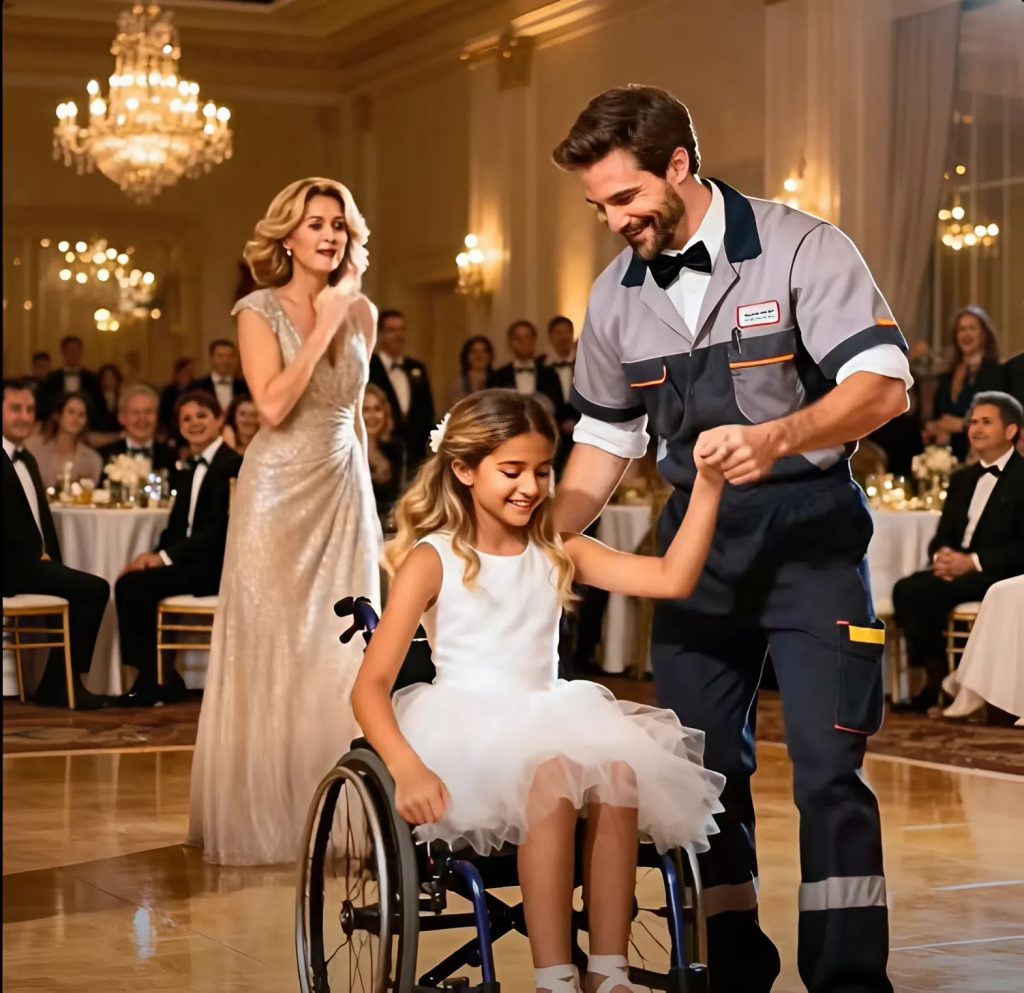
A janitor. A girl in a wheelchair. Two invisible people in a crowded room.
“Alright,” he said gently. “We can try.”
The girl’s eyes brightened. Aaron placed his hands lightly on the back handles of her wheelchair and attempted a clumsy turn to the music. He was too tall, too tired, too unfamiliar with anything resembling grace. But the girl laughed—and that sound changed everything. She moved her chair in small arcs, raised her arms, and for a moment her body did not look like a prison, but like a voice searching for shape.
What neither of them noticed was the woman watching.
She stood in the doorway, frozen, her hands clenched around a purse strap. Her face carried fear, sorrow, anger, guilt—feelings worn by someone who had spent years fighting doctors, therapies, and a world that refused to be kind to her child. She stared at her daughter—Sofia—who danced. Not in therapy, not under clinical instruction, but to live.
In four years, she had not seen her smile like that. Four years of hospitals, diagnoses, restrictions, and silent heartbreak.
And there, in the middle of it all—the janitor.
The woman stepped forward. Sofia stopped. Aaron withdrew. Without raising her voice, the woman took hold of the wheelchair and guided her daughter away. Just before disappearing down the hallway, she looked at Aaron. The glance lasted barely a second, but two broken humans recognized each other in that moment.
Two days passed.
Then a white envelope appeared on the school’s bulletin board. The teachers opened it and fell silent.
Inside, written neatly, were these words:
“My daughter Sofia has cerebral palsy. She has not danced in four years. That night in the gym, she said she felt ‘alive.’
I do not know the name of the man in the work uniform, but he did something doctors have not managed to do.
Please, find him.”
Signed: Mira
The school found him quickly.
The children were the first to understand. They pointed at Aaron in the hallway, whispering and giggling:
“That’s him!”
“He’s the hero!”
Hero. The word hit him like a blow. How could a man who cried into his hands at night—quietly, so his son wouldn’t hear—be a hero? A man who couldn’t save his wife, who could barely keep his family afloat?
But life did not ask for permission.
One afternoon, a white car waited for him in the parking lot. Mira stepped out. She looked exhausted—not angry, just painfully tired.