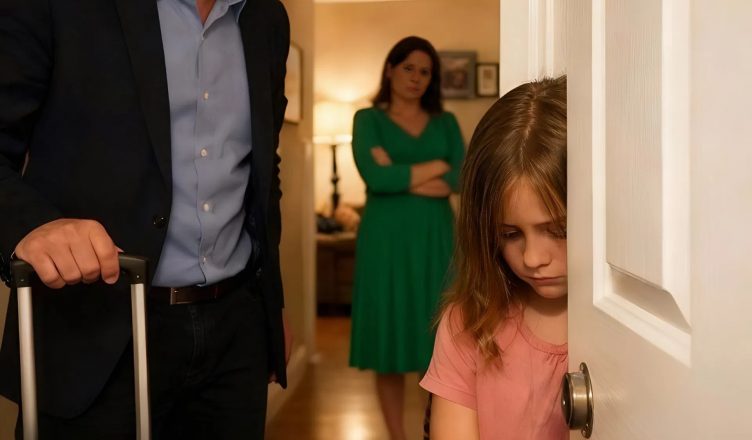
His body had moved before his thoughts — slow, careful, almost fearful, as if even the smallest motion might cause her more pain. Sophie was trembling. Not from cold, but from something deeper. From a fear that had settled into her body and refused to leave.
“Easy… Daddy’s here now,” he whispered, though his own voice sounded unfamiliar to him.
He helped her sit on the edge of the bed, making sure her back didn’t touch the headboard. Sophie stiffened instantly and squeezed her eyes shut, bracing herself as if the pain would strike again on its own. That reflex hurt Aaron more than any scream could have.
“How long has it been hurting?” he asked softly.
“Almost all the time,” she answered. “Mostly at night. When it’s dark. When I think you might not come back.”
The words knocked the breath out of him.
Aaron looked around the room. Everything was spotless — the bed perfectly made, toys lined up with unnatural precision, the floor immaculate. Once, he would have seen this as proof of stability. Now he saw something else entirely: silence enforced, order born of fear rather than care. This wasn’t a sanctuary. It was a quiet cage.
He wanted to ask more. But he was afraid of what he might hear.
“Where’s Mom?” he asked at last.
Sophie flinched.
“She said she was tired… and went to sleep. She said if I told you, it would be my fault. That things would get worse.”
Aaron closed his eyes for a brief moment. Just one. To keep from shouting. To keep the anger from exploding out of him.
He knelt in front of his daughter again.
“Listen to me carefully,” he said, calm but firm. “You didn’t do anything wrong. Ever. Not then. Not now. Do you understand?”
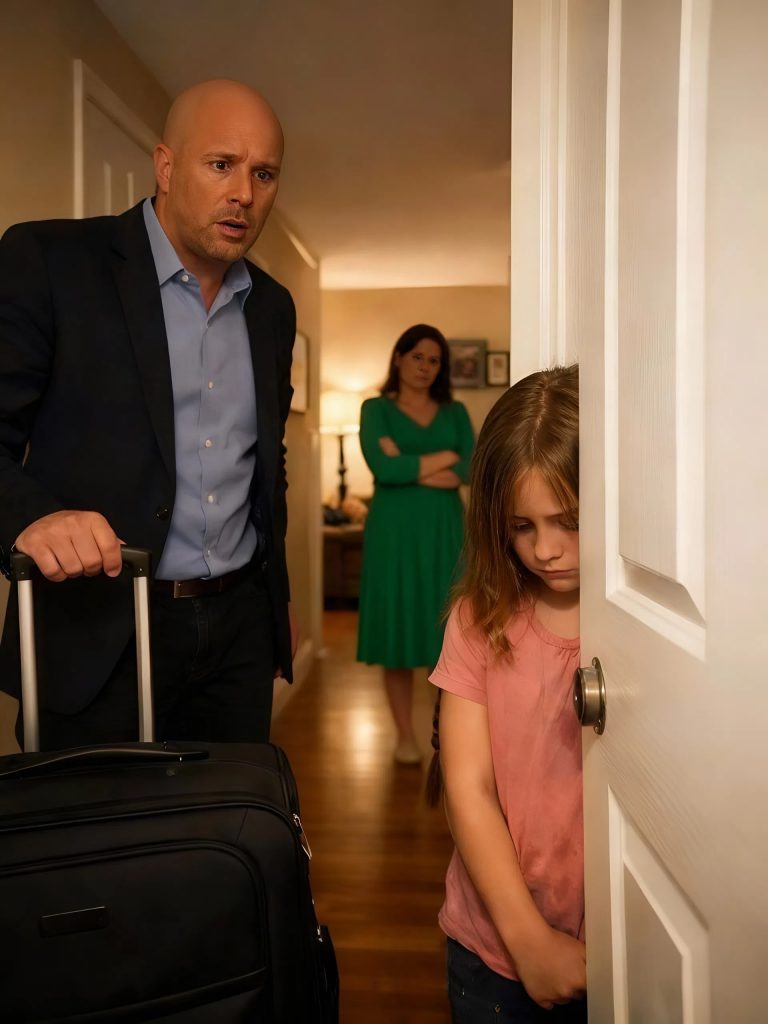
Sophie nodded slowly, but there was no relief in her eyes. Only exhaustion and fear — emotions far too heavy for an eight-year-old child.
Aaron stepped into the hallway and pulled out his phone. His hands were shaking so badly he struggled to dial.
“My daughter has severe back pain,” he told the emergency operator. “Yes. I don’t think the injury is recent. Please send an ambulance. Right now.”
When he returned, Sophie was sitting in the exact same position, motionless, as if she believed that even the slightest movement would trigger another wave of pain.
“We’re going to the hospital,” he said gently. “They’ll take care of you.”
“Are you mad at me?” Sophie asked in a barely audible voice.
He froze.
“At you?” He shook his head. “Never.”
She started to cry. Silently. Tears slid down her cheeks, but no sound escaped her lips — as if even crying had been forbidden.
At the hospital, the doctors spoke in low voices. For too long. They ran tests, exchanged heavy looks. Aaron felt a cold weight settle in his chest.
“There’s a fracture in her spine,” the doctor finally said. “It’s not recent. We’re also seeing signs of older bruising. We are required to contact child protective services.”
Aaron nodded. He already knew.
When the social worker approached him, he didn’t try to explain or defend anything.
“I didn’t know,” he said simply. “But now I do. And I’m not leaving her.”
He spent the night on a hard plastic chair beside the hospital bed. Sophie slept, clutching his finger as if afraid he might disappear. Aaron stared at the white wall and realized the truth: the home he believed was safe had only been a carefully maintained illusion.
He thought about every time he said “later.” Every sign he ignored. Every absence he justified.
The next morning, he filed a report. The investigation began. Then the court hearings. Then the long road to healing.
But every evening, he was there. Reading. Sitting in silence. Holding her hand.
And one day, Sophie whispered:
“Daddy… I can sleep now. It doesn’t hurt anymore.”
And in that moment, Aaron understood that the most terrifying truths don’t begin with screams — they begin with a whisper that no one wanted to hear for far too long.