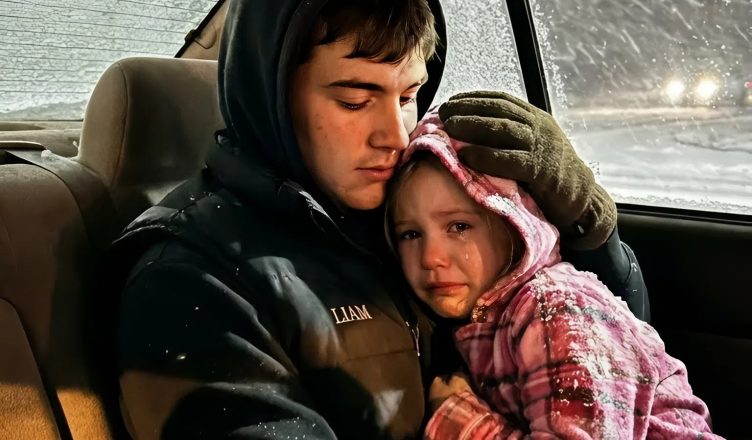
They had already decided she was dead.
They hadn’t lost her.
They hadn’t made a mistake.
They had planned this.
“Mia…” My voice cracked. “Sweetheart, listen to me. You didn’t do anything wrong. Do you hear me?”
Her eyes searched my face, desperate, confused. “They said I wasn’t worth fixing anymore,” she whispered. “They said the donors wouldn’t like me broken.”
I didn’t ask who they were. I already knew.
The Sterlings weren’t just wealthy. They were untouchable. Champions of charity. Faces on hospital wings and children’s foundations. Every December, they hosted that gala—not for joy, not for faith, but for optics. Cameras. Applause. Control.
And my little sister had seen something she was never meant to see.
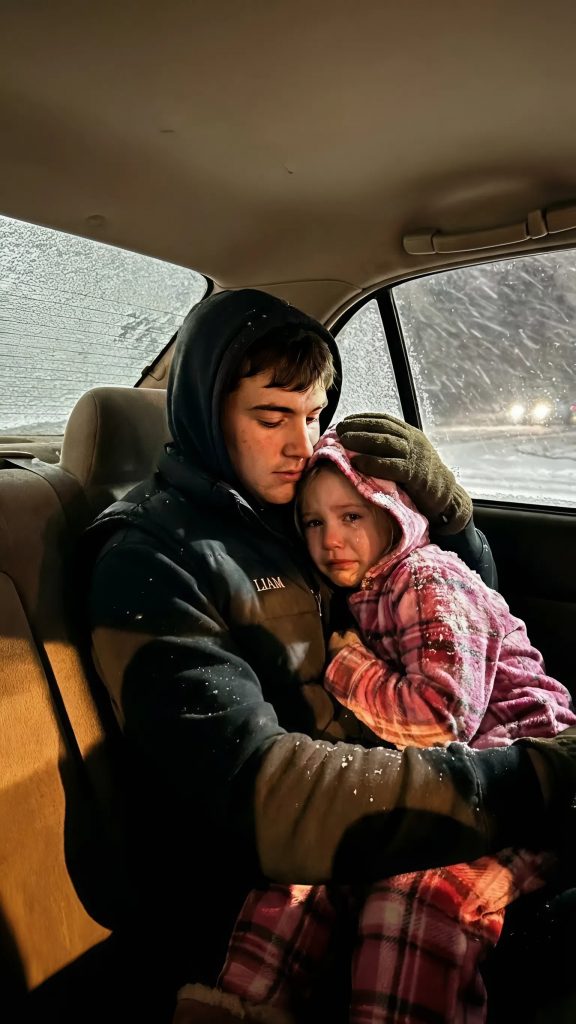
I drove straight to the emergency room, running red lights, my hands locked so tight around the steering wheel my knuckles burned. Mia faded in and out beside me, murmuring things that made my stomach twist.
“Room C… the cold room…”
“They keep files on all of us…”
“They said accidents are easier than returns…”
At the hospital, doctors rushed her away. When they lifted her shirt fully, one nurse gasped. Another turned away.
There were old bruises beneath the new ones. Yellowing. Fading. Layered like a history written into her skin.
This wasn’t a moment of rage anymore.
This was war.
While Mia slept under heated blankets and IVs, I made phone calls.
Old favors. Quiet numbers. People who owed me things I’d never asked to collect—until now.
By morning, I had names.
By noon, I had files.
By nightfall, I had proof.
The Sterlings weren’t adopting children to save them. They were acquiring assets.
Children with specific genetic markers. Children insured under private experimental clauses. Children whose “care” was subsidized by offshore research grants disguised as philanthropy.
And when a child didn’t meet expectations?
When treatments failed?
When the numbers didn’t add up?
The solution was simple.
An accident.
A disappearance.
A death certificate prepared in advance.
I found six more.
Six children.
All adopted.
All declared deceased within two years.
All ruled “tragic but unavoidable.”
And Mia was supposed to be number seven.
I went back to the Sterling Estate on December 26th.
The gates opened this time.
Inside, the house was silent—cleaned of Christmas, stripped of warmth. Richard Sterling met me in the study, his face calm, annoyed more than concerned.
“You weren’t authorized to remove the child,” he said evenly. “This will complicate things.”
“She’s my sister.”
“She was an investment,” he corrected. “And she failed.”
I didn’t hit him.
I didn’t scream.
I slid the folder across his desk.
Medical records.
Financial transfers.
Internal emails.
And one familiar document—creased, damp, unmistakable.
Mia’s death certificate.
For the first time, his expression changed.
Behind him, the study door opened.
So did the cameras.
The ones I’d had installed twelve hours earlier.
The ones now livestreaming to three investigative journalists, a federal task force, and one very interested prosecutor.
“You should’ve destroyed the body,” I said quietly. “Faking a death only works if the victim actually dies.”
They were arrested before sunset.
Both Sterlings.
Two doctors.
One private contractor.
The gala sponsors disappeared overnight. So did the money.
The charity shut its doors within a week.
Mia survived.
She still wakes up screaming sometimes. She still flinches when adults raise their voices. But she laughs again. She wears real pajamas now. Warm ones. And she knows this house—my house—is permanent.
As for me?
They thought I was weak.
Easy to silence.
A disposable relative.
They were wrong.
And every December 25th, when the snow falls heavy and quiet, I remember the night they tried to erase my sister from the world—
—and the night I made sure the truth buried them