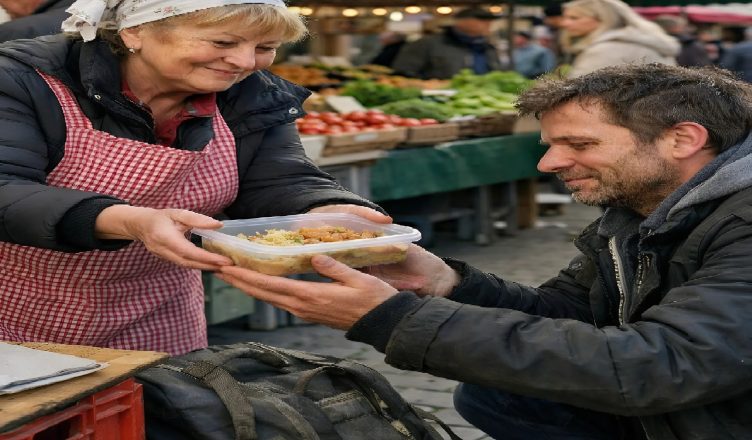
The wind moves through the stalls as if it owns the place. It slips under coats, runs icy fingers along ribs, and steals the last remaining warmth from tired bodies.
Grandma Zsófia shifted her weight from one foot to the other, trying to warm her numb toes inside her worn-out shoes. The insoles had long since soaked through, and the cold crept up from the pavement to her knees.
“So, Zsófia, not much business today?” came a confident voice from her left.
Ilona, who sold cheese and sour cream, adjusted the collar of her thick sheepskin coat. She stood in the “good spot,” right by the entrance where customers first walked in. There was always a small line at her stall. Coins clinked. People laughed. Meanwhile, Zsófia had been pushed near the trash bins with her jars of sauerkraut — left with drafts and silence.
“I’m managing,” Zsófia replied quietly, wiping down a large glass jar with a cloth.
“Of course you are. You’re too proud to complain,” Ilona scoffed. “I saw your granddaughter yesterday. Those boots of hers are falling apart. Aren’t you ashamed? A former schoolteacher, and the child walks around in rags.”
Zsófia said nothing, though the words cut deep.
Her daughter, Katalin, had moved back home six months earlier — two suitcases in hand, her seven-year-old daughter Marika beside her, and emptiness in her eyes. Her husband had found himself a “younger muse” and thrown them out without hesitation. Katalin worked as a nurse, taking double shifts and nights, but the money was never enough. Loans, bills, medication — it never ended.
That day, Zsófia had promised herself she wouldn’t go home until she earned enough for new winter boots for Marika. Most of the amount was already in her apron pocket. Just a little more was needed.
Around noon, when the crowd thinned, a man appeared between the stalls.
He limped slightly on his right leg. His face was pale and hollow, his hair untrimmed. An oversized jacket hung from his shoulders; his pants were dirty, his shoes soaked and splitting at the seams. People instinctively stepped aside.
He stopped first at Ilona’s stand.
“Ma’am… could you help me? Something to eat… or a little money for a ticket to the train station…”
Ilona didn’t even look up.
“This isn’t a charity. Get lost before I call security.”
The man swallowed and moved on. There was no anger in his eyes — only exhaustion. The kind that belongs to someone who hasn’t been seen as a person for a long time.
He stopped in front of Zsófia.
“Ma’am… could I have a piece of bread? I haven’t eaten all day.”
She noticed his hands — bluish from the cold, trembling. She remembered a neighbor who had once frozen to death in a shed during winter. The same distant look.
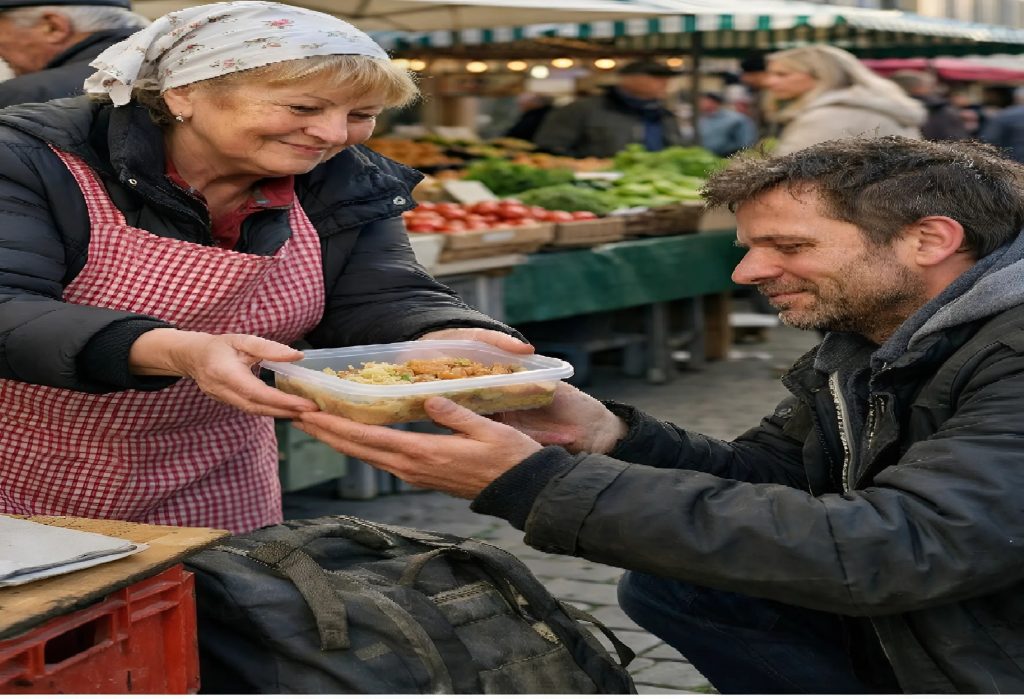
Without a word, she took out her own lunch: buckwheat with meatballs and a slice of bread.
“Here. It’s still warm.”
He ate quickly, almost desperately. When he finished, he whispered, “Thank you… I didn’t think I’d make it through today.”
Zsófia felt the money in her pocket. Marika’s boots. Katalin’s medicine. A voice in her head warned: You barely have enough for yourselves.
She looked at his soaked shoes. It was below freezing outside.
She knew he wouldn’t last long.
Before she could change her mind, she pulled out all the money she had saved.
“Take it. For a ticket and food. Go to the station.”
“I can’t… I won’t be able to pay you back.”
“You don’t have to,” she said firmly.
“My name is Pál. I’ll never forget this.”
A week passed in worry. Marika caught a cold. Money ran out. At night, Zsófia lay awake questioning her decision.
Then, on Friday evening, bright headlights lit up their small house. A large black SUV stopped at the gate. Curtains shifted along the street as neighbors peeked outside.
A tall man stepped out of the vehicle, dressed in an elegant cashmere coat and polished shoes.
“Good evening, Mrs. Zsófia.”
She recognized the voice.
“Pál?”
He smiled.
He explained that he had been robbed during a business trip. His wallet, phone, and documents were taken. Without identification or access to money, he had ended up on the streets for several days. The cash she had given him allowed him to reach his brother in another city. From there, everything was set in motion. The criminals were caught.
“It wasn’t just the money that saved me,” Pál said calmly. “It was the fact that you looked at me like I still mattered.”
He opened the trunk of the SUV. Inside were boxes — groceries, warm clothes, and a brand-new pair of winter boots for Marika. Then he handed her an envelope. Inside was a proposal for regular financial support through the foundation he managed, along with enough money to significantly reduce Katalin’s debts.
“This is too much,” Zsófia whispered.
“No,” he replied. “It’s right.”
As the SUV slowly drove away, the street fell silent.
Marika tried on her new boots. They fit perfectly.