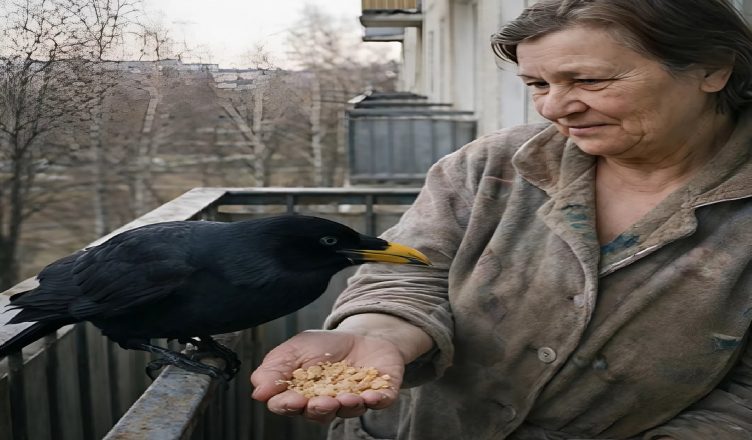
At first, it happened almost by accident. One cold winter day, she scattered a handful of bread crumbs along the railing of her balcony—simply to break the silence. The bird did not approach immediately. It watched her from the branch of an old birch tree in the courtyard below. Black, sleek, sharp-eyed. Only after several long minutes did it dare to fly closer.
From that day on, it became a ritual.
Each morning unfolded in the same quiet order. The soft hum of the kettle. The familiar weight of her worn robe on her shoulders. A small handful of crumbs resting in her palm. And the waiting.
The crow arrived almost at the same time every day. First it would land on the neighboring rooftop, then glide down to the balcony railing. It tilted its head slightly, as if in greeting. In time, it began eating straight from her hand.
The woman lived alone. Her husband had passed away years earlier, and her son had moved to another city. His phone calls became less frequent as time went on. The apartment was filled with a heavy stillness, but the mornings had purpose. On the balcony, she did not feel entirely alone. She spoke to the crow out loud—about the weather, about her neighbors, about the ache in her knee. The bird listened in its own silent way.
The neighbors often complained about pigeons. They installed spikes and grumbled about mess and noise. But this crow kept its distance. It never caused trouble. It seemed to understand invisible boundaries.
Six years passed without a single missed day.
In rain. In frost. Even on mornings when the woman felt weak and had to steady herself against the wall before stepping outside. The crow always came.
Until one morning, it didn’t.
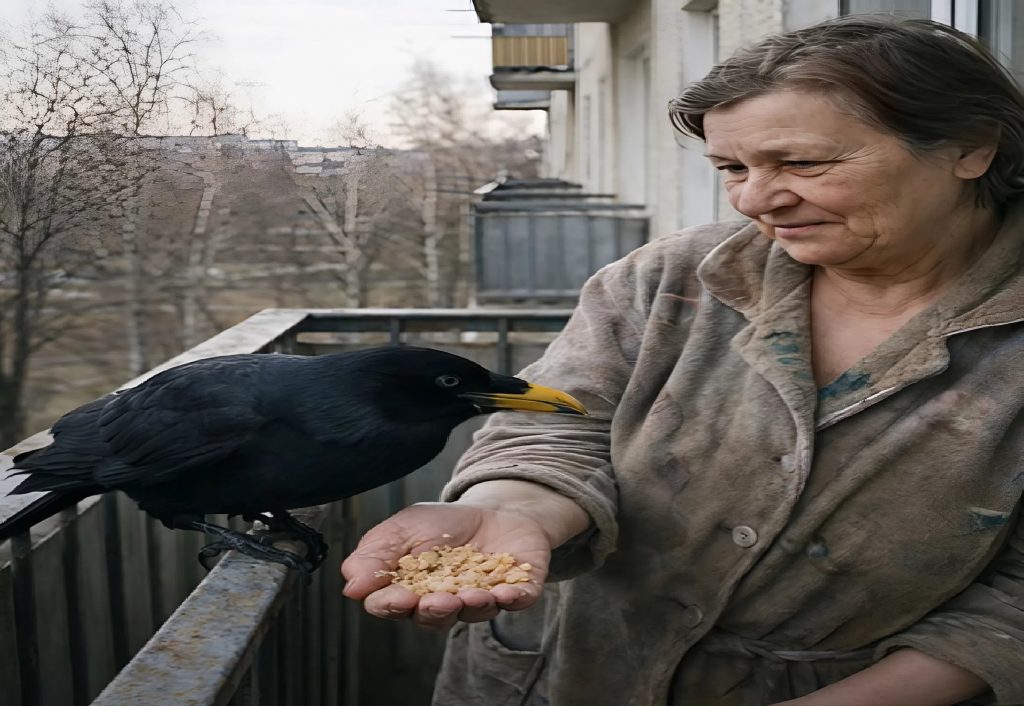
She stepped onto the balcony as usual, crumbs in her hand. She waited ten minutes. Then twenty. Other birds circled the courtyard, their calls echoing faintly, but the familiar shape was nowhere to be seen.
She returned the next day. And the day after that. Days slowly turned into a week.
Her concern gradually settled into a quiet emptiness.
Soon after, workers arrived to cut down the old birch tree in the courtyard—the very tree where the crow used to perch before flying over. They said it was unsafe. The woman stood watching as the trunk fell to the ground, feeling as though something inside her had fallen with it.
The truth reached her by chance. A neighbor mentioned that a dead crow had been found in the yard. “Probably poison,” he said casually. “People put it out for rats.”
The words struck her harder than she expected.
It was only a bird. Yet for her, it had been six years of presence. Six years of certainty that each morning, someone would arrive just for her.
The following day, she stepped onto the balcony again. This time without crumbs. She simply stood there, looking at the pale sky.
Then another crow landed on the railing. Smaller. More cautious. It kept its distance, studying her carefully.
The woman slowly went back inside, took a piece of bread, and crumbled it into her palm.
The new bird hesitated, then moved a little closer.
In that moment, she understood something quietly profound. Everything eventually disappears—trees, birds, even the closeness between people.
But what has been shared sincerely does not vanish entirely. It simply changes form.