
Discussing rising prices and the unpredictable weather. In one of the aisle seats sat a young man, about eighteen or nineteen years old. He had tattoos on his forearm and neck, light stubble on his face, and wore a dark T-shirt. He looked exhausted. He wasn’t speaking to anyone, just staring quietly ahead.
At the next stop, a woman boarded with two small children. One held tightly to her hand, the other clung to her side. There were no empty seats. She quickly scanned the bus and fixed her gaze on the young man.
She stepped toward him and said sharply,
“Excuse me, young man, give me your seat. I have two children.”
The bus gradually fell silent. Several passengers turned to watch. The young man lifted his eyes and looked at her calmly, but he did not move.
“Can’t you see I have two little kids?” she continued, louder now. “Or do you just not care?”
A few people nodded in agreement.
“Young people these days have no respect,” she added for the whole bus to hear. “Sitting there comfortably while a mother with children has to stand.”
The young man replied quietly,
“I haven’t been disrespectful.”
“Then stand up,” she interrupted. “It’s basic manners. A real man doesn’t stay seated when a mother is standing.”
The tension in the bus thickened. After a moment, the young man slowly stood up and grabbed the handrail for support. The woman moved toward the seat with a look of triumph.
“See? That wasn’t so hard,” she said with satisfaction.
But he didn’t simply step aside. Slowly, he rolled up his sleeve. Beneath the tattoos, a fresh surgical scar was clearly visible. Not an old mark, but a recent operation, still healing. A hospital wristband circled his wrist — something no one had noticed before.
“I was discharged from the hospital this morning,” he said calmly. “I had spinal surgery. The doctor told me not to stand for long.”
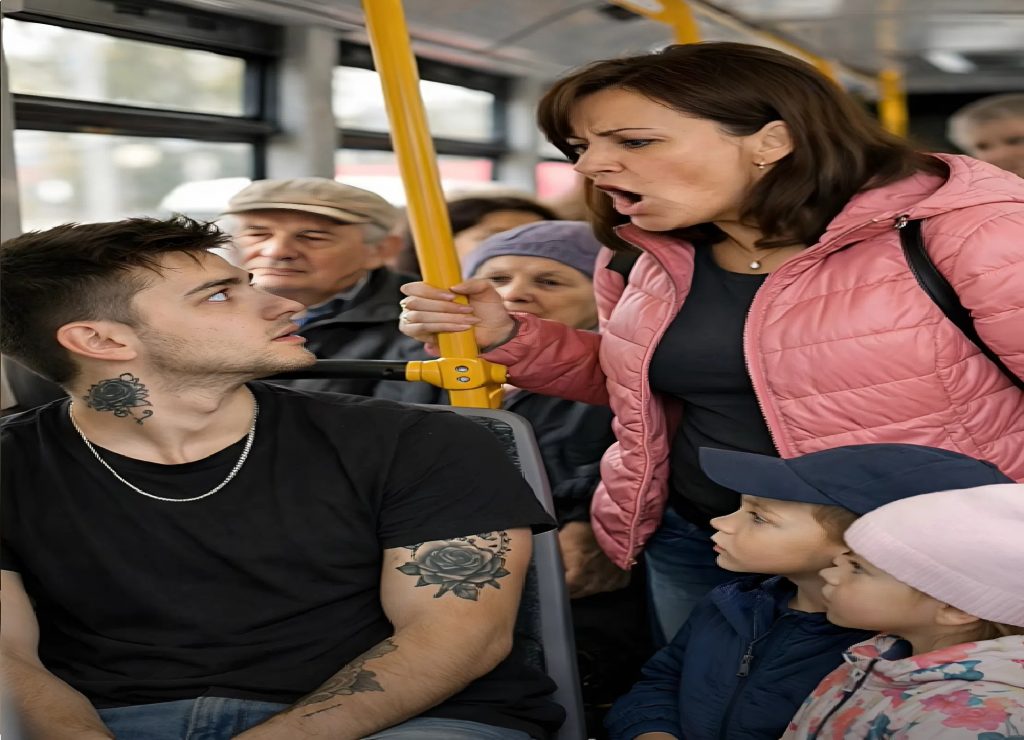
A heavy silence filled the bus. The woman froze mid-step. Her expression shifted from certainty to confusion.
“I… I couldn’t have known,” she muttered.
He nodded.
“That’s true. But you could have asked before judging.”
An elderly woman who had been watching quietly stood up.
“Please, sit down,” she said gently to him. “I can stand.”
The young man offered a faint smile.
“Thank you, but let the children sit. They’ve done nothing wrong.”
The mother sat down with her children, no longer speaking. She avoided looking at him. Around them, passengers suddenly noticed what they had ignored before — his pale face, the careful way he shifted his weight, the medication visible in his pocket.
At the next stop, an older man stood and addressed him.
“I’m getting off here. Let me walk you to a bench so you can rest.”
The young man nodded gratefully and stepped off the bus slowly.
As the doors closed and the bus drove on, the atmosphere inside had changed. It was no longer about a seat. It was about assumptions. About how easily people judge based on appearance — tattoos, stubble, a tired expression — without knowing anything about the story behind it.
That day, many passengers got off the bus thinking deeply. They realized that respect doesn’t begin with accusations. It begins with a simple question. And sometimes, true strength is shown not through raised voices, but through quiet dignity.