
A stiff envelope wrapped in clear plastic. It had been concealed with such precision that it was obvious—whoever placed it there never intended for it to be found. My heart pounded so hard it almost hurt.
I carefully pulled the package out. My hands were shaking. The plastic had been sealed with several layers of tape. This wasn’t an accident. It wasn’t something done in a moment of anger. It was deliberate. Thought out. I tore the wrapping open slowly—and inside was my son’s old passport.
I nearly dropped it.
It was the same passport that had mysteriously disappeared years ago. Back then, we searched everywhere, filed reports, asked friends and relatives. It was never recovered. And now here it was, hidden inside the blanket I had knitted for my granddaughter with my own hands.
But that wasn’t all.
Tucked between the passport pages were folded documents—copies of bank agreements, transaction records, signed authorizations. My son’s name. Large sums of money. Signatures. And among them, unmistakably, my daughter-in-law’s signature.
I had to sit down. The documents revealed that just months before his death, my son had opened a separate bank account. According to the contract, in the event of his passing, the funds were to be divided between his daughter—my granddaughter—and me, as her legal guardian until she reached adulthood.
Yet the money had been withdrawn shortly after his funeral.
Through a power of attorney.
A power of attorney issued to my daughter-in-law.
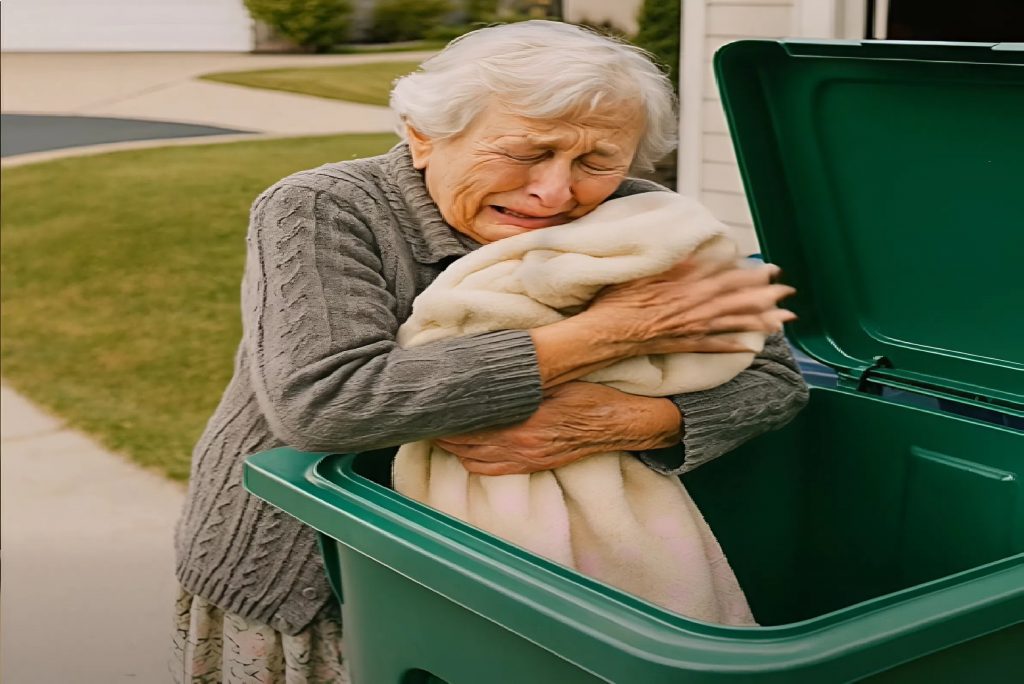
A cold wave passed through me. Why hide these papers inside the blanket? Why not destroy them? Then the answer came. Destroying official documents could raise suspicion. But hiding them inside something sentimental—and then throwing that item away—would quietly erase the evidence. She must have believed I would never search through a trash container.
She thought the blanket would disappear—and with it, the truth.
Suddenly, the small details from the past few months made sense: her distant tone, her insistence on selling the apartment, the excuses that limited my visits with my granddaughter. I had blamed it on grief. Now I saw something else.
I examined the nearly invisible seam. The thread was new, perfectly matched to the fabric. The documents hadn’t been hidden years ago—they had been placed there recently. Perhaps when she started to fear that something might surface.
I didn’t sleep that night. I kept thinking about my son’s smile when he talked about securing his daughter’s future. He wanted stability for her. Protection. And his final intention had been sewn into a blanket made with love.
The next morning, I made a decision.
I photocopied every document and contacted a lawyer I trusted. Calmly, I explained what I had found. After a long pause, he said quietly, “If these documents are authentic, this could have serious legal consequences.”
From that moment, it was no longer about money. It was about justice. About protecting my granddaughter’s future. About honoring my son’s memory.
A few days later, my daughter-in-law came to see me. She looked tense. She casually asked whether I had happened to find any “old items” she had thrown away. I looked directly into her eyes and told her the blanket was with me.
For a brief second, her face turned pale.
That was enough.
I felt no triumph. No anger. Only a steady resolve. I was no longer just a grieving mother. I was a grandmother determined to defend the truth.
Sometimes the deepest secrets are hidden in the most ordinary places—in a nearly invisible seam, inside something others consider worthless. That day, I didn’t just pull a blanket out of a trash bin.
I uncovered the truth someone had tried to bury.