The dispatcher was talking, asking questions, but her voice had turned into distant noise. One thought kept pounding through my head, louder than the sirens that were already approaching.
What have I done?
I had just called the police on a man who might have saved a child’s life.
People were gathering now, forming a loose, uneasy circle. Some whispered. Some filmed. Some stared openly, unsure what they were witnessing.
“Did he steal that baby?”
“No… he broke the window.”
“Where are the parents?”
Tom ignored all of it.
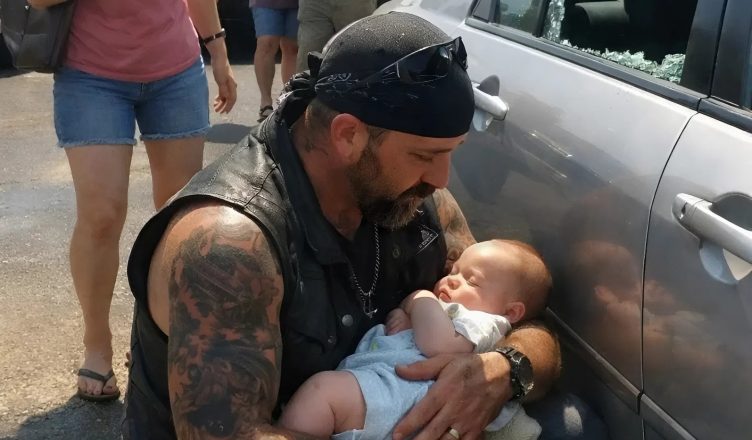
He knelt beside the shallow fountain, positioning his body so his broad back blocked the sun. The baby lay cradled against his chest, her skin frighteningly hot, her tiny fingers barely moving. His tattooed hands—hands I had immediately judged as dangerous—were gentle, precise, almost reverent as he dipped them into the water and cooled her skin.
“She’s overheating,” he said, his voice firm but controlled. “Car was locked. Too long.”
Only then did I realize how quiet the parking lot had become. The heat still pressed down, thick and suffocating, but now it felt sharper—like a reminder of how close we all were to something irreversible.
The sirens arrived fast.
A patrol car screeched to a stop, followed by an ambulance. Officers jumped out, hands already near their weapons.
“Step back. Get away from the child!” one of them shouted.
“Hands where we can see them. Now.”
Tom looked up slowly.
For a brief moment, something crossed his face—not fear, not anger, but exhaustion. The kind that comes from carrying old losses that never truly heal. He raised his hands carefully, deliberately, while still angling his body to keep the baby shaded.
“I didn’t hurt her,” he said evenly. “She was trapped inside. That car was an oven. I broke the window because there wasn’t time.”
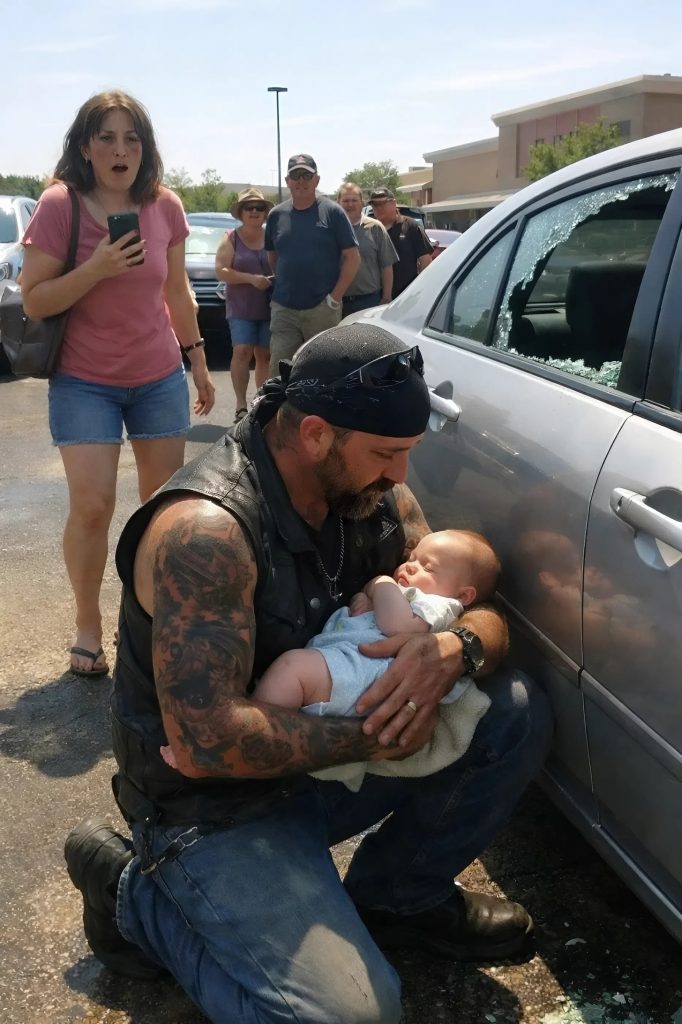
A paramedic rushed forward and gently took the baby from his arms. Everyone seemed to stop breathing at once.
“She’s alive,” the medic said after checking her pulse. “Weak, but alive. We got here in time.”
A collective gasp rippled through the crowd. Someone sobbed openly.
Then a scream tore through the air.
“My baby! Oh my God, my baby!”
A woman came running across the parking lot, her face pale, eyes wild. Shopping bags slipped from her hands as she saw the broken window, the ambulance, the child. Her knees gave out, and she collapsed onto the pavement, sobbing uncontrollably.
“I was only gone for a few minutes,” she cried. “I didn’t know it could happen so fast.”
No one yelled at her.
No one accused her.
Because the truth was already devastating enough: those minutes had almost cost a life.
Tom sat down on the curb as an officer secured his wrists in handcuffs—procedural, temporary. He didn’t protest. Didn’t argue. His leather vest was soaked with water, sweat streaking through the ink on his arms.
I forced myself to step closer, my heart pounding.
“I was the one who called,” I said quietly. “I thought…”
He looked at me for a long moment, then gave a slow nod.
“I know,” he replied. “Most people do.”
Later, I learned why he had reacted so quickly. Why he carried tools. Why he recognized the danger instantly.
Years ago, he had lost his own daughter. Heat. Neglect. A moment that couldn’t be undone.
Since then, he never walked past a child alone in a car. Never hesitated. Never waited for permission.
The baby survived.
The mother was treated for shock.
The broken glass remained scattered across the asphalt, glittering in the sun like a warning no one should ignore.
And I drove home knowing something inside me had changed forever.
Now, when I hear a motorcycle engine growl nearby, I no longer think of danger.
I think of a man who was willing to shatter a window, face handcuffs, and be judged by strangers—
just to make sure a child got another chance to breathe.