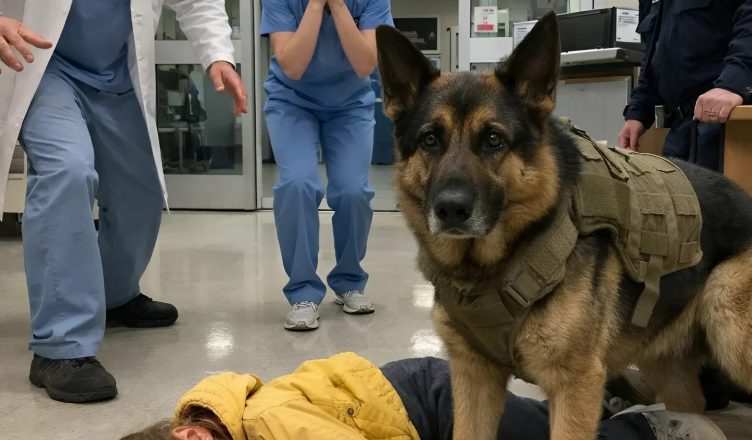
None of us did. The room felt suspended outside of time, as if the universe itself was holding its breath, watching to see whether it would allow this child to stay.
“Again,” I said hoarsely. “Shock again.”
The defibrillator whined, the child’s small body jolted, and for a terrifying heartbeat nothing happened.
Then—barely there, but unmistakable—a line trembled on the monitor.
“I’ve got a rhythm,” Allison gasped.
I leaned in, fingers at the girl’s neck, afraid to hope. Then I felt it. Weak. Erratic. Alive.
“Pulse,” I said, and the word cracked as it left my mouth.
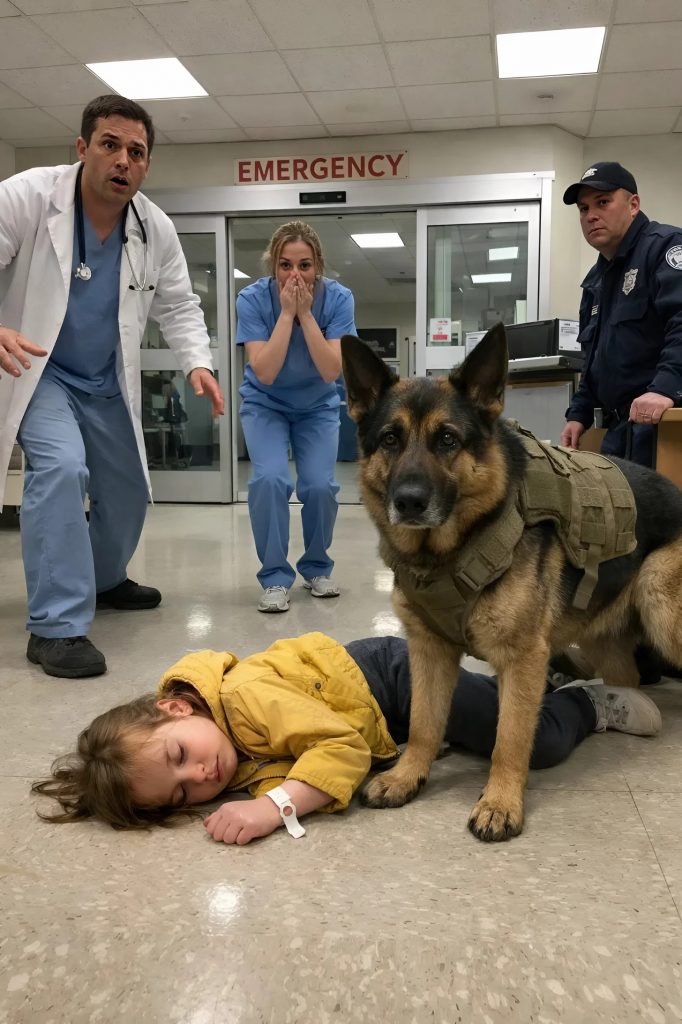
The German Shepherd lifted his head instantly. His ears twitched, his entire body tightening as if he understood the meaning before we did. He let out a soft sound—not quite a bark, not quite a whine—something between relief and exhaustion, and then his legs finally gave out. He slid down to the floor, eyes never leaving the girl.
We stabilized her just enough to move her to the pediatric ICU. As they wheeled her out, I stayed back with the dog, who was now trembling violently, the adrenaline bleeding out of him along with too much blood.
“Let me see that shoulder,” I said quietly.
He didn’t resist. Up close, the wound was worse than I’d thought—deep punctures, torn flesh. Bite marks.
“Another dog?” Allison asked.
I shook my head. “No. Human. Blunt trauma too. He was hit. Hard.”
Security finally called animal control, but I blocked the door.
“Not yet,” I said. “He’s a patient.”
I cleaned and dressed the wound as best I could. Under the grime and blood, a faded tattoo-like marking was visible beneath his fur—military ink.
“That’s a K-9,” Frank murmured. “Army, I think.”
It explained the discipline. The intelligence. The fact that he had crossed half the city, injured and bleeding, carrying a child instead of running for help himself.
When I finished, he rested his head against my knee, utterly spent.
Hours later, when the ICU called to say the girl was stable but unconscious, I allowed myself to sit down. That was when I noticed it—the thing we had all been too frantic to fully register.
The bracelet on her wrist.
It wasn’t a hospital band. It wasn’t jewelry. It was a thin, scorched strip of metal, half-hidden beneath bruises and rope burns, stamped with a number and a unit insignia I recognized instantly from my brother’s time in the service.
I felt cold.
“This child,” I said slowly, “she’s connected to the base.”
The pieces fell into place with sickening clarity.
The girl had been reported missing three days earlier. Her father, a decorated sergeant, had died overseas. Her mother’s new boyfriend had “volunteered” to take her in temporarily. Child services had dropped the ball. The report was buried. No one followed up fast enough.
Except the dog.
His name, we learned later, was Rex. He had belonged to the girl’s father. After the funeral, Rex had been deemed “unfit for reassignment” due to aggression and scheduled for euthanasia. Somehow, he escaped.
He found her.
When police arrived, they listened in stunned silence as we told the story. When they went to the address listed on the missing person report, they found evidence that made hardened detectives look away—restraints, blood, signs of prolonged abuse.
The man was arrested before sunrise.
The girl woke up two days later.
She didn’t speak at first. She just reached out, eyes scanning the room wildly until Rex was brought in on a leash. The moment she saw him, she sobbed. Real sobs. The kind that break something open inside you.
“He came,” she whispered, burying her face in his fur. “I knew he would.”
Rex thumped his tail weakly, licking her hand, alive in a way I hadn’t seen since that night.
I stood in the doorway, unable to move.
I have seen organs fail. I have watched families shatter. I have pronounced more deaths than I care to remember. But nothing—nothing—has ever rewritten my understanding of loyalty, love, and sacrifice the way that night did.
We like to believe heroes look a certain way. Uniforms. Badges. Titles.
Sometimes, they come soaked in rain, bleeding, on four legs, carrying the most precious thing they have left in the world between their teeth.
And sometimes, they arrive just in time to remind us what humanity owes to those who never stopped protecting it—even when we failed first.