
Аnd suddenly understood something with terrifying clarity: the most dangerous cruelty is never loud. It happens quietly, under soft lighting, with wine glasses raised and laughter used as camouflage.
Jason’s mother was the first to speak.
She set her glass down gently, as if she were handling something fragile — not the table, but her sense of moral superiority.
“You’re misunderstanding the situation,” she said calmly. “This is a family matter. We’re simply helping Emily learn balance.”
I turned to her, slowly.
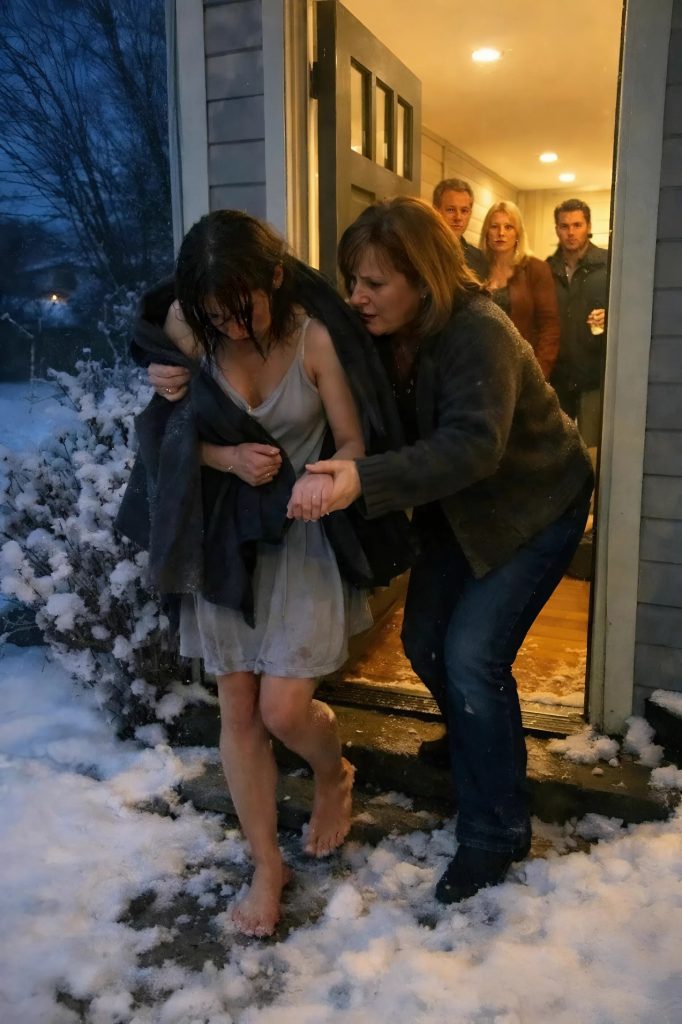
“Balance?” I repeated. “You sent my daughter barefoot into the snow in freezing weather. Is that what you call guidance?”
Jason’s father scoffed, not even attempting to hide his irritation.
“In our generation, women were taught to respect their husbands,” he said. “There’s far too much talking these days, and not enough obedience.”
That word — obedience — landed heavily in the room.
Emily’s hand tightened around mine. I felt it instantly. That reflexive fear. The instinct to brace for consequences. I had seen it in too many women’s eyes over the years — the fear of being labeled difficult, dramatic, ungrateful.
“Do you know what’s truly disturbing?” I said quietly, and it was the calmness in my voice that finally unsettled them. “You disguise cruelty as tradition. You rename humiliation as discipline. And you call silence a virtue.”
Jason stepped forward.
“You don’t understand,” he said sharply, addressing me as if I were the unreasonable one. “She agreed to this. We talked about it.”
I looked directly at him.
“She agreed because you convinced her that love has to be earned through suffering,” I said. “Because little by little, you erased her boundaries until she could no longer tell the difference between choice and survival.”
Emily inhaled sharply. I felt it — not physically, but somewhere deeper. As if my words had found the first crack in a wall built over years.
“That’s not true,” Jason snapped. “No one forced her.”
I turned to my daughter and asked softly,
“Emily, if you had refused to go outside tonight… what would have happened?”
She stayed silent for too long.
Then she whispered,
“He would’ve said I was destroying the family.”
“That without him, I was nothing.”
“That if I left, everyone would know how ungrateful I am.”
The silence that followed was thick and suffocating.
I straightened and said the sentence I knew would shatter their rules permanently:
“My daughter will no longer stay silent to protect your comfort.”
I turned to Emily.
“You’re coming with me.”
“You can’t just take her,” Jason’s mother protested. “She’s an adult. This is her home.”
I met her gaze without flinching.
“A home is where you are not punished for speaking.”
“A home is where fear isn’t used as correction.”
“A home is where respect does not require humiliation.”
I pulled a blanket from the back of a chair, wrapped it around Emily, and helped her put on my boots right there in the living room. No one stopped me. No one dared.
As we reached the door, Jason called after us,
“You’re ruining her life.”
I turned back.
“No,” I said. “I’m giving it back to her.”
Outside, the snow was still falling. But it no longer felt cruel.
In the car, Emily stared out the window for a long time before speaking.
“I thought this was love,” she said quietly.
“I thought enduring it meant I was trying hard enough.”
I took her hand.
“Love does not require you to disappear,” I said. “It does not demand pain as proof of loyalty.”
She cried then — truly cried — not from hurt, but from release.
Later, I heard that Jason told people I had “turned her against the family.”
That I had “interfered.”
That I had “taken away their chance.”
The truth was simpler — and far more uncomfortable.
Their control only worked while she stayed silent.
That night, the silence ended.
And if anyone asks whether I regret the words I spoke, my answer is honest:
No.
Because sometimes, saving someone doesn’t require permission.
It requires taking their hand and walking them out of the cold — even if everyone inside the house stands against you.