
I believed in his calm voice, his reasonableness, his ability to sound like the most stable man in any room. He never raised his hand. He never shouted. He didn’t need to. He was far more precise than that.
He knew how to explain things away.
My fears were “hormones.”
My doubts were “overthinking.”
My tears were “emotional manipulation.”
When I told him I was pregnant, he smiled. Said all the right things. Promised we were a team. And then, slowly, he began to disappear—not physically, but emotionally. He stopped asking about doctor’s appointments. He sighed when I was tired. He rolled his eyes when I needed reassurance.
Then came the control.
Questions disguised as concern.
Comments framed as jokes.
Warnings wrapped in logic.
By the time I suggested living separately for a while, I barely recognized myself. And that was when he leaned in close enough that I could smell his cologne and whispered, calmly and clearly:
“You’re going to regret this.”
I didn’t understand then how literal he meant it.
In the courtroom, I told my story without raising my voice. Without crying. I spoke like someone reading a report, because I knew emotion could be used against me. Courts don’t trust tears. They trust documentation.
Nathan sat across from me, arms crossed, occasionally shaking his head as if I were inventing everything. He smirked once. He never once looked at my stomach.
When the judge asked him directly,
“Did you send these messages?”
he didn’t hesitate.
“They’re taken out of context,” he said smoothly. “She’s emotionally unstable.”
The words landed exactly where he intended. They always had.
But this time, they didn’t work.
The judge lowered his glasses and began reviewing the evidence—screenshots, timelines, medical notes, witness statements. He didn’t rush. The silence stretched. Nathan’s confidence began to fracture in small, visible ways.
“Mr. Cole,” the judge finally said, “a threat doesn’t always sound like shouting. Sometimes it sounds like certainty. Like a promise.”
The room went still.
“I am granting the temporary protection order,” he continued. “No contact. Any attempt to intimidate or interfere will be considered a direct violation of this court’s ruling.”
Nathan stood up abruptly.
“This is ridiculous,” he snapped. “She’s destroying my life.”
The judge didn’t raise his voice. He didn’t need to.
“Sit down,” he said firmly. “You’ve done enough.”
That was the moment everything shifted.
Not because I was pregnant.
Not because I looked fragile.
But because the truth, once allowed into the room, is impossible to control.
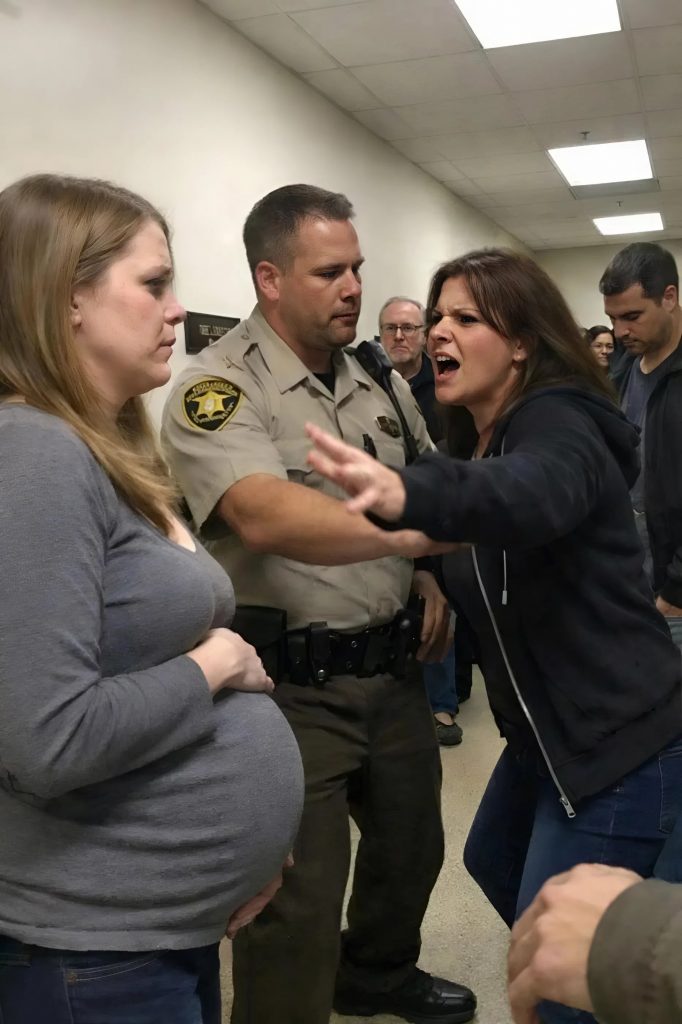
When the hearing ended, I walked into the hallway feeling hollowed out. My legs trembled. My hands shook. But beneath the exhaustion, there was something unfamiliar and steady growing inside me.
Relief.
Madison was waiting near the exit. She didn’t shout this time. She didn’t smile. She just watched me, and for the first time, there was no triumph in her eyes—only understanding. Maybe even fear.
I walked past her without a word.
In the parking lot, I stopped, placed both hands over my stomach, and let myself breathe.
“We’re going to be okay,” I whispered.
Because that day taught me something I will never forget:
The most dangerous moment isn’t always when someone attacks you.
Sometimes, it’s the moment you stop staying silent—and take your power back.