
“Yes,” I managed, tightening my grip on the doorframe. “What happened? Is she okay?”
The officer shifted his weight as if the next sentence physically hurt to deliver.
“She passed away last night.”
For a few seconds, I was sure I misheard. Words distorted, blending with the ringing in my ears. Sophie peeked from behind my leg, rubbing her sleepy eyes.
“What do you mean passed away?” I whispered. “She was just working. She was fine.”
He nodded toward the small brown box in his hands. “Her name was Martha Hayes. Sixty-seven years old. Heart failure. The store manager identified her after closing. Found your address in her locker.”
My mouth went dry. The entire world seemed to shrink to the size of that cardboard box.
“Why… why would she have my address?”
The officer slowly held the box out to me.
“She wrote a note,” he said. “Everything inside belongs to you.”
I took the box because my hands didn’t know what else to do. The officer tipped his hat in a gesture of sympathy and walked away, the siren cutting through the cold morning air as Sophie clung tighter to my leg.
We shut the door. The house felt different now, colder somehow. I set the box on the kitchen table. It was light, weightless, the kind of box that didn’t look capable of holding anything important, yet something about it terrified me.
Sophie climbed into a chair. “Who was she, Mommy?”
I swallowed. “Someone who needed kindness.”
The wind howled outside, rattling the windows. I opened the box.
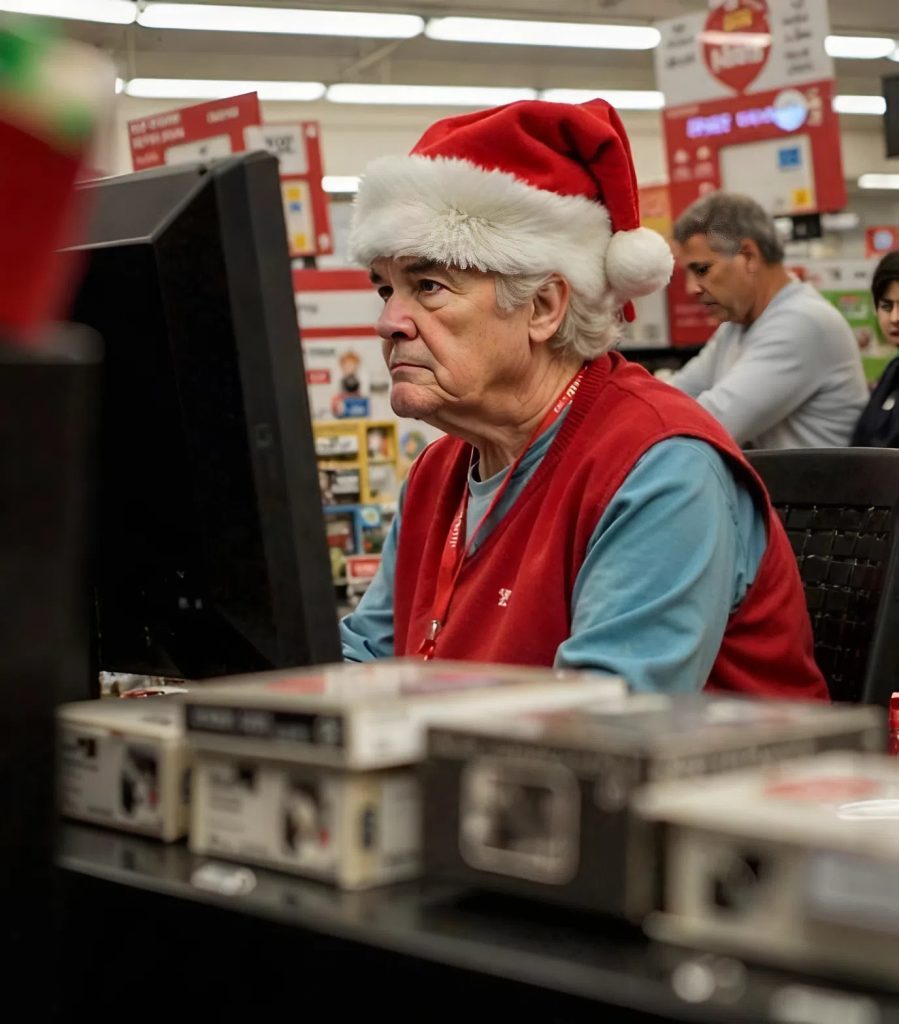
Inside, neatly folded, were a faded red scarf, a crumpled name badge that read “MARTHA,” a worn photograph of a smiling man in uniform, an unopened Christmas card, and a small envelope with my name written in shaky cursive.
My stomach tightened. I opened the envelope.
Inside was a handwritten letter dated the morning of Christmas Eve. The edges trembled between my fingers as I read it aloud in my mind.
“Dear kind stranger,
I do not know your name, but you reminded me that people can still be gentle. This morning I woke up and thought about my William. He used to tell me that the worst part of growing old was not the aches or the wrinkles, but becoming invisible. He passed three years ago today. Christmas Eve. I stopped attending family gatherings after that. Everyone moved on. I did not.
Tonight, a woman yelled at me for being slow. She sounded like everyone else who forgot I exist. Then you appeared, and for a moment, I felt seen again. I promised myself I would go to dinner with you and your daughter. I even bought a pie on my break. But on the way home, my heart did what hearts often do after being too lonely for too long.
If you are reading this, I did not make it. Do not feel sad for me. Feel proud that your kindness was the last thing I heard on this earth. It was enough. You were enough.”
By the time I reached the last word, my vision blurred. Sophie’s small hand rested on mine.
“What does it say?” she asked.
“It says… we made her feel special.”
Sophie nodded slowly, as though understanding more than any seven-year-old should. “Can we still set a place for her at the table tonight?”
My throat closed. “Yes,” I said. “We can.”
We opened the Christmas card next. Inside was a note scribbled on the left flap.
“For the family that still believes in Santa.”
There was no signature, just a tiny drawing of a star.
After breakfast, while Sophie played with her dolls, I unwrapped the photograph. A younger Martha stood beside the smiling uniformed man. Behind them, Christmas lights blurred like falling stars. On the back, in faded ink, were the words: “William, Christmas 1984.”
I traced the handwriting with my thumb. At that moment, guilt washed over me. I had invited her to dinner like it was nothing, like it didn’t carry the weight of three years of grief. I did not call to check. I did not think to worry.
But the more I read her letter, the more I understood: she didn’t want to be saved. She just wanted to feel human.
That night, I set an extra plate at the table. Sophie wrote a name card, carefully printing the letters: M-A-R-T-H-A. She placed it beside the plate with a seriousness only children possess.
We ate in silence for the first few minutes. Somehow, the quiet felt respectful rather than uncomfortable. Sophie finally broke it.
“Do you think she saw us?”
I nodded. “I think she did.”
After dinner, as I collected the plates, I noticed something taped under Martha’s name badge in the box. A folded receipt. The timestamp read 6:57 PM, Christmas Eve. Three minutes after I left the supermarket. A pumpkin pie.
Sophie saw me holding it and asked to see it too. She stared at the timestamp for a long time.
“She really was coming,” she whispered. “She really tried.”
We both stared at the receipt until the edges curled slightly from our fingertips.