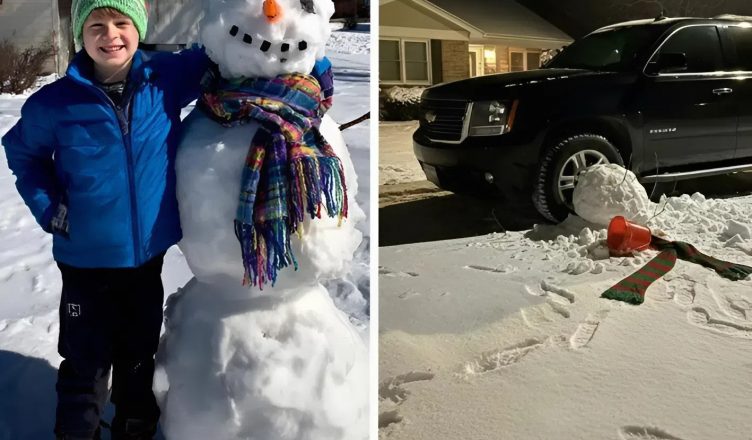
Outside, Mr. Streeter was standing next to his car, frozen in shock. His bumper was pressed against something white—except this time, it wasn’t a snowman.
At first glance, it looked like a pile of snow. But then I saw the small wooden stakes poking out, the line of neon flags from my husband’s tool shed, and a perfectly square patch of packed ice surrounded by bright orange cones. It looked like a miniature construction zone. Nick had transformed the lawn into something that demanded attention, and it had worked. The moment the bumper hit the hardened ice block hidden under loose snow, the car jerked and the front grille snapped inward.
“WHAT ON EARTH IS THIS?!” Mr. Streeter yelled, pointing at the lawn. “Did you set THIS up?!”
Nick opened the front door before I could stop him, boots half-on, coat unzipped, cheeks burning from cold and excitement.
“It’s a border,” he announced proudly. “For my snowman.”
Mr. Streeter stared at him as if the world had turned upside down. “A bord— You can’t just— You—” He sputtered like an overworked engine.
Nick calmly walked to the driveway edge and pointed at a handmade sign hammered into the soil. In big block letters, written in permanent marker, it read:
DO NOT CROSS. PRIVATE PROPERTY. SNOWMAN LIVES HERE.
Below it, Nick had drawn a stick-figure snowman with a terrified face and X’s for eyes.
I came running out, pulling Nick behind me, feeling my face burn with embarrassment and fear of what was coming next.
“Mr. Streeter, I am so sorry, I didn’t—”
“No,” he snapped. “I want to hear what THIS is about.” He pointed at Nick again.
Nick didn’t even flinch. He lifted his chin the way children do when they’ve decided they’re done being small.
“You keep running over my snowmen,” he said. His voice didn’t shake, even though his breath puffed out in nervous little clouds. “I asked you to stop. Mom asked you to stop. But you said it’s just snow. Well… your car just hit ‘just ice.’ Now you know how it feels.”
The silence that followed was the kind that doesn’t need winter air to be cold.
I waited for shouting, threats, maybe even calls to insurance, lawyers, police — something ugly. This was a grown man, furious, humiliated, and staring down an eight-year-old who had just taught him the definition of a boundary the hard way.
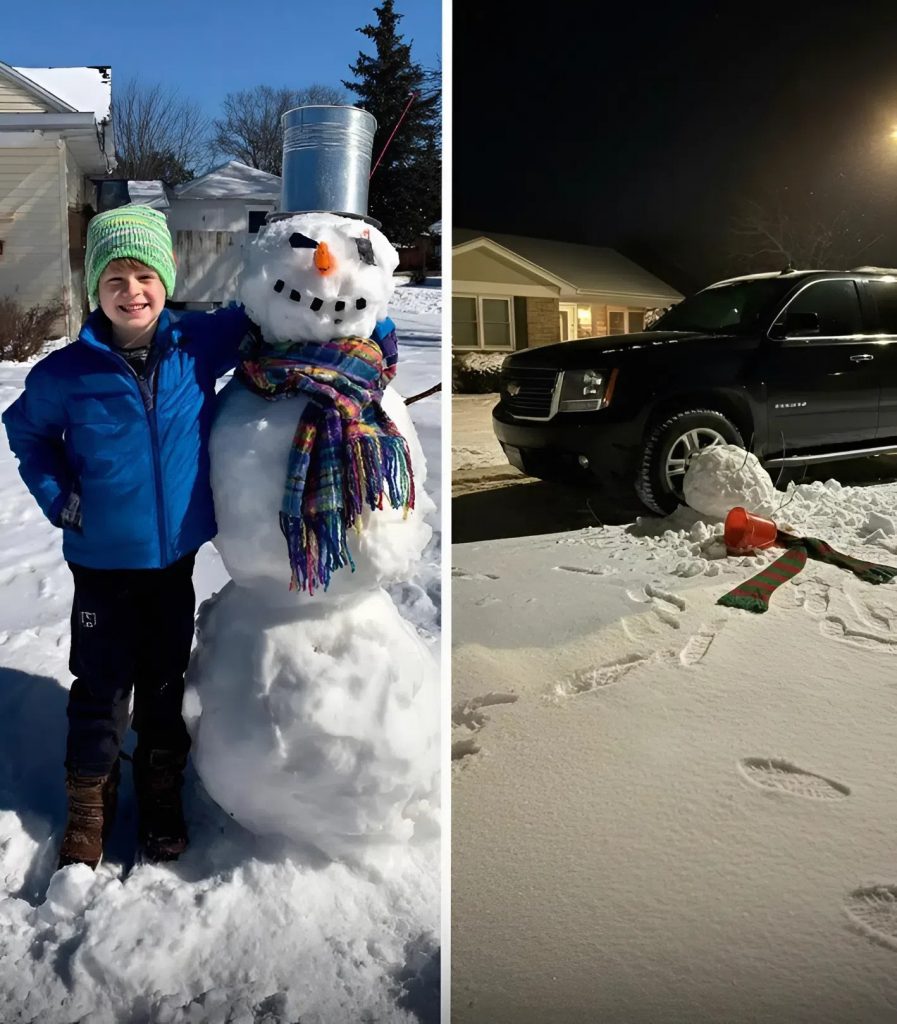
But then something unexpected happened.
Mr. Streeter swallowed, blinked a few times, and leaned down to Nick’s eye level.
“You built all this?”
Nick nodded.
“You dragged cones… stakes… ice… and put signs up… by yourself?”
“No,” Nick said calmly. “Mom said I’m not allowed to use stakes. So I asked Mr. Dawson across the street to hammer them in for me.”
Across the road, old Mr. Dawson lifted a mittened hand in triumph, the kind of wave that said he’d been waiting months for someone to challenge Streeter’s tire-happy habits.
“And,” Nick continued, pointing at the square of ice, “that’s a freezer block. I made it in old Tupperware. I read online that ice is harder than snow. So snowmen need defense.”
The absurdity was too much. I saw the anger leaving Mr. Streeter’s face as reality sank in: he’d been outmaneuvered by a child with a science experiment.
Then Nick delivered the finishing blow.
“Snowmen can’t move. They can’t run away from cars. So someone has to protect them. That’s a rule.”
“A rule?” Mr. Streeter muttered, baffled.
“It’s called being a grown-up,” Nick said.
It was like watching a clean punch land in slow motion. There was no malice, just truth — sharp, simple, and humiliating.
For the first time since we moved into that house, Mr. Streeter didn’t have a comeback.
He straightened, glanced at his slightly bent grille, rubbed his forehead, and exhaled a long, defeated breath.
“I… never thought about it that way,” he muttered. “I really didn’t think it mattered.”
“It matters to me,” Nick said.
Another silence. No wind. No cars. Just winter breathing around us.
Finally, Streeter cleared his throat. “Alright,” he said, looking at Nick instead of me. “I’m sorry. For running them over. I’ll… stay in my lane from now on.”
“And maybe slow down?” Nick added.
Streeter nodded again. “Yeah. Slow down.”
He stepped back into his car, backed carefully — very carefully — into his driveway, and parked. No tires touched our grass. No crunching snow. No careless shortcuts.
Nick watched him go, satisfied in a way I’d never seen. Not vengeful. Not smug. Just relieved that someone finally understood.
That night, after dinner, as I tucked him into bed, I asked the question that had been spinning in my head since dusk.
“Why did you do all that? The signs, the ice, the cones…”
Nick shrugged, pulling the blanket up to his chin.
“Dad says borders matter. Not just for land. For people. If you don’t show them where the line is, they drive over you. I didn’t want to get driven over anymore.”