
Maybe a delivery gone to the wrong address. Instead, a woman stood on his porch. She was not shivering, not desperate, not lost. In fact, she looked like someone who came straight from a heated car and a different social circle: tailored coat, carefully styled hair, and a look of calculated confidence.
“I’m Lily’s mother,” she announced without a hint of warmth.
“And I’m here to take my daughter back.”
Daniel’s fingers tightened on the doorframe. His pulse kicked up. Fifteen years of memories flashed through his head so vividly they almost felt physical — the tiny girl left on his doorstep on a bitter winter night, wrapped in a jacket too thin for the season; first school days with oversized backpacks and missing teeth; nights spent with cold compresses and thermometers; loud teenage arguments followed by quiet apologies; graduation photos pinned to the bulletin board; and that childish drawing on the fridge that had lived there for more than a decade — two stick figures holding hands, and underneath, shaky letters spelling: “my dad.”
“You abandoned her here,” Daniel finally said.
“She was four. She was freezing, terrified, and completely alone. She didn’t even have a name tag. You never came back.”
The woman blinked, but her expression stayed flat — no remorse, no sadness, no reflection.
“It was a complicated time,” she replied dryly. “But that was then. Now I have everything in order — resources, stability, legal support. It’s time for Lily to return.”
The word “return” hit Daniel like a slap. He remembered all too well that nothing had been “in order” for him back then. He hadn’t had a wife, didn’t have parental training, didn’t have savings or even a plan. What he had was a freezing little girl staring at him with terrified eyes, and a choice — and he made it.
“Lily doesn’t have to see you,” Daniel said, controlling his voice. “And you don’t get to just—”
“I’m not asking,” the woman cut in. “I have documents. Adoption can be challenged under certain circumstances. My attorney is already handling it. You’re a police officer — I assume you understand how the legal system works.”
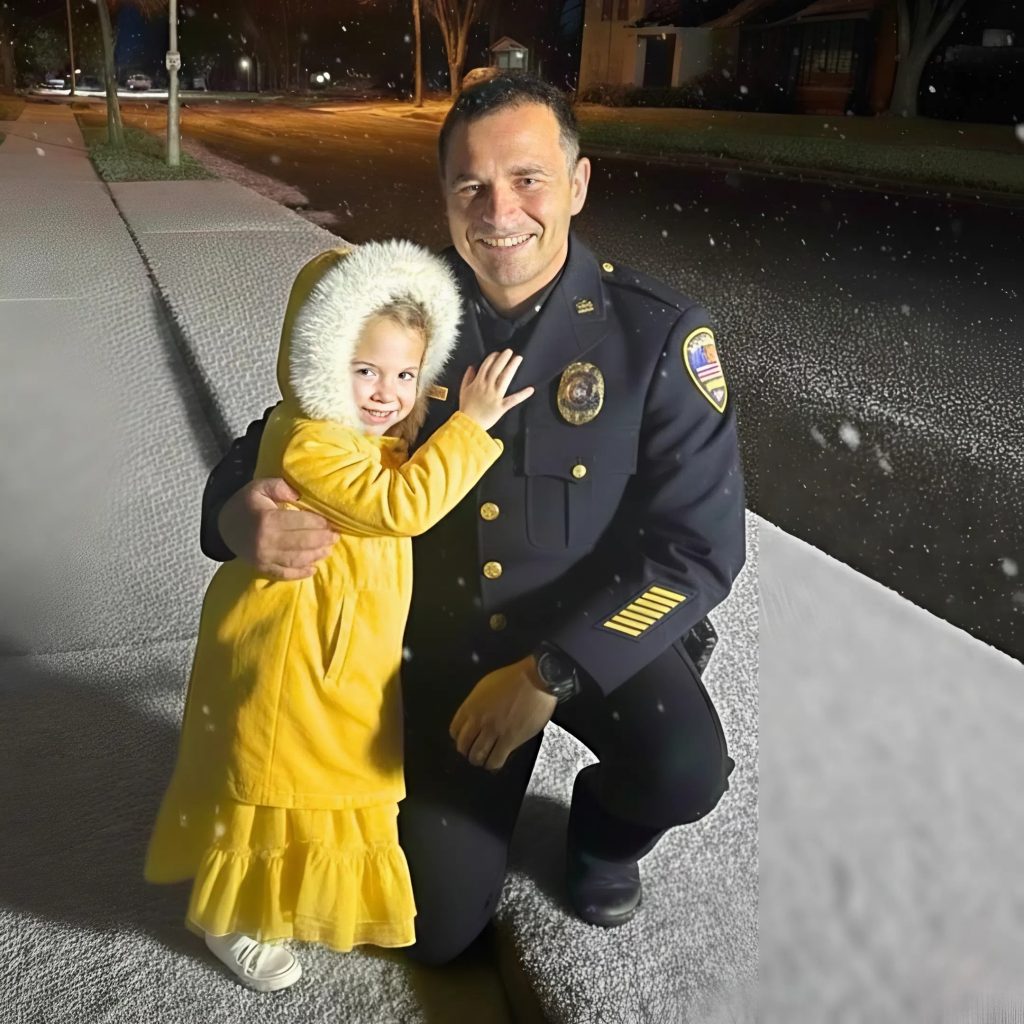
Before Daniel could speak again, footsteps sounded from the staircase. Lily descended slowly, wearing a loose sweater she always used for late-night studying. Her hair was tied up in a messy knot, her expression tense — not dramatic, not hysterical, just quietly shaken in a way that hurt more than tears.
The woman scanned her, and Daniel hated the way she did it — not as a mother seeing her child after years, but as someone inspecting an asset.
“You’ve grown,” she said, as if commenting on shoes.
“Better than I expected.”
Daniel almost stepped forward right then, but Lily’s voice came first — soft, uneven:
“Why? …Why did you leave me here?”
The woman exhaled, annoyed by the question.
“I was young. Your father left, I had no money, no support. Someone offered a temporary solution and I took it. Now things are different. You belong with me.”
“No,” Daniel said.
The woman gave a short, empty laugh.
“You actually think you have a say? Adoption isn’t permanent if certain criteria are met. And I have a family, a name, financial assets. Lily has a place in that structure.”
Lily stared at her.
“A place? What kind of place?”
Finally, the woman’s mask slipped just enough to reveal her intention.
“My mother is dying. Her estate is significant, but it can only pass to a direct descendant. With you there, everything transfers properly. You would receive money, and we preserve the family fortune. Everyone wins.”
There was nothing maternal in her tone. No guilt, no sorrow. Just a transaction.
Lily stood still for a long moment. Then her expression shifted — not to anger, but to clarity.
“So I’m not a child,” she said quietly. “I’m a requirement.”
“Don’t be dramatic,” the woman snapped. “I’ll return tomorrow with my lawyer. Be ready.”
Daniel inhaled sharply — ready to talk about laws and rights and guardianship — but Lily lifted her hand, stopping him. She walked closer to the woman and spoke in a steady, low voice:
“This man raised me. He took me to the doctor when I was sick. He waited outside my school in the rain. He listened when I cried, and when I was scared, and when I didn’t know who I was. He taught me how to ride a bike and how to fix burnt toast. He was there for every important moment. He is my family.”
The woman narrowed her eyes.
“You’re a child, you don’t—”
“I’m not a child anymore,” Lily interrupted. “And I choose to stay here. Not because of money. Because this is home.”
Silence followed — thick and heavy. The woman’s jaw tightened. Then she turned sharply, walked out without another word, and the door clicked behind her. A car door slammed a moment later, and then everything was still.