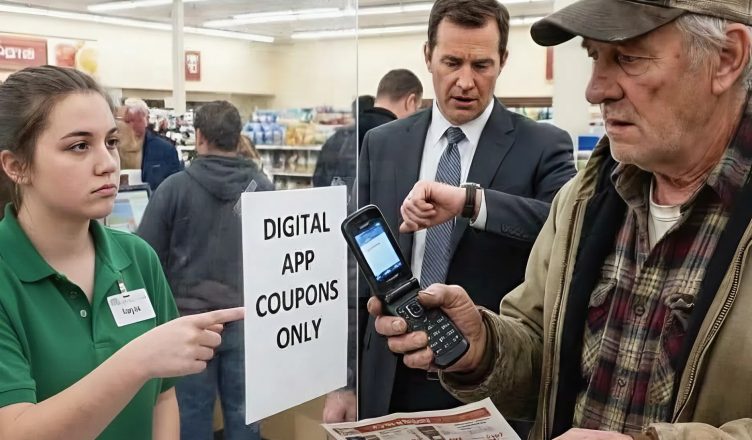
When he said that, it hit me harder than any overtime shift at the plant ever has. And here’s the part that nobody wants to talk about—because it’s ugly, and uncomfortable, and cuts too close to the bone:
We are building a society that quietly deletes people.
Not with guns.
Not with bombs.
But with QR codes, “digital-only deals,” and systems that demand compliance with technology over simple human dignity.
Frank climbed into that truck like a man climbing into a coffin—slow, stiff, wincing just a little. The truck coughed to life with the kind of engine note that belonged on a VHS tape about American steel and heartland grit. He gave me a nod, like a salute between forgotten soldiers, then rolled out of the lot.
I stood there for a minute, the glow from the Mega-Mart automatic doors washing over me while car after car streamed past. The world kept moving, like nothing had happened. But something had happened, and if you were paying attention, it was horrifying.
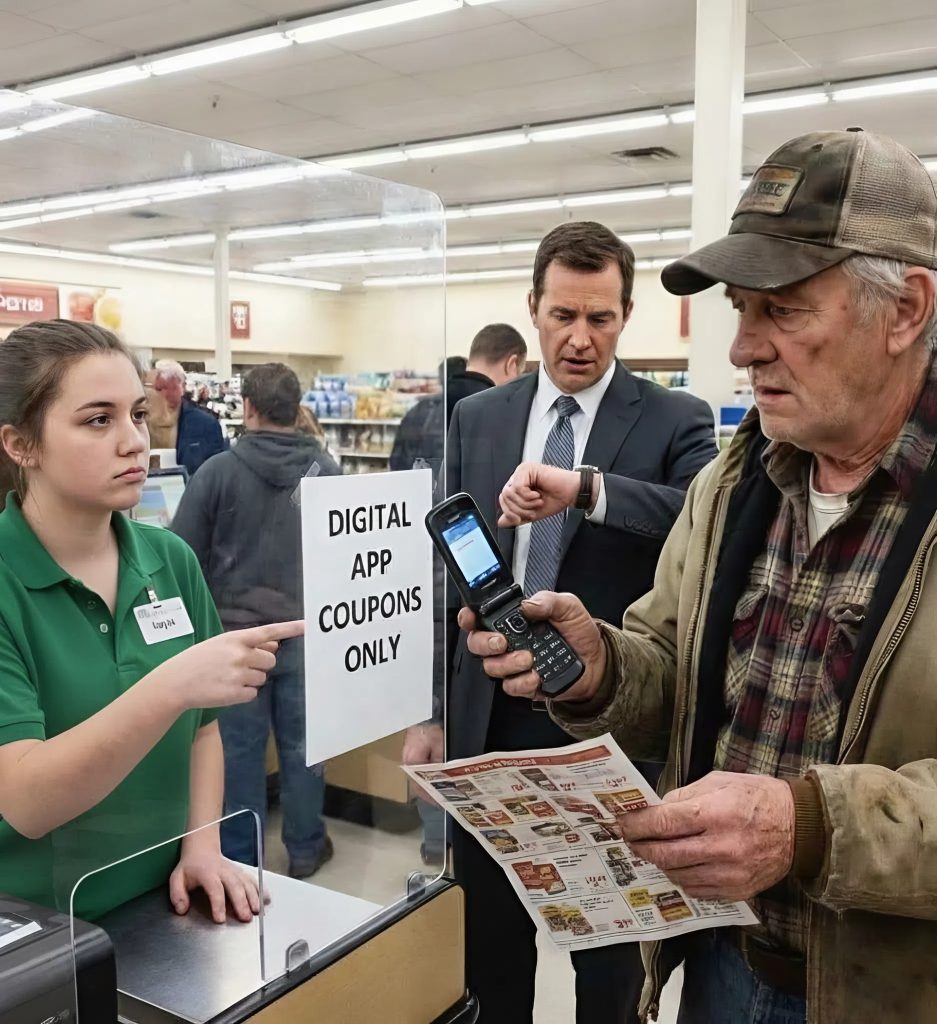
Inside that building was a microcosm of a quiet war—the war on the analog human.
And here’s the shocking part:
Frank is not alone.
I’ve seen it in hospitals where the elderly can’t check in without a tablet that glitches.
I’ve seen it in banks where tellers pressure old folks to “just download the app.”
I’ve seen it at airports, cafeterias, even laundromats—where a person without a smartphone is treated like a trespasser from a dead civilization.
We built a world where:
Cash is suspicious,
Questions slow down the line,
And human interaction is “inconvenient.”
But what terrifies me most isn’t the tech. It’s the attitude.
That cashier didn’t hate Frank. She just didn’t care.
The system told her “no app = no deal,” and she followed it. Mechanical. Detached. Popping gum between commands like a bored robot wearing eyeliner.
And Suit Guy? He wasn’t the villain either. He was just infected with a modern disease:
Impatience disguised as importance.
We are producing people who believe waiting thirty extra seconds is oppression, while watching an old man sacrifice his dignity for dog food isn’t worth a blink.
Tell me—what kind of society is that?
I drove home that night with my pizza and beer in the passenger seat, but the taste of both was ruined. I kept replaying Frank’s voice in my head:
“Feels like the world’s telling me I don’t belong anymore.”
And the terrifying truth is—he’s right.
There’s an entire generation being shoved out of the world they built with their hands.
Let’s talk about Frank for a second—
This was a man whose fingers probably twisted bolts on machinery older than the cashier’s parents. A man who knew the sound of a misfiring carburetor by ear. A man who could read the weather off a horizon, not a weather app. Guys like him built factories, bridges, engines, family homes, entire towns.
And now?
A teenage cashier with acrylic nails has more power over his daily life than he does.
Because she has the app.
Because the system speaks her language, not his.
Because the world decided that having a smartphone is more important than having strength, grit, or experience.
If that doesn’t send a chill down your spine, then you’re not paying attention.
When I got home, I sat on the edge of my bed and stared at my phone. That glowing rectangle that listens, tracks, measures, predicts, manipulates… the same device that unlocked a 14-dollar discount for a stranger. The same device that humiliated him first.
And then it hit me like a gut punch:
This wasn’t a story about eggs.
It wasn’t about coupons, or sale ads, or checkout lines.
It was about power.
Not political power. Not money.
But access. Digital access. App access. Account access. Tech access.
In 2026, access is survival.
You want cheaper food? App.
You want healthcare? Portal.
You want to board a plane? Digital ID.
You want to apply for work? Online form.
You want to talk to customer support? Chatbot.
You want to exist in the economy? Smartphone.
Try existing without it—you’ll learn very quickly that the world doesn’t just inconvenience you…
It amputates you.
The next day I went back to Mega-Mart for dog food for my own mutt. I saw the same cashier, same register, same sign about digital deals. But this time I noticed something else—an older couple in their seventies at self-checkout, defeated, waving over an attendant because the machine froze.
Behind them, some college kid rolled his eyes and mouthed “Jesus Christ” to his girlfriend.
And I realized:
The humiliation isn’t exceptional.
It’s normal.
We’ve normalized shaming people for aging.
We’ve normalized penalizing people for not upgrading.
We’ve normalized treating human beings like glitches in a system built for convenience over compassion.
So here’s the big, ugly, shocking truth: