People woke with roosters, fed their animals, repaired fences, and returned to their homes when the sun went down. Only one house kept its lights on until late at night — the home of an elderly woman named Anna. She lived alone with an old cat and never complained about the silence surrounding her.
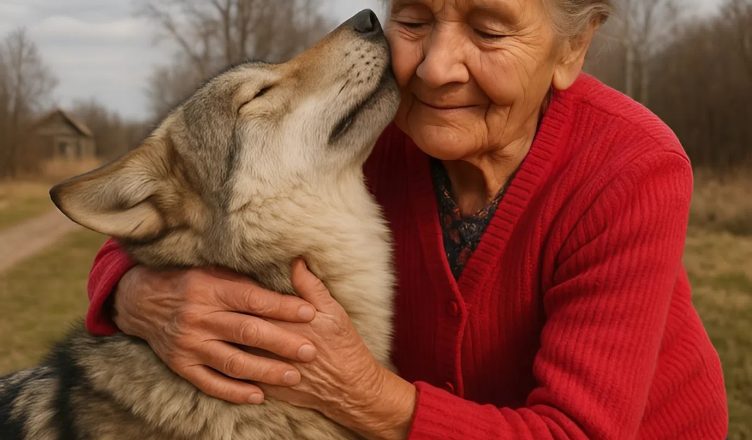
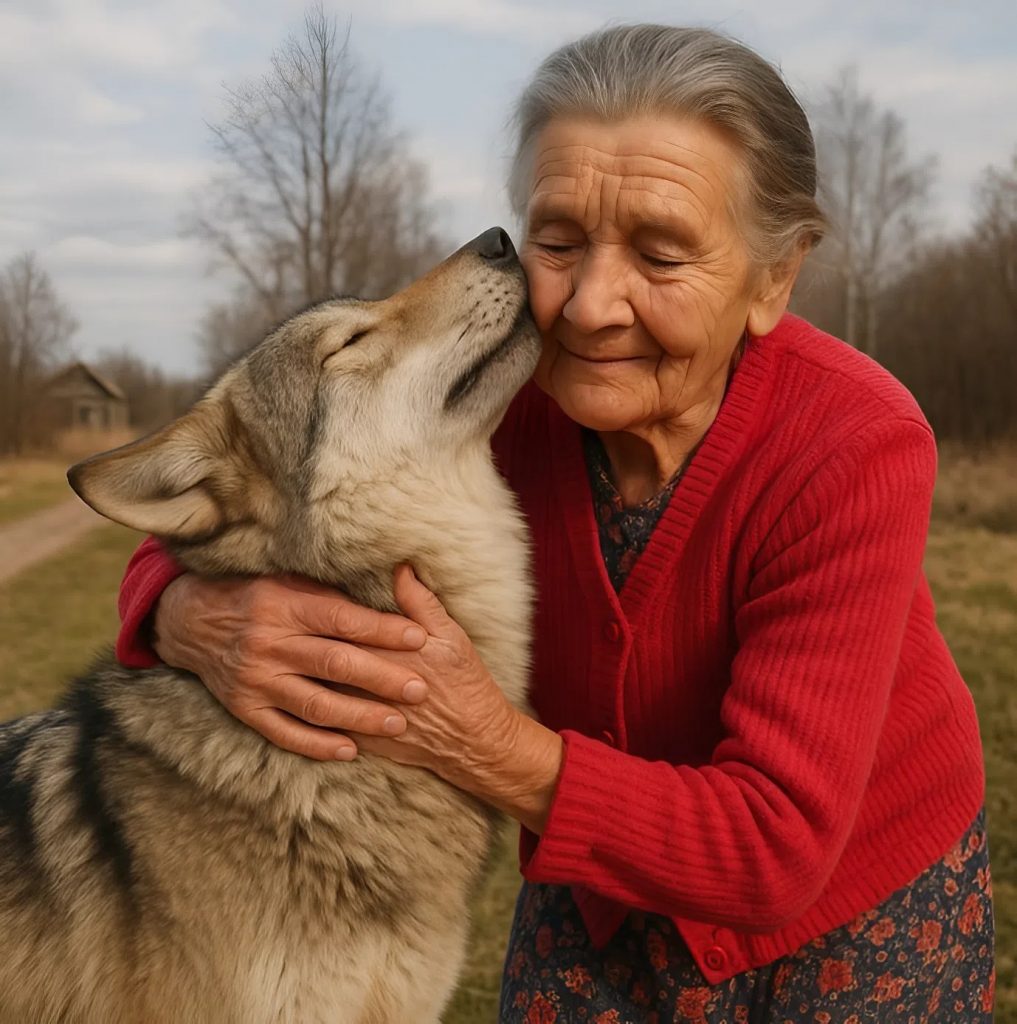
One early morning, when the frost still clung to the ground and smoke curled lazily from chimneys, Anna found a small trembling bundle at her gate. It was a pup — thin, shivering, and staring at her with enormous, desperate eyes. Without hesitation, Anna picked up the tiny creature, brought it inside, fed it, and warmed it by the stove. She named him simply: Wolf.
The pup grew with astonishing speed. He was sharper than ordinary dogs, perceptive, almost eerily aware of everything around him. He rarely barked; instead, he emitted a low growl when something bothered him. Neighbors joked that he was “too serious for a normal dog,” but Anna only smiled and stroked his head.
“He is wise,” she said softly, “just a little different.”
Wolf guarded the yard like a silent soldier. No stranger could even approach the gate without facing his piercing stare. In winter, when blizzards howled outside the window, Wolf slept by the oven, his head resting against Anna’s knee.
Then, rumors spread across the region — two men had escaped from a nearby prison. Authorities urged everyone to lock their homes and windows. Doors creaked under new heavy bolts, and the streets became empty much earlier than usual. But Anna, living on the outskirts and rarely visiting the village center, knew nothing of it.
One night, when the cold was sharp enough to cut through the thickest wood, Wolf suddenly rose from his spot by the fire. His entire body stiffened. His ears tilted forward. The fur along his spine lifted in a bristling ridge, and a deep, ominous growl rolled from his chest. Anna looked at him in confusion.
“What’s wrong, boy?” she whispered.
There was no answer, of course — only the heavy silence of a winter night.
But outside, near the edge of the forest, two figures were moving through snow and shadows — ragged, breathless, and starving. Their clothes were torn, stained, and their eyes burned with the cruel instinct of cornered wild animals. They knew exactly where they were going: to the house of a woman rumored to live alone.
They did not expect resistance.
Anna woke to the sound of the door scraping. Before she could rise fully from her bed, the door burst open and heavy boots pounded across the floor. One of the men seized her by the arm and shoved her against the wall. Fear crashed over her so violently she could barely breathe. She was certain she was moments away from death.
What happened next was not something any rational person would predict.
From the darkness came a guttural roar — raw, primal, and terrifying. Wolf launched himself forward with blinding speed. He collided with the man holding Anna, and the room erupted into chaos. Anna heard a scream, followed by the sickening crunch of bone. The second man yanked out a knife, but Wolf turned on him with unnatural precision. The blade never reached its target. Wolf’s teeth sank into the man’s wrist, and the knife clattered across the floor.
The struggle was violent — too violent to resemble a dog defending its owner. This was something older, deeper, and far less domesticated. Anna watched, frozen, as Wolf tackled the second man to the floor and pinned him there, his jaws inches from the man’s throat.
Moments later, a beam of light cut through the darkness — a flashlight. A young officer from the village stormed into the house. He had been tracking the fugitives for hours.
“Get back!” he shouted instinctively. “Move away!”
But Wolf did not budge. His eyes burned with a wild intensity that frightened even the armed officer. Only after one of the criminals passed out did Wolf finally release him and step back. Then, as if nothing extraordinary had happened, he walked to Anna and rested his head gently on her lap, panting heavily.
The criminals were arrested on the spot. Anna was taken to the local hospital, shaken and pale. The doctors later told her that the stress alone could have stopped her heart. Had Wolf not intervened, she might not have survived the night.
When Anna returned home the following morning, there were officials waiting. They examined tracks in the snow, interviewed neighbors, and took samples from Wolf’s fur and saliva. Eventually, one of them sat down with Anna in her kitchen.
“Mrs. Anna,” he said carefully, “we need to inform you… this animal is not a dog.” He showed her a printed report. “DNA tests indicate he’s a gray wolf. How he ended up here is unclear.”
Anna looked out the window toward the distant woods. She did not seem surprised.
“The forest has its own ways,” she said quietly. “Sometimes it sends help.”