Every burst of sobbing shook his tiny body, drained his color, and made his breathing stutter. Doctors had warned the young mother dozens of times:
“Never let a cat near the baby — especially if the child is sick!”
But after too many sleepless nights, too many desperate hours, Klara broke every rule she had been given.
From the very first days after birth, she sensed that her son was different. The little bundle in a blue onesie and pink cap rested against her chest, warm and fragile — but her happiness quickly turned into dread when the doctors delivered their verdict:
The newborn had a congenital heart defect.
Not immediately life-threatening, but extremely delicate — requiring perfect calm and minimal stress.
“Do not let him cry,” the doctors insisted.
Yet preventing the crying was impossible. Each whimper made the baby’s lips fade to gray, his breath catch, and his tiny chest tremble.
“Breathe, sweetheart… breathe…” Klara whispered again and again, powerless.
Nights were the worst. The baby coughed, wheezed, and gasped for air, while Klara sat beside the crib, exhausted beyond tears. At first her husband, Dmitri, tried to help — but fatigue soon hardened him.
“You’re spoiling him,” he snapped one night. “He needs discipline, not your endless crying.”
“He’s not even a month old,” Klara protested. “His heart might not survive this.”
Dmitri only shrugged coldly, as if the conversation bored him.
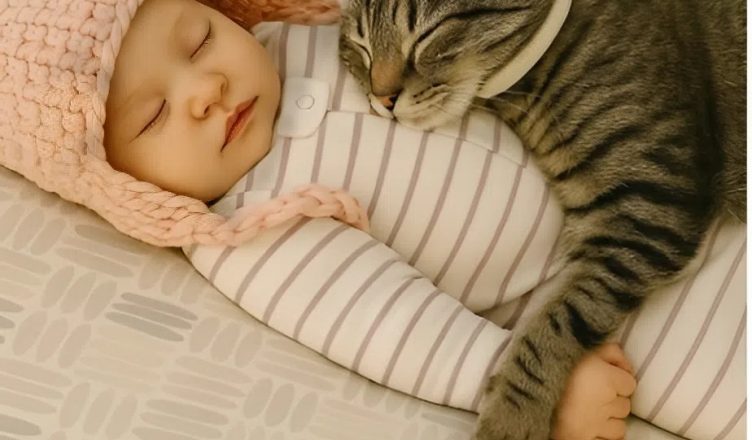
One night, when the baby was screaming from discomfort and sheer exhaustion, Klara collapsed into a chair, barely conscious. That was the moment when the gray tabby cat, Barsik, slipped quietly into the room… and leapt straight into the crib.
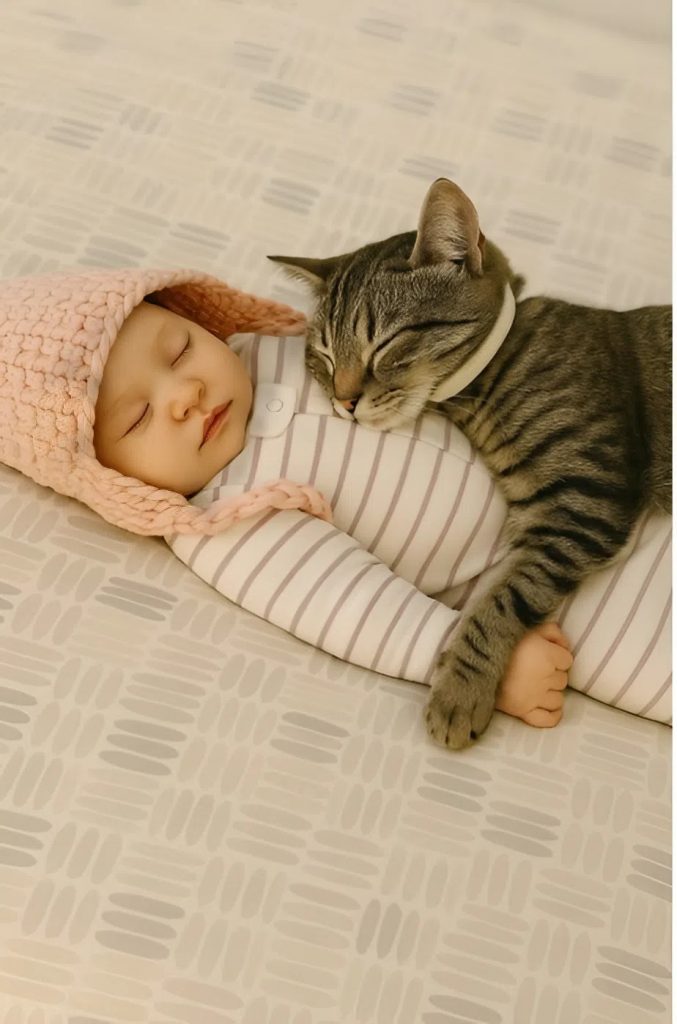
Barsik didn’t meow, didn’t nudge anyone for attention. Instead, he curled up gently beside the struggling infant, pressing his warm body against the baby’s ribs. Klara froze. Through blurred tears she saw something she could hardly believe: the baby’s crying stopped mid-scream. His breathing evened out. His eyes opened — and for the first time in days, he fell silent.
Barsik sniffed the baby’s cheek, closed his eyes, and rested his head on the tiny chest. The room filled with a strange, heavy stillness — a fragile peace stolen from chaos.
That night, the baby slept for more than four hours without waking.
By morning, Klara awoke in panic. Had she broken every medical warning for nothing? Articles online described terrifying cases of cats stealing air from infants, causing allergies, asthma — even suffocation under blankets.
But when she leaned over the crib, she found the child sleeping peacefully, and Barsik beside him, breathing gently.
Then came Dmitri’s voice from the doorway:
“What the hell have you done?”
He glared not at the child, but at the cat.
“It’s in the crib,” he said, stunned with disgust. “Are you out of your mind?”
Klara attempted to explain, voice trembling:
“He slept… he wasn’t crying… he breathed normally…”
“And if that thing suffocates him?” Dmitri barked. “Do you want the headlines? ‘Mother lets animal kill her baby’? Is that your plan?”
Klara fell silent. She knew he wouldn’t understand.
Days passed. Barsik never left the baby’s side. Nights became quieter. Whenever the infant began to whimper, the cat slipped into the crib as if on instinct, and the crying stopped before it escalated into a dangerous episode.
But while the house grew calmer, the world outside was merciless. Relatives scolded, neighbors whispered, and nurses reacted with horror.
“Cats carry germs,” one warned.
“Sick children can’t handle that kind of exposure,” said another.
“You’re putting him at risk,” they repeated.
Yet Klara endured — until one morning everything changed.
The baby woke not with a cry, but with a series of short, choking gasps. His lips turned blue, his fingers cold. Dmitri grabbed his keys, but Klara knew the hospital was too far. She held the baby against her chest, shaking with fear — and at that exact moment, Barsik jumped up and pressed his entire body against the child.
A deep, rumbling purr filled the room — not soft and pleasant, but powerful and vibrating like a motor. The vibrations traveled through the baby’s chest, loosening something inside. Suddenly, the infant drew the deepest, clearest breath Klara had ever seen. He began to cry — not weakly, but strong and alive.
Klara burst into tears. Dmitri halted at the doorway, speechless for the first time in months.
From that day, nothing was the same.
A month later, during a medical check-up, the cardiologist studied the results in silence. He measured the heartbeat again. And again. Finally, he looked up:
“What have you been doing at home?”
Klara hesitated. She feared sounding unstable. She whispered only:
“Peace. And affection.”
The doctor leaned back, puzzled.
“The heart has strengthened,” he said slowly. “Not dramatically — but noticeably. I don’t have an explanation.”