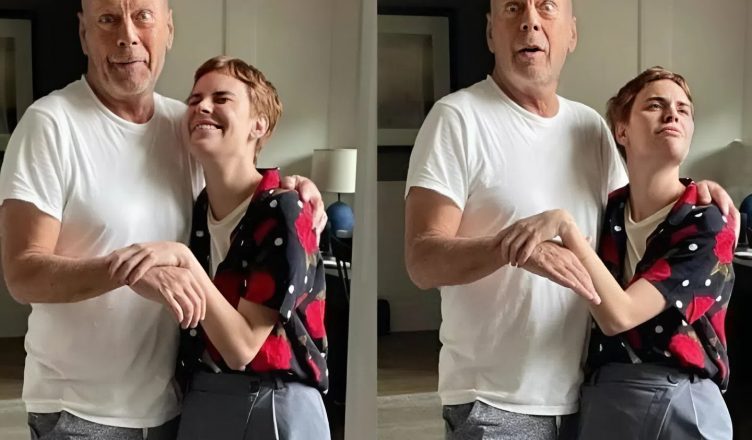
In today’s never-ending news cycle, most stories blaze for a moment and then disappear. Bruce Willis’ story, however, refuses to fade. It moves slower, cuts deeper, and forces the world to look straight at a reality many fear. Now it has reached a new and unsettling chapter: his wife has confirmed that the actor will relocate to a second home specially prepared for his condition — a decision that reveals just how far the illness has progressed.
For decades, Bruce Willis embodied toughness, charisma, and unstoppable energy on screen. Millions looked up to him as a cultural icon, a Hollywood hero who always survived the impossible. Today he is facing something no stunt double can protect him from: a neurodegenerative disease that relentlessly strips away identity and memory. The diagnosis — frontotemporal dementia — was made public by the family earlier, and it instantly reshaped everything around him.
Emma Heming-Willis, the actor’s wife, explained that Bruce will be living in a quieter house, far from noise, cameras, unexpected visitors and stimulation that can send his mind into anxiety and confusion. She stressed that this is not isolation — it is protection. Frontotemporal dementia often triggers disorientation, restlessness, agitation and emotional instability. These symptoms quickly turn a normal household into a battlefield.
In the new house, every detail is designed to reduce stress. Soft lighting, minimal furniture, clear pathways, predictable routines and a very controlled environment aim to limit panic episodes and moments of fear. For someone losing his orientation in time and space, such adjustments are not luxury — they are survival.
According to a close family friend, this decision was not easy and was delayed as long as possible. The family believed that staying in a home full of memories, familiar smells and everyday rhythms would help anchor Bruce to reality. But dementia follows its own rules. When a person no longer recognizes rooms they once knew, gets lost during casual conversations, or freezes in simple situations, even the warmest home can become a frightening maze.
Fans around the world reacted with shock. They still remember Willis as the fearless figure diving through explosions, cracking dark jokes and refusing to die onscreen. Now they watch as a man they admired fights a battle with no script, no special effects and no guaranteed victory. On social media, the tone shifted from playful nostalgia to something quieter, heavier, almost mournful. People shared clips from his movies with messages of gratitude rather than excitement, as if instinctively sensing that an era is ending.
Neurologists have long stressed that frontotemporal dementia is not the same as Alzheimer’s. It primarily affects behavior, personality, speech and emotions before memory loss becomes obvious. Patients may become apathetic, irritable, withdrawn or unexpectedly uninhibited. These shifts can be devastating for loved ones, often more than memory decline itself. With no cure available, families must adapt, restructure their world and reduce chaos as much as possible.
Emma Heming-Willis emphasized that family ties will not be cut. Bruce will still see his children, relatives and close friends, but visits will be carefully planned and controlled to avoid emotional overload. Life is no longer organized in months or years — it is arranged in days, sometimes hours. Dementia changes time, pace and expectations.
And hovering over everything is one brutal question no one dares answer: will Bruce retain pieces of his own history? Will he recognize the voices and faces of the people who love him? Will he smile at an old scene from “Die Hard,” understanding that it once belonged to him? No doctor, no family member, no expert can promise anything. That uncertainty is what makes this situation so devastating.
Today, the Willis family’s priorities are no longer Hollywood, fame or legacy. What matters now is peace, dignity and emotional safety. The second house will not be a prison — it will be a refuge. A final shield against confusion, overstimulation and the quiet fading of identity.
Many consider this one of Hollywood’s most tragic silent chapters. Not because of scandal, money or celebrity drama, but because it touches the very core of human existence — memory, personality and connection to reality. No action scene, no stunt, no heroic moment compares to the cruelty of watching a mind slowly disappear while the person remains physically present.
Bruce Willis once entertained the world with stories of unbreakable heroes. Today, his own story is teaching millions that the hardest battles are not fought with fists, bullets or explosions — but in the fragile corridors of the human brain.