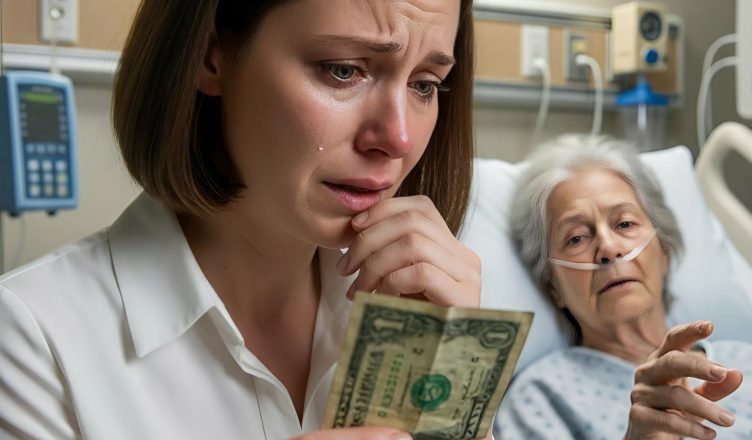
and felt a chill crawl up my spine. It was just an old, faded banknote — creased, worn, almost worthless. Yet after her words, it suddenly felt unbearably heavy.
That day, I couldn’t focus on my husband at all. Daniel talked about physical therapy, about the doctor being cautiously optimistic, and I nodded, barely listening. One sentence kept echoing in my head:
“Only if you’re brave enough to look into my name.”
That evening, while Daniel slept, I took the banknote out and examined it under the bedside lamp. The year was almost erased, the edges soft from time. In one corner, barely visible, was a handwritten mark — a name.
Margaret L. Whitmore.
My throat tightened. That couldn’t be meaningless.
The next morning, I asked a nurse where Margaret had been transferred. She hesitated, then lowered her voice.
“I’m sorry… She passed away during the night. Heart failure.”
The words knocked the breath out of me. I stepped into the hallway and cried for the first time since the accident — quietly, painfully, with the strange grief of losing someone I had known only briefly, yet deeply.
But her message wouldn’t let me go.
A week later, Daniel was discharged. Life tried to return to normal, but something inside me had shifted. I couldn’t throw the banknote away. I couldn’t tuck it into a drawer and forget it. Every time I touched it, my heart beat faster.
One night, after Daniel fell asleep, I finally searched her name online.
At first, the results were dull — archives, old documents. Then I found a headline from more than twenty years ago:
“The Rise and Fall of the Whitmore Trust: Charity Scandal Shakes the City.”
I read with disbelief. Margaret Whitmore had once been the co-founder of a major charitable foundation. It paid for surgeries, helped the homeless, supported struggling families. Hundreds of lives had been changed.
Then money disappeared.
Her partners accused her of fraud. The press tore her apart. There were court hearings, public humiliation, whispered judgments.
She was eventually cleared of all charges. Proven innocent.
But the damage was irreversible.
The foundation closed. Friends vanished. Family distanced themselves. Her name was never restored.
I stared at the screen, shaking. The woman who had eaten soup quietly beside my husband’s hospital bed… the woman who had no visitors, no flowers… she had once saved countless lives.
And she died alone.
The next day, I drove to the address listed in an old article. A small, neglected house at the edge of town. Overgrown weeds. Faded paint. A neighbor confirmed it.
“Yes, Margaret lived here. She was kind. After the scandal, though… people pretended she didn’t exist.”
I showed her the banknote.
Her face changed.
“Oh… that,” she whispered. “She used to call it her reminder. She always said it proved that even something that looks worthless can save a life.”
That was the moment everything clicked.
Margaret hadn’t given me money.
She had given me responsibility.
A month later, Daniel and I opened a small fund. No official name. No publicity. Just a quiet promise. We put in everything we could. I sold jewelry. He sold his old motorcycle. We didn’t wait until we were “ready.”
We started small.
Sometimes it was a warm meal for someone sitting alone in a hospital room.
Sometimes it was help with medication.
Sometimes it was simply sitting beside someone who hadn’t been touched or spoken to in days.
The old banknote still sits in my wallet.
It has almost no monetary value.
But it changed how I see the world.
It taught me that kindness doesn’t need recognition.
That doing the right thing can cost you everything — and still be worth it.
And that one brave choice, made at the right moment, can carry someone else’s legacy forward.
Margaret didn’t disappear.
She trusted me to continue what she started.