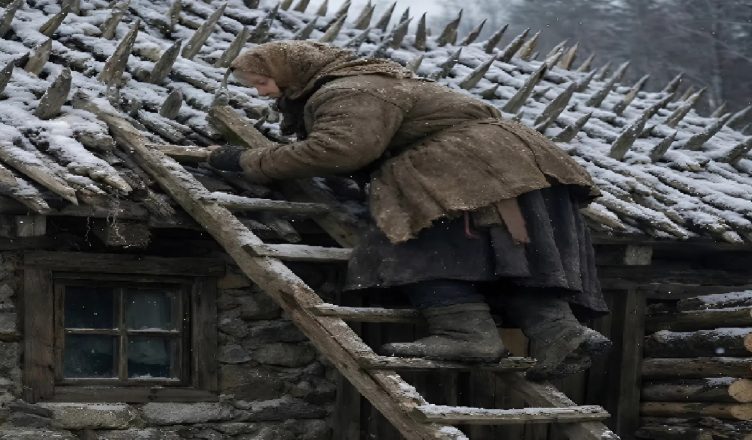
With each passing afternoon, more of them appeared. The roof began to look unusual—almost menacing. At first, the villagers simply stared. Soon, however, the whispers began.
“Have you seen what she’s done to her house?”
“Yes… Ever since her husband passed away, she hasn’t seemed the same.”
She had been living alone for a year. Quiet, distant, keeping mostly to herself. And now this strange construction crowned her home like some kind of barricade. Some said grief had unsettled her mind. Others claimed she was afraid of thieves. A few even suggested darker, more imaginative explanations.
What no one noticed was the precision of her work.
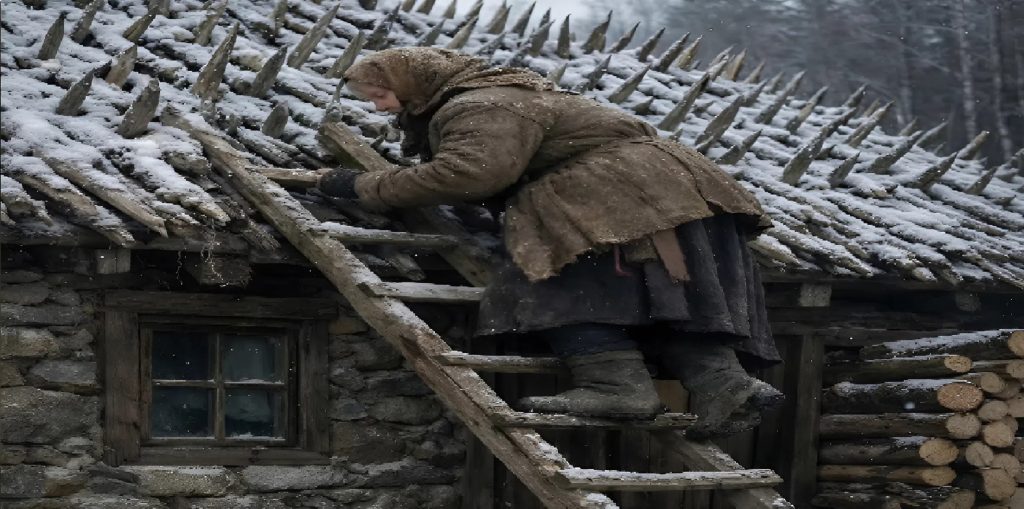
Each stake was carefully selected. The wood had to be dry, solid, dependable. She carved every tip to an exact angle and placed them in deliberate positions—not randomly, but according to a clear pattern. She knew her roof intimately—every beam, every weak joint, every vulnerable edge.
One afternoon, a neighbor finally asked her directly:
“Why are you doing this? Are you afraid of something?”
She looked at him calmly.
“It’s protection.”
“From what?”
“From what’s coming.”
She offered nothing more.
Autumn arrived with strong winds that rattled windows and tore loose shingles from several homes in the village. But the true test came in winter.
In mid-December, an unusually heavy snowstorm swept through the region. The snow was thick and wet, clinging stubbornly to rooftops and compressing under its own weight. Throughout the night, unsettling cracking sounds echoed across the village. Before dawn, the first roof collapsed on the outskirts. Then another gave way.
People rushed outside with shovels, desperately trying to clear the accumulating snow. But it kept falling, layer upon layer, growing heavier by the hour.
And then someone noticed something strange.
Snow did not gather in thick sheets on the old woman’s roof. The sharp wooden stakes interrupted the buildup, breaking the snow into smaller sections. Instead of forming a single crushing mass, it split and slid down between the stakes, falling safely to the ground before it could weigh too much.
By morning, when the storm finally eased, it became painfully clear: her house was the only one whose roof remained intact.
The villagers stood silently, staring upward. What they had dismissed as madness now revealed itself as foresight.
Her husband had been a carpenter all his life. In his final years, he often spoke about how winters were changing—how the snow seemed heavier than before, more dangerous to aging roofs. Together, they had discussed ways to strengthen their home. He had drawn sketches, made calculations, noted structural concerns. After his death, those papers remained in a drawer.
She never threw them away.
Throughout the summer and fall, she quietly brought their shared plan to life. She hadn’t explained herself because she knew no one would truly listen.
After the storm, the neighbors approached her not with suspicion, but with humility. They asked for guidance. They wanted to understand how to reinforce their own homes the same way. This time, she did not climb the ladder alone.
That winter left a lasting mark on the village. It was not only a lesson about the power of nature, but about the danger of quick judgment. How easily we label something as foolish simply because we do not understand it. How quickly we laugh before we ask.
Sometimes what looks strange is not insanity.
Sometimes it is preparation.
And sometimes it is a quiet act of love—honoring the wisdom of someone who is gone, yet whose thoughts continue to offer protection long after they have left.