
At seventy-two, he believed he had already seen everything life had to offer. For decades he had spent his summers on this very stretch of coast, watching fashions evolve, children grow up, couples fall in love and drift apart. He had quietly accepted that the spotlight now belonged to the young.
Then he noticed her.
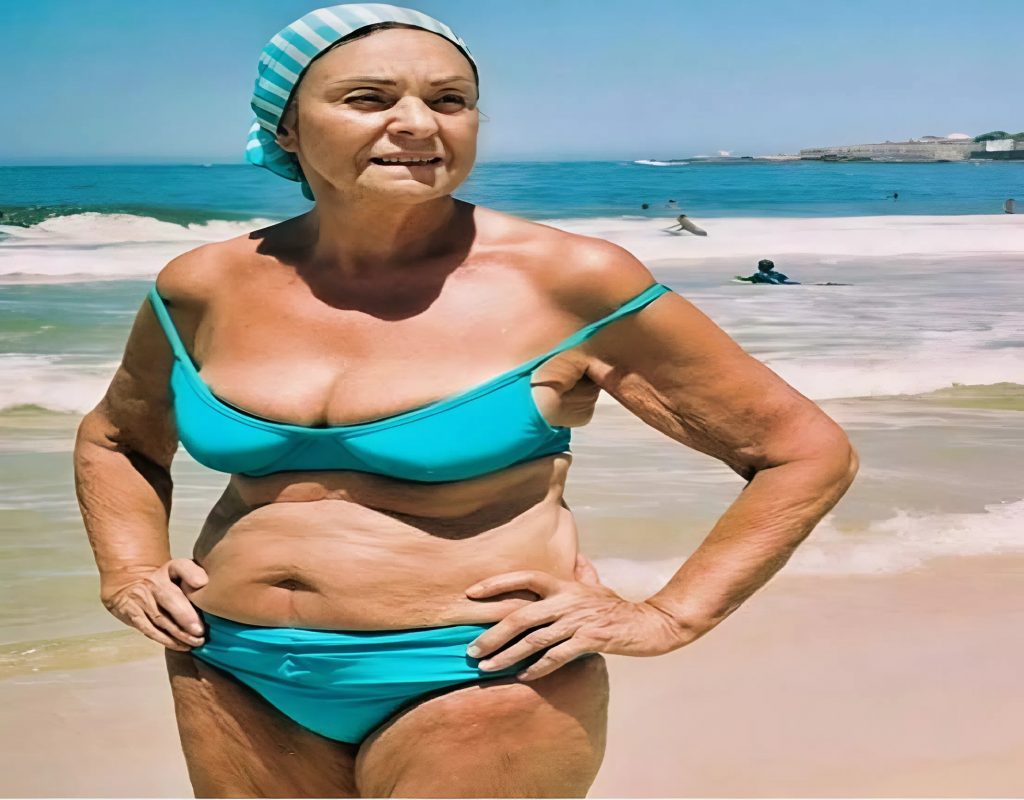
She emerged from the sea with steady, unhurried steps. She appeared to be around his age. Her swimsuit was bold—bright in color, modern in cut, undeniably eye-catching. It was the kind of choice many would consider “too much” for someone in her seventies. Yet it wasn’t the swimsuit itself that held his gaze. It was the way she carried herself. Her back was straight, her chin slightly lifted, her movements relaxed and assured. She didn’t attempt to cover herself with a towel. She didn’t glance around for approval. She simply walked as though she had every right to occupy that space.
He found himself unsettled. That night, he replayed the scene in his mind. Wasn’t there an unspoken rule about aging gracefully? Shouldn’t people their age choose subtlety over boldness? His generation had been taught that dignity meant restraint—that growing older required blending into the background rather than standing out. But who had decided that?
The next morning, she was there again, strolling along the shoreline. The breeze lifted her silver hair, and there was a quiet vitality in her step. Some beachgoers watched with admiration; others whispered behind sunglasses. She seemed unaware of both reactions. Her confidence was neither loud nor defensive. It was calm, almost luminous.
Driven by curiosity—and perhaps by his own discomfort—he approached her. He greeted her politely and struck up a brief conversation. After a moment, he carefully suggested that perhaps a more modest swimsuit might be “more suitable” at their age. He believed he was offering thoughtful advice, even kindness.
She looked at him for a second, then laughed softly. It wasn’t mocking. It was open, warm, almost liberating.
“At my age,” she said gently, “I no longer dress to meet other people’s expectations. I dress to feel alive.”
The words landed harder than he expected. He realized that what had unsettled him wasn’t the brightness of the fabric or the cut of the swimsuit. It was her freedom. Her refusal to shrink herself for the comfort of others.
All his life, he had followed invisible rules. What was appropriate. What was dignified. What was acceptable “for a man his age.” Over time, he had slowly stepped back, mistaking invisibility for elegance. He had assumed that fading into the background was part of growing older.
But perhaps it wasn’t.
The story of their exchange traveled quietly along the beach. Some people criticized her boldness. Others seemed inspired. A few older women began wearing brighter colors. Some men removed the oversized shirts they used to hide their bodies. A subtle shift hung in the air, as though something long unspoken had finally been questioned.
A few days later, he bought a new pair of swim trunks. They weren’t flashy, but they were more daring than anything he had worn in years. The first time he stepped onto the sand wearing them, his heart beat faster. He felt the weight of curious glances. Still, he kept walking.
He understood then that true elegance does not come from hiding. Confidence is not measured by age but by acceptance. Wrinkles are not failures; they are records of living. Time is not something to conceal but something to honor.
The real question is not whether modesty is more refined than confidence after seventy. The real question is whether we dare to remain visible. Whether we allow ourselves to celebrate our bodies and our stories instead of apologizing for them.
Life after seventy is not an exit from the stage. It can be the beginning of a new act—one where, at last, we step forward not to impress anyone, but simply to be fully, unapologetically ourselves.