The quiet one. The drifter. The cautionary tale served between appetizers and dessert.
But the truth doesn’t need rehearsal. It waits.
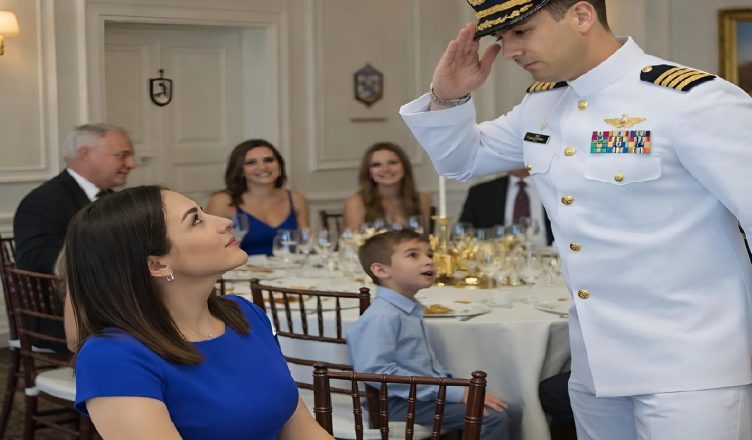
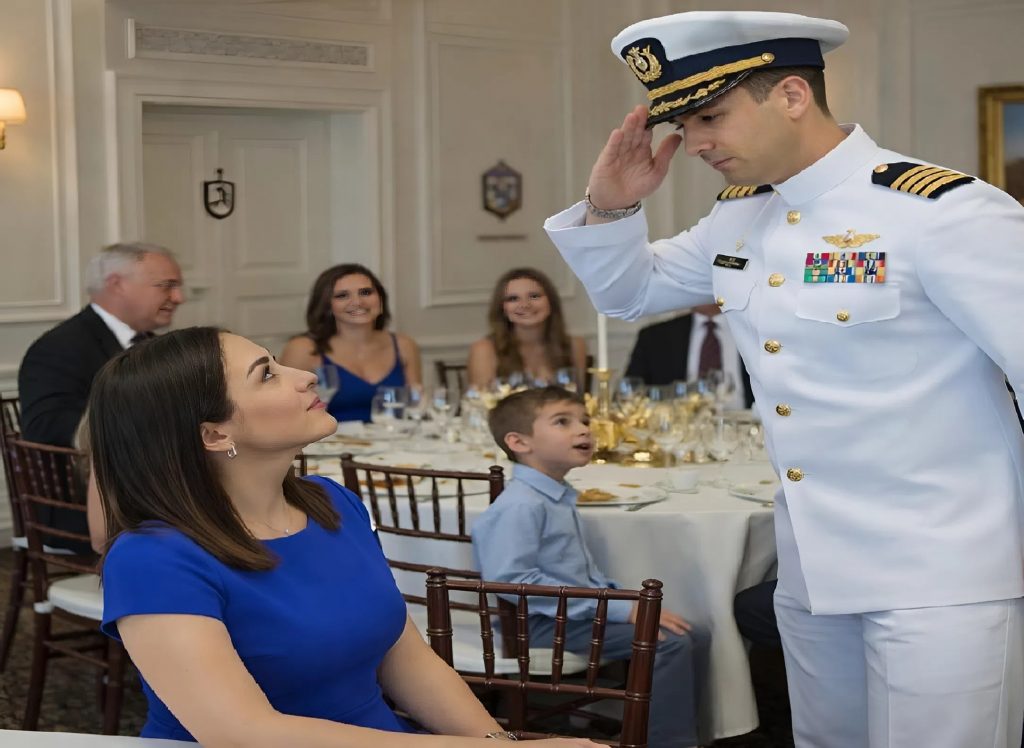
Commander Marcus Wyn — a man whose uniform carried more history than most people’s entire biographies — didn’t look at my parents. He didn’t look at the guests. He looked only at me.
“Lieutenant Commander,” he repeated, his tone firm, respectful. “It’s an honor.”
The title landed in the room like a controlled detonation.
Not loud. Not chaotic.
Precise.
My mother blinked first. “Marcus… I’m sorry, what did you just say?”
He turned slightly, enough to acknowledge her without breaking posture. “Ma’am, your daughter holds a rank equivalent to mine. Different branch. Different theater. Same weight.”
You could almost hear the mental scrambling. The recalculation of years. Of jokes. Of smug introductions at church luncheons.
Luke let out a nervous laugh. “Okay, what is this? Some kind of inside joke?”
Marcus didn’t smile.
“No joke.”
Silence spread across the banquet room, swallowing the clink of glasses and the low hum of the air conditioner. Even the gold centerpieces seemed suddenly gaudy, overcompensating for a room that had just lost control of its narrative.
I finally spoke.
“I asked him not to say anything,” I said quietly. “For years.”
My father’s voice came out hoarse. “Not say what?”
I met his eyes — the same eyes that had skimmed over me during introductions, that had paused awkwardly where pride should have been.
“That I serve,” I said. “Just not in ways that come with parades.”
No Instagram posts.
No brunch uniforms.
No applause.
Marcus reached into the inner pocket of his dress whites and removed a slim leather folder. He handed it to my father.
Inside were citations. Redacted commendations. A letter with most of its lines blacked out — except for the closing sentence:
“Her actions prevented catastrophic loss of life and ensured mission continuity under extreme conditions.”
My mother pressed her fingers to her mouth.
Luke’s earlier joke — Some of us actually work for a living — hung in the air like something rotten.
“I thought you were freelancing,” he muttered weakly.
“I was deployed,” I replied.
Not once. Not twice.
Years.
Assignments you don’t describe at dinner tables. Operations that don’t make the news. Rooms where failure isn’t embarrassing — it’s fatal.
Talia stood slowly, her birthday sash glinting under chandelier light that now felt interrogative rather than celebratory.
“Why didn’t you tell us?” she asked.
I held her gaze. “Because the work isn’t about being known.”
It was the simplest truth in the room.
For so long, I had mistaken their silence for strength — as if enduring dismissal was the same thing as grace. I let them believe I was idle because correcting them would have required explaining things I wasn’t permitted to explain.
So I carried the jokes.
The pauses.
The label: deadbeat.
Marcus stepped back half a pace, giving me the floor entirely.
“She briefed rooms that would make most admirals sweat,” he said evenly. “I’ve read summaries of operations where her decisions shifted entire outcomes. We study scenarios like that at the Academy.”
That was the moment my father’s posture changed.
Not dramatically.
But enough.
The fork on his plate lay untouched. His rehearsed authority dissolved into something smaller — something human.
“All this time,” he said slowly, “we thought…”
“I know what you thought,” I interrupted gently.
And I did.
They thought success had to be visible to be valid. Framed. Toasted. Posted. Retweeted.
They liked their triumphs loud.
Mine were classified.
A server, frozen near the wall with a tray of champagne flutes, seemed unsure whether to move. The room felt suspended between two realities: the comfortable fiction and the inconvenient truth.
Luke cleared his throat. “So what exactly do you do?”
I smiled — not sharp, not smug.
“Enough.”
That was all I was allowed to say. And suddenly, it was enough for them too.
Marcus placed his cap back under his arm and gave a small nod — the kind exchanged between equals.
“Permission to speak freely, ma’am?” he asked lightly, though the protocol was half-teasing.
“Granted.”
He turned to the room.
“Some roles are designed for visibility,” he said. “Others are designed so you never know they existed. The second kind are often the reason the first kind can sleep at night.”
No one laughed.
No one clinked glasses.
For the first time in years, no one tried to define me.
My mother approached cautiously, as if stepping toward something fragile.
“You let us believe…” she began, but the sentence died before it reached accusation.
“Yes,” I said. “I did.”
Because defending myself would have required breaking promises I’d signed in ink thicker than family approval.